UNITED NATIONS: The UN Security Council on Thursday unanimously adopted a resolution renewing its mission in Libya for another year and pledging to support struggling efforts to build a ceasefire in the war-torn country.
Libya has been mired in chaos since an uprising toppled and killed dictator Muammar Qaddafi in 2011, when the United Nations mission in Libya (UNSMIL) was established.
The Security Council said it asked the UN Secretary-General "to assess the steps required to reach a lasting ceasefire (and) the possible role of UNSMIL in providing scalable ceasefire support."
The pledge of support was requested by UN envoy to Libya Ghassan Salame, who has pushed for a restart of the political process since Khalifa Haftar's self-styled Libyan National Army launched an offensive in April to conquer the capital, Tripoli.
Haftar's forces are fighting those of the Government of National Accord (GNA), which is led by Fayed al-Sarraj and is recognized by the UN.
While Sarraj is backed by Turkey and Qatar, Haftar enjoys varying levels of support from Egypt, the United Arab Emirates, the United States, Russia, and France.
Last week, Salame warned that without action by the Security Council, Libya's conflict would escalate if outside patrons step up support for the warring sides.
But General Ahmed al-Mesmari, spokesman for Haftar's forces, on Saturday ruled out any political negotiations.
"The time of going back to dialogue is over," said al-Mesmari, speaking in the UAE. "The military solution is the best solution to spread security and reimpose the law."
Since April, fighting between pro-GNA and pro-Haftar forces has killed at least 1,093 people and wounded 5,752, while some 120,000 others have been displaced, according to the World Health Organization.


![]()

UN renews Libya mission, pledges to support a ceasefire
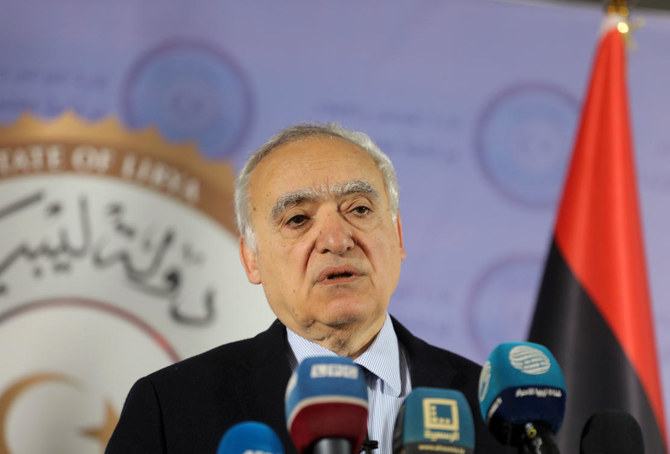
UN renews Libya mission, pledges to support a ceasefire

Latest updates


© 2026 SAUDI RESEARCH & PUBLISHING COMPANY, All Rights Reserved And subject to Terms of Use Agreement.