

Trump fires national security adviser John Bolton

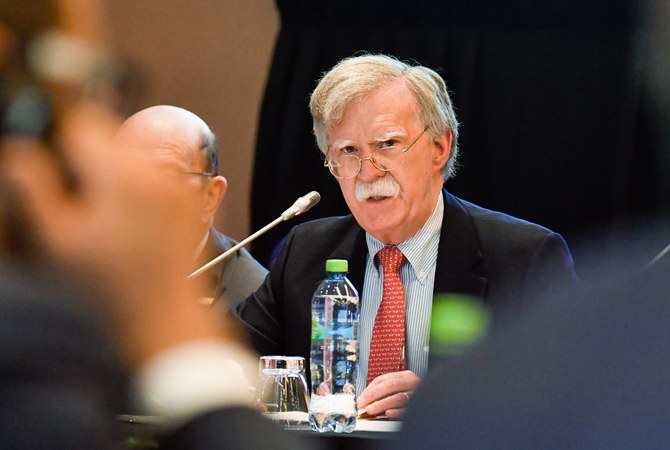
Trump said he strongly disagreed with John Bolton on several issues. (AFP/File photo)
Updated 11 September 2019
Follow

Trump fires national security adviser John Bolton

  • Trump tweeted that he told Bolton Monday night his services were no longer needed at the White House and said Bolton submitted his resignation on Tuesday morning
  • Bolton espoused hawkish foreign policy views dating back to the Reagan administration and became a household name over his vociferous support for the Iraq War

WASHINGTON: President Donald Trump said Tuesday he fired national security adviser John Bolton, citing strong disagreements on a number of policy issues.
Trump tweeted that he told Bolton Monday night his services were no longer needed at the White House and said Bolton submitted his resignation on Tuesday morning. Trump said that he “disagreed strongly” with many of Bolton’s suggestions, “as did others in the administration.”

Bolton responded in a tweet of his own that he offered to resign Monday “and President Trump said, ‘Let’s talk about it tomorrow.’“
Bolton’s ouster came as a surprise to many in the White House. Just an hour before Trump’s tweet, the press office announced that Bolton would join Secretary of State Mike Pompeo and Treasury Secretary Steven Mnuchin in a briefing.

Bolton was always an unlikely pick to be Trump’s third national security adviser, with a world view seemingly ill-fit to the president’s isolationist “America First” pronouncements.
He’s espoused hawkish foreign policy views dating back to the Reagan administration and became a household name over his vociferous support for the Iraq War as the US ambassador to the UN under George W. Bush. Bolton even briefly considered running for president in 2016, in part to make the case against the isolationism that Trump would come to embody.
Inside the administration he advocated caution on the president’s whirlwind rapprochement with North Korea and against Trump’s decision last year to pull US troops out of Syria. He masterminded a quiet campaign inside the administration and with allies abroad to convince Trump to keep US forces in Syria to counter the remnants of the Islamic State and Iranian influence in the region.
Bolton was named Trump’s third national security adviser in April 2018 after the departure of Army Gen. H.R. McMaster.


UN’s top court opens Myanmar Rohingya genocide case

Updated 6 sec ago
Follow

UN’s top court opens Myanmar Rohingya genocide case

  • The Gambia filed a case against Myanmar at the UN’s top court in 2019
  • Verdict expected to impact Israel’s genocide case over war on Gaza

DHAKA: The International Court of Justice on Monday opened a landmark case accusing Myanmar of genocide against its mostly Muslim Rohingya minority.

The Gambia filed a case against Myanmar at the UN’s top court in 2019, two years after a military offensive forced hundreds of thousands of Rohingya from their homes into neighboring Bangladesh.

The hearings will last three weeks and conclude on Jan. 29.

“The ICJ must secure justice for the persecuted Rohingya. This process should not take much longer, as we all know that justice delayed is justice denied,” said Asma Begum, who has been living in the Kutupalong refugee camp in Bangladesh’s Cox’s Bazar district since 2017.

A mostly Muslim ethnic minority, the Rohingya have lived for centuries in Myanmar’s western Rakhine state but were stripped of their citizenship in the 1980s and have faced systemic persecution ever since.

In 2017 alone, some 750,000 of them fled military atrocities and crossed to Bangladesh, in what the UN has called a textbook case of ethnic cleansing by Myanmar.

Today, about 1.3 million Rohingya shelter in 33 camps in Cox’s Bazar, turning the coastal district into the world’s largest refugee settlement.

“We experienced horrific acts such as arson, killings and rape in 2017, and fled to Bangladesh,” Begum told Arab News.

“I believe the ICJ verdict will pave the way for our repatriation to our homeland. The world should not forget us.”

A UN fact-finding mission has concluded that the Myanmar 2017 offensive included “genocidal acts” — an accusation rejected by Myanmar, which said it was a “clearance operation” against militants.

Now, there is hope for justice and a new future for those who have been displaced for years.

“We also have the right to live with dignity. I want to return to my homeland and live the rest of my life in my ancestral land. My children will reconnect with their roots and be able to build their own future,” said Syed Ahmed, who fled Myanmar in 2017 and has since been raising his four children in the Kutupalong camp.

“Despite the delay, I am optimistic that the perpetrators will be held accountable through the ICJ verdict. It will set a strong precedent for the world.”

The Myanmar trial is the first genocide case in more than a decade to be taken up by the ICJ. The outcome will also impact the genocide case that Israel is facing over its war on Gaza.

“The momentum of this case at the ICJ will send a strong message to all those (places) around the world where crimes against humanity have been committed,” Nur Khan, a Bangladeshi lawyer and human rights activist, told Arab News.

“The ICJ will play a significant role in ensuring justice regarding accusations of genocide in other parts of the world, such as the genocide and crimes against humanity committed by Israel against the people of Gaza.”