KARACHI: Security across Pakistan was beefed up on Tuesday as Ashura is observed around the country, with thousands of extra security personnel protecting mourners and almost all cellular services suspended in major cities where the processions are passing through.
Ashura is the 10th day of Muharram, the first month in the Islamic calendar, where Shia Muslims pay homage to Imam Hussain, the grandson of Prophet Muhammad (peace be upon him).
For the purpose, and to prevent any untoward incidents in areas that have witnessed sectarian violence in the past, authorities have tightened security in several parts of Karachi, Peshawar, Dera Ismail Khan, and the Khurram tribal district with additional personnel deployed in major metro cities.
“In Sindh, including its capital Karachi, 71,485 policemen, including 6,539 officers are performing duties with the help of 31 armored vehicles, 1,824 police vans and 1,938 motorcycles to protect mourning gatherings and processions,” Sohail Ahmed, a police spokesperson, told Arab News.
Ahmed said 156 policewomen were also on duty for Ashura day.
In the past, militant and other attacks on the mass gatherings every year, especially in Karachi, triggered serious sectarian tensions. In December 2009, a huge bomb ripped through a Shia procession moving along a marked route in the city with dozens killed and scores injured, despite the presence of thousands of security forces who had been on high alert.
Until 2013, mourners and processions were frequently attacked on the occasion in Karachi by proscribed groups, and despite an improvement in the law and order situation in recent years, police and Rangers claimed on Tuesday to have taken all-out measures to ensure security for the main procession to be taken out in the city.
“Around 10,500 personnel, including 5,500 in Karachi, are being deployed across Sindh,” a spokesperson of the military rangers told Arab News, and said aerial surveillance had also been added to arrangements, to ensure that security was foolproof.
Pillion riding has been proscribed and special rooms set up to monitor the procession through close-circuit cameras installed at sensitive points in Karachi.
In the eastern city of Lahore, 8,000 police personnel are on duty guarding the main procession and smaller gatherings. The city of Quetta, in the southwestern province of Balochistan, which was the site of a major Ashura militant attack in 2004, has 5,500 security personnel deployed to maintain order alongside the paramilitary forces of the Frontier Corps.


![]()
![]()

Security beefed up in major Pakistani cities for Ashura
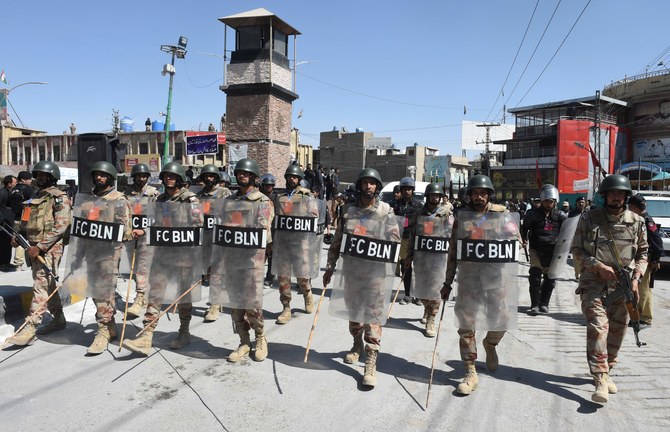
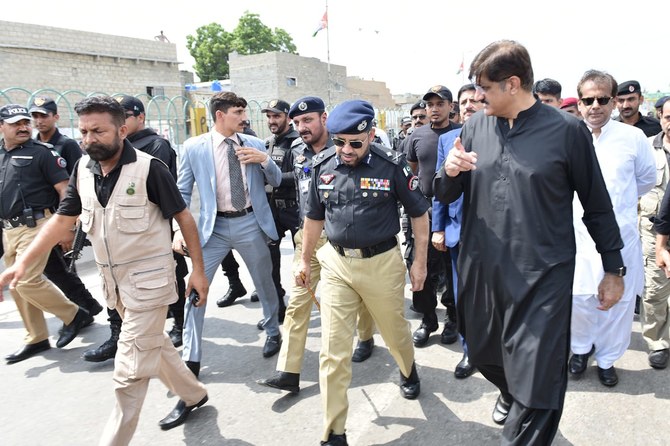
Security beefed up in major Pakistani cities for Ashura
- Tens of thousands of police and paramilitary personnel have been deployed in south eastern Sindh province
- Muharram processions were frequently attacked in the past, but a crackdown against militants improved law and order
Latest updates


© 2026 SAUDI RESEARCH & PUBLISHING COMPANY, All Rights Reserved And subject to Terms of Use Agreement.