KHARTOUM: Sudan’s first cabinet since the ouster of president Omar Al-Bashir was sworn in Sunday as the African country transitions to a civilian rule following nationwide protests that overthrew the autocrat.
The 18-member cabinet led by Prime Minister Abdalla Hamdok, which includes four women, took oath at the presidential palace in Khartoum, an AFP correspondent reported.
It is expected to steer the daily affairs of the country during a transition period of 39 months.
The line-up was formed after Sudan last month swore in a “sovereign council” — a joint civilian-military ruling body that aims to oversee the transition.
The 18 ministers were seen greeting members of the sovereign council, including its chief General Abdel Fattah Al-Burhan, in images broadcast by state television from the palace.
“We have to put in a lot of efforts to meet our people’s demands,” Information Minister Faisal Mohamed Saleh told reporters after the swearing in ceremony.
“The world is watching us. It is waiting to see how we can solve our issues.”
The sovereign council itself is the result of a power-sharing deal between the protesters and generals who had seized power after the army ousted Bashir in April.
Hamdok’s cabinet, which has the country’s first female foreign affairs minister, is expected to lead Sudan through formidable challenges that also include ending internal conflicts in three regions.
Rebel groups from marginalized regions of Darfur, Blue Nile and South Kordofan states had waged long wars against Bashir’s forces.
“The road ahead is not easy. We will face many challenges but we have to work on them,” said Walaa Issam, Minister for youth and sports.
Sudan’s power-sharing deal aims to forge peace with armed groups.
Hamdok’s cabinet will also be expected to fight corruption and dismantle the long-entrenched Islamist deep state created under Bashir.
Bashir had seized power in an Islamist-backed coup in 1989 and ruled Sudan with an iron fist for three decades until his ouster.
It was a worsening economic crisis that triggered the fall of Bashir, who is now on trial on charges of illegal acquisition and use of foreign funds.
According to doctors linked to the umbrella protest movement that led to Bashir’s fall, more than 250 people have been killed in protest-related violence since December.
Of that at least 127 were killed in early June during a brutal crackdown on a weeks-long protest sit-in outside the military headquarters in Khartoum. Officials have given a lower death toll.


Sudan’s first post-Bashir cabinet sworn in
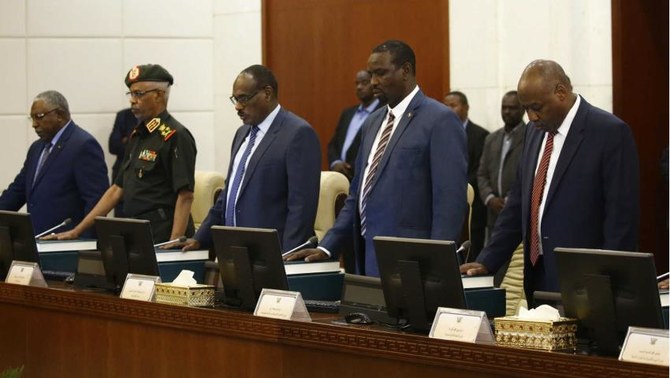
Sudan’s first post-Bashir cabinet sworn in

- The 18-member Cabinet took oath at the presidential palace in Khartoum
- The Cabinet, led by Prime Minister Abdalla Hamdok, includes four women


’No one to back us’: Arab bus drivers in Israel grapple with racist attacks
- “People began running toward me and shouting at me, ‘Arab, Arab!’” recalled Khatib, a Palestinian from east Jerusalem
JERUSALEM: What began as an ordinary shift for Jerusalem bus driver Fakhri Khatib ended hours later in tragedy.
A chaotic spiral of events, symptomatic of a surge in racist violence targeting Arab bus drivers in Israel, led to the death of a teenager, Khatib’s arrest and calls for him to be charged with aggravated murder.
His case is an extreme one, but it sheds light on a trend bus drivers have been grappling with for years, with a union counting scores of assaults in Jerusalem alone and advocates lamenting what they describe as an anaemic police response.

One evening in early January, Khatib found his bus surrounded as he drove near the route of a protest by Israel’s ultra-Orthodox Jewish community.
“People began running toward me and shouting at me, ‘Arab, Arab!’” recalled Khatib, a Palestinian from east Jerusalem.
“They were cursing at me and spitting on me, I became very afraid,” he told AFP.
Khatib said he called the police, fearing for his life after seeing soaring numbers of attacks against bus drivers in recent months.
But when no police arrived after a few minutes, Khatib decided to drive off to escape the crowd, unaware that 14-year-old Yosef Eisenthal was holding onto his front bumper.
The Jewish teenager was killed in the incident and Khatib arrested.
Police initially sought charges of aggravated murder but later downgraded them to negligent homicide.
Khatib was released from house arrest in mid-January and is awaiting the final charge.
- Breaking windows -
Drivers say the violence has spiralled since the start of the Gaza war in October 2023 and continued despite the ceasefire, accusing the state of not doing enough to stamp it out or hold perpetrators to account.
The issue predominantly affects Palestinians from annexed east Jerusalem and the country’s Arab minority, Palestinians who remained in what is now Israel after its creation in 1948 and who make up about a fifth of the population.
Many bus drivers in cities such as Jerusalem and Haifa are Palestinian.
There are no official figures tracking racist attacks against bus drivers in Israel.
But according to the union Koach LaOvdim, or Power to the Workers, which represents around 5,000 of Israel’s roughly 20,000 bus drivers, last year saw a 30 percent increase in attacks.
In Jerusalem alone, Koach LaOvdim recorded 100 cases of physical assault in which a driver had to be evacuated for medical care.
Verbal incidents, the union said, were too numerous to count.
Drivers told AFP that football matches were often flashpoints for attacks — the most notorious being those of the Beitar Jerusalem club, some of whose fans have a reputation for anti-Arab violence.
The situation got so bad at the end of last year that the Israeli-Palestinian grassroots group Standing Together organized a “protective presence” on buses, a tactic normally used to deter settler violence against Palestinians in the Israeli-occupied West Bank.
One evening in early February, a handful of progressive activists boarded buses outside Jerusalem’s Teddy Stadium to document instances of violence and defuse the situation if necessary.
“We can see that it escalates sometimes toward breaking windows or hurting the bus drivers,” activist Elyashiv Newman told AFP.
Outside the stadium, an AFP journalist saw young football fans kicking, hitting and shouting at a bus.
One driver, speaking on condition of anonymity, blamed far-right National Security Minister Itamar Ben Gvir for whipping up the violence.
“We have no one to back us, only God.”
- ‘Crossing a red line’ -
“What hurts us is not only the racism, but the police handling of this matter,” said Mohamed Hresh, a 39-year-old Arab-Israeli bus driver who is also a leader within Koach LaOvdim.
He condemned a lack of arrests despite video evidence of assaults, and the fact that authorities dropped the vast majority of cases without charging anyone.
Israeli police did not respond to AFP requests for comment on the matter.
In early February, the transport ministry launched a pilot bus security unit in several cities including Jerusalem, where rapid-response motorcycle teams will work in coordination with police.
Transport Minister Miri Regev said the move came as violence on public transport was “crossing a red line” in the country.
Micha Vaknin, 50, a Jewish bus driver and also a leader within Koach LaOvdim, welcomed the move as a first step.
For him and his colleague Hresh, solidarity among Jewish and Arab drivers in the face of rising division was crucial for change.
“We will have to stay together,” Vaknin said, “not be torn apart.”


