

Sudan’s post-Bashir transition faces further delay

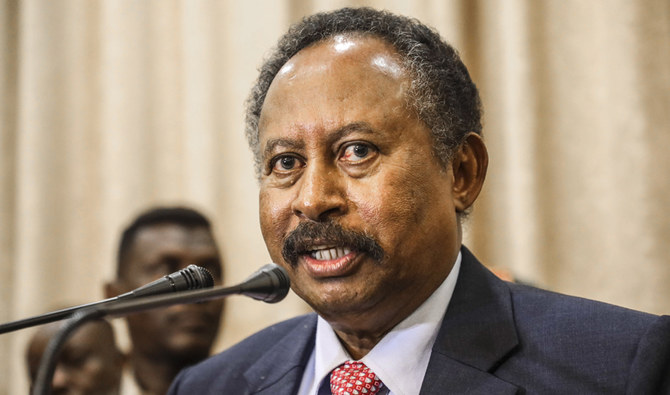
In this Aug. 21, 2019 file photo, Sudan's new Prime Minister Abdalla Hamdok speaks during a press conference in Khartoum, Sudan. (AP)
Updated 01 September 2019
Follow

Sudan’s post-Bashir transition faces further delay

  • A power-sharing deal formally signed on Aug. 17 between the protest group and the military generals stipulates a legislative body should be formed within 90 days of its signing

KHARTOUM: Sudan’s hard-won transition to civilian rule fell further behind schedule on Sunday, days after the new prime minister delayed the formation of the first government since veteran leader Omar Al-Bashir was ousted.

Prime Minister Abdalla Hamdok, a seasoned UN economist who faces the daunting task of rescuing his country’s moribund economy, was supposed to unveil a Cabinet on Wednesday under a post-Bashir roadmap.

But he is still considering the candidates, causing a knock-on delay to the first meeting between the government and the joint civilian-military ruling body overseeing the transition which was supposed to have been held on Sunday. Hamdok, who took the oath on Aug. 21, only received the nominees list from the Forces for Freedom and Change (FFC) umbrella protest group on Tuesday and has been mulling the candidates since then.

“The FFC was late in submitting the list of nominees to the PM which has ultimately delayed the unveiling of Cabinet,” protest leader Amjed Farid told AFP.

Ibrahim Al-Amin, another protest leader, said the delay “is entirely the responsibility of the FFC” as there were “differences” within the group over the candidates.

On Sunday, the FFC said it held “deep and constructive discussions” with Hamdok the day before about the candidates of the transitional Cabinet. The premier has not publicly commented on the delay.

Sudan swore in a “sovereign council,” a joint civilian-military ruling body, to guide the country through a three-year transitional period nearly two weeks ago.

It is the result of a power-sharing deal formally signed on Aug. 17 between the FFC and the military generals who seized power after ousting Bashir in April.

The deal stipulates a legislative body should be formed within 90 days of its signing.

The legislature should include no more than 300 members, with 201 seats allotted to the FFC. Under the deal, the Cabinet should be largely selected by the premier.

Only the interior and defense ministers will be chosen by the military members of Sudan’s ruling body.

Amin said the delay in announcing the Cabinet would “certainly have a negative impact” by slowing down the transition.

It is not the first hurdle thrown up in Sudan’s path out of decades of authoritarianism.

The lineup of Sudan’s 11-member sovereign council was held up for two days over differences within the opposition camp, before it was finally revealed on Aug. 21.

Hamdok, who built a career in continental and international organizations, most recently as deputy executive secretary of the UN’s Economic Commission for Africa in Addis Ababa, last week confirmed receiving a list of 49 candidates for 14 ministries.

A source close to the premier told AFP on Sunday that “consultations are still under way for the final list.”

Hamdok, who was nominated by the protest movement, had previously said he would be choosing technocrats based on their “competence” to lead Sudan through formidable challenges that also include ending internal conflicts.

Rebel groups from marginalized regions including Darfur, Blue Nile and South Kordofan state waged long wars against Bashir’s forces.

Sudan’s power-sharing deal aims to forge peace with armed groups.

On Saturday, four rebel groups from Darfur said they will be “negotiating with transitional authorities with a unified vision,” without elaborating.

Hamdok’s Cabinet will also be expected to fight corruption and dismantle the long-entrenched deep state created under Bashir’s 30-year rule. 

Bashir was taken to Kober prison in Khartoum shortly after his ouster. The former president was charged on Saturday with illegal acquisition and use of foreign funds.


A look at Ramadan and how Muslims observe the holy month

Updated 4 sec ago
Follow

A look at Ramadan and how Muslims observe the holy month

  • Ramadan is the ninth month of the Islamic lunar calendar; the month cycles through the seasons
  • Ramadan is followed by the Islamic holiday of Eid Al-Fitr
CAIRO: Observant Muslims the world over will soon be united in a ritual of daily fasting from dawn to sunset as the Islamic holy month of Ramadan starts. For Muslims, it’s a time for increased worship, religious reflection and charity. Socially, it often brings families and friends together in festive gatherings around meals to break their fast.
Ramadan is followed by the Islamic holiday of Eid Al-Fitr.
First day of Ramadan expected around Feb. 18-19
Ramadan is the ninth month of the Islamic lunar calendar; the month cycles through the seasons.
The start of the month traditionally depends on the sighting of the crescent moon. This year, the first day of Ramadan is expected to be on or around Feb. 18 or 19. The actual start date may vary among countries and Muslim communities due to declarations by multiple Islamic authorities around the globe on whether the crescent had been sighted or different methodologies used to determine the beginning of the month.
This year, the start of Ramadan is expected around the same time as Ash Wednesday, a solemn day of fasting and reflection that signals the start of Lent, the most penitential season of the church calendar for Catholics and many other Christians.
Fasting is one of the pillars of Islam
Fasting is one of the Five Pillars of Islam, along with the profession of faith, prayer, almsgiving and pilgrimage.
Muslims see various meanings and lessons in observing the fast.
It’s regarded as an act of worship to attain piety and one of submission to God. The devout see benefits, including practicing self-restraint, cultivating gratitude and empathizing with people who are poor and hungry.
The daily fast in Ramadan includes abstaining from all food and drink — not even a sip of water is allowed — from dawn to sunset, before breaking the fast in a meal known as “iftar” in Arabic.
Muslims typically stream into mosques for congregational prayers and dedicate more time to religious contemplation and the reading of the Qur’an, the Muslim holy book.
Charity is a hallmark of Ramadan. Among other ways of giving, many seek to provide iftar for those in need, distributing Ramadan boxes filled with pantry staples, handing out warm meals alongside such things as dates and juice or helping hold free communal meals.
Muslims eat a predawn meal, called “suhoor,” to hydrate and nurture their bodies ahead of the daily fast.
Exemptions from fasting
There are certain exemptions, such as for those who are unable to because of illness or travel. Those unable to fast due to being temporarily ill or traveling need to make up for the missed days of fasting later.
Cultural and social traditions associated with Ramadan
Muslims are ethnically and racially diverse and not all Ramadan traditions are rooted in religion. Some customs may transcend borders, while others can differ across cultures.
Many social rituals center on gathering and socializing after the daily fast. Some Muslims decorate their homes, put out Ramadan-themed tableware and centerpieces or throng to markets and Ramadan bazaars.
In Egypt, Ramadan is typically a festive time. Colorful lanterns, in different shapes and sizes, dangle from children’s hands and adorn homes. Ramadan songs may be played to welcome the month.
Ramadan’s soundscape in Egypt has traditionally included the predawn banging on drums by a “mesaharati” who roams neighborhoods, calling out to the faithful, sometimes by name, to wake them up for the suhoor meal.
New TV shows and communal meals
A lineup of new television series is another social fixture of the month in some countries, and advertisers compete for viewers’ attention.
In various regions, some Muslims worry that the month is getting commercialized, and say an emphasis on decorations, TV shows, outings or lavish iftar banquets can detract from Ramadan’s religious essence. Others say that a balance can be struck and that, in moderation, such rituals are part of the month’s festive spirit.
In Indonesia, Ramadan rituals vary across regions, reflecting the diversity of cultures. In deeply conservative Aceh province, animals are slaughtered during Meugang festivities, the meat cooked and shared with family, friends, poor people and orphans.
Hundreds of residents in Tangerang, a city outside the capital, Jakarta, flock to the Cisadane River to wash their hair with rice straw shampoo and welcome the fasting month with a symbolic spiritual cleansing.
Across the island of Sumatra, after evening prayers, many boys and girls parade through the streets, carrying torches and playing Islamic songs.
In the United States, where Muslims make up a racially and ethnically diverse minority, gathering at mosques and Islamic centers when possible for iftar meals and prayers provides many Muslim families with a sense of community. Some Muslims also organize or attend interfaith iftar meals.