ISLAMABAD: Pakistan has plugged almost all loopholes in its financial system to curb terrorist financing and money-laundering as per the requirement of the Financial Action Task Force (FATF) to get off the financial watchdog’s gray list, said the government’s Economic Advisory Council member, Dr. Ashfaque Hasan Khan, as a final evaluation of the country’s progress report on the twin issues began in Bangkok on Sunday.
Last year, the FATF placed Pakistan on a gray list of countries with inadequate terror funding controls. In June, the watchdog said Pakistan had until October to improve its financial operations. If the South Asian nation does not comply with an agreed-upon action plan by then, it will be blacklisted and face sanctions that are going to hurt its economy and exports.
Led by Federal Minister for Economic Affairs Hammad Azhar, Pakistan’s economic team is holding a face-to-face meeting with the FATF’s Asia Pacific Group (APG) in Bangkok for a final evaluation of its Anti-Money Laundering and Combating the Financing of Terrorism (AML/CFT) system. The meeting will continue till September 10.
“We have done a lot, plugged almost all loopholes in our financial system [to curb terror financing and money laundering] and are quite confident to get off the FATF’s gray list,” Khan said.
“Our economic team is well-equipped to answer all the questions of the APG members in Bangkok,” he said. “On the basis of this evaluation, the FATF will decide in October whether to keep us [Pakistan] on its gray list or downgrade to the blacklist.”
Khan said that Pakistani authorities in the last one year had initiated “effective actions” against proscribed outfits, charity organizations and militant factions to choke their sources of funding.
In the meantime, the State Bank of Pakistan imposed a fine of over Rs850 million on 10 private banks due to various “deficiencies” in their AML/CFT systems and for violating laws related to foreign exchange.
“This shows our resolve to strengthen our financial system as per the requirements of the FATF and other global institutions,” he added.
According to the 36-nation FATF charter, the support of at least three member states is essential to avoid blacklisting. India – Pakistan’s arch-rival and a co-chair of the joint group of FATF and its Asia Pacific Group – has been pushing for Islamabad’s blacklisting.
“The FATF may keep Pakistan on its gray list even after October for two reasons: Indian influence and the recent deadlock in the US-Taliban peace talks,” Muzamil Aslam, another senior economist, told Arab News.
He said the FATF had been “highly politicized” by India and the US to protect their vested interests, adding that “we should not expect a decision purely on our actions to fulfill its action plan.”
The FATF will formally announce its decision regarding Pakistan in Paris after a plenary that starts on October 13.


![]()

Pakistan delegation in Bangkok for final FATF review
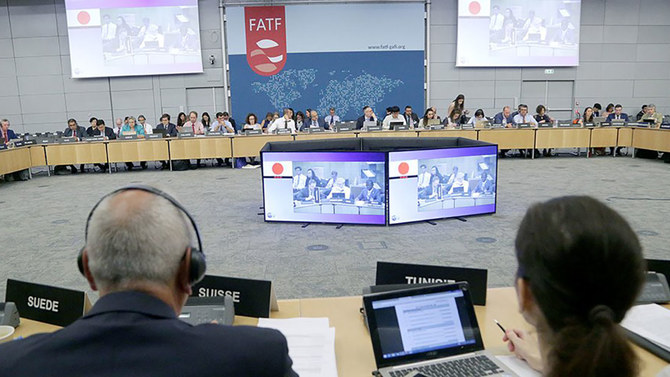
Pakistan delegation in Bangkok for final FATF review
- Experts say the country’s team is well prepared to negotiate with the global financial watchdog
- The FATF will take its decision about Pakistan in October
Latest updates


Recommended


© 2026 SAUDI RESEARCH & PUBLISHING COMPANY, All Rights Reserved And subject to Terms of Use Agreement.