

Milestone in Philippines’ Mindanao as Muslim fighters demobilize

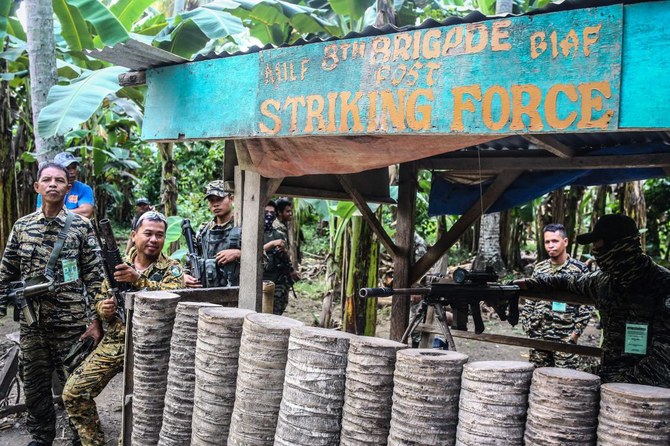
Moro Islamic Liberation Front fighters stand guard at the entry of Camp Darapanan, Sultan Kudarat on Saturday, September 7, 2019 ahead of a weapons decommissioning ceremony. (AFP)
Updated 07 September 2019
Follow

Milestone in Philippines’ Mindanao as Muslim fighters demobilize

  • In a message, Duterte thanked all those who had worked to end armed hostilities between the government and MILF
  • About 1,060 members of the Bangsamoro Islamic Armed Forces (BIAF) were presented to the president at the Old Capitol of Maguindanao in Simuay, Sultan Kudarat

MANILA: The long quest for peace in the Philippines’ troubled south marked another milestone on Saturday as Moro Islamic Liberation Front (MILF) fighters began to demobilize in a ceremony witnessed by President Rodrigo Duterte.

About 1,060 members of the Bangsamoro Islamic Armed Forces (BIAF) were presented to the president at the Old Capitol of Maguindanao in Simuay, Sultan Kudarat. 

In a message, Duterte thanked all those who had worked to end armed hostilities between the government and MILF. 

“I take pride in the fact that we have made significant progress in the Comprehensive Agreement on the Bangsamoro (CAB) including the decommissioning process,” the president said. “This is indeed a huge step towards our goal of achieving lasting peace in Mindanao.”

Duterte assured the decommissioned combatants of the government’s support as they reintegrate into society and enjoy fruitful and productive civilian lives. 

“Do not be disheartened that you surrendered your firearms to the government — we have given you your own government,” he told the former rebels, referring to the Bangsamoro Autonomous Region in Muslim Mindanao (BARMM). 

“I look forward to having you as government partners as we take further strides in securing lasting peace and order in Mindanao.” 

Duterte then encouraged the former MILF fighters and the rest of the Bangsamoro people to take advantage of all available resources in their land, including oil in the Liguasan marsh, to bring prosperity and development in the region. 

“Let us set aside our differences and avoid further armed conflict. I also invite all concerned stakeholders to continue working with the government so our gains will never go to waste,” the president continued. 

“As you open a new chapter in your lives, I hope you will be inspired to take this opportunity to improve your lives and create a better future for your families and love ones.

“Let us celebrate this milestone confident that we have started building a brighter future for a nation where every Filipino, regardless of ethnicity, gender, religion, or ideological leanings will have the chance to live in peace, prosperity and harmony with one another.” 

BARMM Interim Chief Minister Murad Ibrahim, who also chaired the MILF, said the decommissioning of the BIAF proved the MILF’s commitment to fulfill its obligation under the peace agreement. 

“We assure you that we will continue to uphold our part of the bargain,” he stressed.

“The 1,060 combatants who are to be decommissioned today are not ordinary individuals. They are 1,060 individuals whose lives were drastically affected. These are 1,060 stories of love, faith and sacrifice for the sake of Allah and for the sake of the aspiration of every Bangsamoro,” he added. 

The combatants, he pointed out, are just a small part of the 12,000 BIAF members to be decommissioned this year, and the larger total of 40,000 MILF fighters who will undergo the same process. 

Murad thanked the BIAF for their willingness to give peace a chance. “Let me reiterate, we are undergoing a process for peace. The decommissioning is our first step in achieving our goal to turn from combatants to a civilian but productive life. 

“Now our brave combatants will face a different struggle, to embrace a new mindset that instead of going to the field for conflict, we will now go to the field to harvest our crops. That instead of carrying firearms, we will carry tools for work and education. That instead of thinking about a possible encounter the next day, we can now think of opportunities that awaits us, our children, and those who will follow. 

“It has been a long road for all of us and we are not yet close to the finish line. So much more needs to be done and so much more needs to be fixed. Our time on the battlefield is over, but the cause will live on in each and every single one of you.”


Court records raise doubts that ICE is detaining the ‘worst of the worst’ in Maine

Updated 4 sec ago
Follow

Court records raise doubts that ICE is detaining the ‘worst of the worst’ in Maine

  • Federal officials say more than 100 people have been detained statewide enforcement ‘Operation Catch of the Day’
  • ICE has said the operation is targeting about 1,400 immigrants in a state of about 1.4 million people
PORTLAND, Maine: Immigration and Customs Enforcement has highlighted the detention of people whom it called some of Maine’s most dangerous criminals during operations this past week, but court records paint a more complicated picture.
Federal officials say more than 100 people have been detained statewide in what ICE dubbed “Operation Catch of the Day,” a reference to the fishing industry. ICE said in a statement that it was arresting the “worst of the worst,” including “child abusers and hostage takers.”
Court records show some were violent felons. But they also show other detainees with unresolved immigration proceedings or who were arrested but never convicted of a crime.
Immigration attorneys and local officials say similar concerns have surfaced in other cities where ICE has conducted enforcement surges and many of those targeted lacked criminal records.
One case highlighted by ICE that involves serious felony offenses and criminal convictions is that of Sudan native Dominic Ali. ICE said Ali was convicted of false imprisonment, aggravated assault, assault, obstructing justice and violating a protective order.
Court records show Ali was convicted in 2004 of violating a protective order and in 2008 of second-degree assault, false imprisonment and obstructing the reporting of a crime. In the latter case, prosecutors said he threw his girlfriend to the floor of her New Hampshire apartment, kicked her and broke her collarbone.
“His conduct amounted to nothing less than torture,” Judge James Barry said in 2009 before sentencing Ali to five to 10 years in prison.
Ali was later paroled to ICE custody, and in 2013 an immigration judge ordered his removal. No further information was available from the Executive Office for Immigration Review, and it remains unclear what happened after that order.
Other cases were more nuanced, like that of Elmara Correia, an Angola native whom ICE highlighted in its public promotion of the operation, saying she was “arrested previously for endangering the welfare of a child.”
Maine court records show someone with that name was charged in 2023 with violating a law related to learner’s permits for new drivers, a case that was later dismissed.
Correia filed a petition Wednesday challenging her detention, and a judge issued a temporary emergency order barring authorities from transferring her from Massachusetts, where she is being held. Her attorney said she entered the United States legally on a student visa about eight years ago and has never been subject to expedited removal proceedings.
“Was she found not guilty, or are we just going to be satisfied that she was arrested?” Portland Mayor Mark Dion said during a news conference in which he raised concerns that ICE failed to distinguish between arrests and convictions or explain whether sentences were served.
Dion also pointed to another person named in the release: Dany Lopez-Cortez, whom ICE said is a “criminal illegal alien” from Guatemala who was convicted of operating under the influence.
ICE highlighted Lopez-Cortez’s case among a small group of examples it said reflected the types of arrests made during the operation. Dion questioned whether an operating-under-the-influence conviction, a serious offense but one commonly seen in Maine, should rise to the level of ICE’s “worst of the worst” public narrative.
Boston immigration attorney Caitlyn Burgess said her office filed habeas petitions Thursday on behalf of four clients who were detained in Maine and transferred to Massachusetts.
The most serious charge any of them faced was driving without a license, Burgess said, and all had pending immigration court cases or applications.
“Habeas petitions are often the only tool available to stop rapid transfers that sever access to counsel and disrupt pending immigration proceedings,” she said.
Attorney Samantha McHugh said she filed five habeas petitions on behalf of Maine detainees Thursday and expected to file three more soon.
“None of these individuals have any criminal record,” said McHugh, who is representing a total of eight detainees. “They were simply at work, eating lunch, when unmarked vehicles arrived and immigration agents trespassed on private property to detain them.”
Federal court records show that immigration cases involving criminal convictions can remain unresolved or be revisited years later.
Another whose mug shot was included in materials on “the worst of the worst” of those detained in Maine is Ambessa Berhe.
Berhe was convicted of cocaine possession and assaulting a police officer in 1996 and cocaine possession in 2003.
In 2006 a federal appeals court in Boston vacated a removal order for him and sent the case back to the Board of Immigration Appeals for further consideration.
According to the ruling, Berhe was born in Ethiopia and later taken to Sudan by his adoptive parents. The family was admitted to the United States as refugees in 1987, when he was about 9.
ICE has said the operation is targeting about 1,400 immigrants in a state of about 1.4 million people, roughly four percent of whom are foreign-born.