


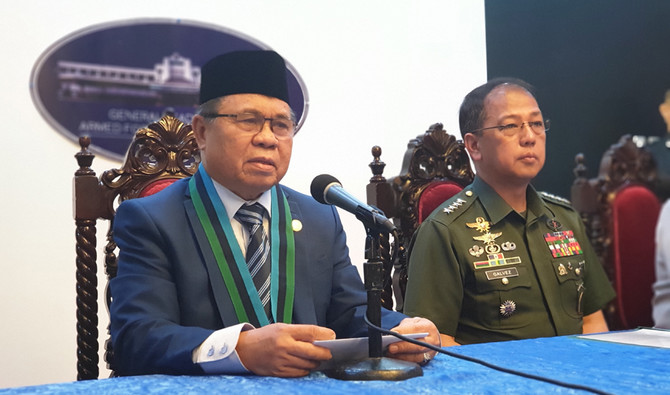

MANILA: Moro Islamic Liberation Front (MILF) Chairman Al Hajj Murad Ebrahim, as a Muslim rebel, once envisioned destroying military camps in the Philippines.
But on Monday, for the first time ever, he visited Camp Gen. Emilio Aguinaldo — the Armed Forces of the Philippines (AFP) main camp — where he was even accorded military honors.
MILF is the Philippines’ Muslim rebel group which, for more than 40 years, has sought autonomy for the Moro people in Mindanao.
“More than four decades ago, I walked out of a university without completing my engineering degree. Many of my Bangsamoro colleagues, I know, did the same. Since then, I have avoided military installations and camps,” Ebrahim told reporters after his meeting with AFP Chief of Staff Gen. Carlito Galvez Jr.
“And to be very candid, during those years of war, I have thought only of destroying or neutralizing military camps and I never imagined during those dark days that I would one day step inside a military camp and be feted with this exceptional honor by what used to be our adversary,” Ebrahim added.
As he sat with Galvez during the press briefing, Murad said he “cannot fully express in words” his gratitude for the privilege of being honored at the headquarters of the AFP.
“I came, I saw, I found friends, and I made peace!” said the MILF chair, adding: “I am truly honored to join our partners in peace, from the highest leadership of the Armed Forces of the Philippines, down to the lowest-ranking element of this institution.”
Murad said his trip to the AFP main camp was to reciprocate the visit of Galvez, who also made a historic visit to the MILF’s Camp Darapanan in Sultan Kudarat in October.
“This visit is a concrete manifestation not only of the solid partnership of our institutions, but a testament of an enduring personal friendship built upon the solid foundation of our mutual commitment to work for peace and see through the dawn of a new day — not just for the Bangsamoro but for this country as well,” Murad said.
The MILF chair said that at the age of 19 in 1969, he left the university to join the Moro struggle in the southern Philippines.
“This happened during the time when there was a series of massacres. We felt there was already a genocidal campaign against the Moro people so we were forced to organize ourselves to defend. Generally it’s a defense,” he said.
The situation, he said, worsened in 1972 when martial law was declared by the late strongman Ferdinand Marcos.
“The atrocities of the government security forces have worsened. Many Moro people have died so we have to organize already not only a defense but a liberation organization, which is the birth of the Moro National Liberation Front (MNLF),” said Murad. The MILF would later become a faction of the MNLF.
He pointed out, though, that their policy from the beginning was that they “have never considered the AFP or any soldier of the Republic as (their) enemy.”
“What we have always considered as the enemy is oppression and injustice. This is the teaching of Islam and this is what we have always adhered to in the Code of Conduct of the Bangsamoro Islamic Armed Forces (BIAF). In the pursuit, however, of our struggle for the right to self-determination of our people, we then saw the AFP as the instrument of the injustices committed against our people such as the loss of our homeland, discrimination and prejudices, and massacres, as well as the denial of our freedom to practice our religion,” Murad said.
But over the years, he stressed, they have also seen the gradual transformation of the AFP, which he now calls their “partners in peace.”
Galvez, for his part, said the reciprocal visit of Murad signifies the strong trust and confidence of the MILF leadership in the AFP and the national government, and the same was true of the military’s trust and confidence in the MILF leadership.
He then cited the visit of MILF Vice Chairman Ghazali Jaafar and BIAF Chief of Staff Sammy Al Mansour and colleagues at the Bangsamoro Transition Commission in Camp Aguinaldo to convey their commitment toward the peaceful resolution of all conflict in the Bangsamoro region.
“On Oct. 6, we paid a visit to MILF Camp Darapanan in Sultan Kudarat, and we declared that the war is over between the AFP and the MILF. I was much honored when around 6,000 men and women of the MILF lined up together on the 5 km road from Cotabato City to Simuay to welcome us,” said the AFP chief.
“The visits done by AFP and MILF manifest the strong mutual desire of both parties toward just and lasting peace for the Bangsamoro Region,” Galvez continued.
Murad’s visit to the AFP camp comes two months ahead of the plebiscite for the Bangsamoro Organic Law (BOL), creating the Bangsamoro Autonomous Region (BAR) which will replace the Autonomous Region in Muslim Mindanao. The BAR will enjoy fiscal autonomy and be governed by the Bangsamoro Parliament.
Meanwhile, Organization of Islamic Cooperation (OIC) Secretary-General Dr. Yousef Al Othaimeen has officially affirmed his support of the ongoing peace process in the Southern Philippines.
Murad told Arab News that the OIC secretary-general gave his commitment during a meeting last Nov. 6 at the OIC office in Jeddah.
During the meeting, the two sides reviewed the latest developments in the peace process in the Mindanao and discussed the forthcoming plebiscite, due to be held in January 2019 to ratify the BOL.
Murad said the secretary-general also assured him that he would try to reach out to the member states of the OIC to support the peace process in Mindanao.
“He knows there will be many challenges, among them the establishment of the (Bangsamoro) government.”
“He (the secretary-general) also said he will personally visit the Philippines before the plebiscite,” Murad added.
A statement posted in the OIC website said the secretary-general welcomed developments in the peace process in Mindanao and urged all parties to remain fully committed to the process.
“Talks also focused on the visit by the secretary-general to the region and the importance of the Bangsamoro people to unify, consolidate and converge together toward the advancement of the peace process and the final resolution of the situation in Mindanao,” it added.


