

Milestone in Philippines’ Mindanao as Muslim fighters demobilize

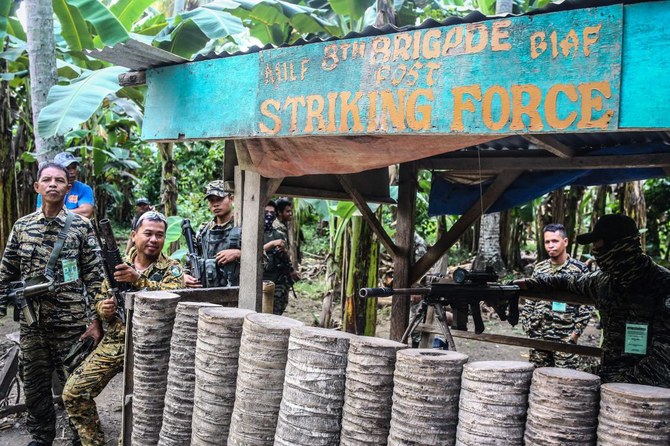
Moro Islamic Liberation Front fighters stand guard at the entry of Camp Darapanan, Sultan Kudarat on Saturday, September 7, 2019 ahead of a weapons decommissioning ceremony. (AFP)
Updated 07 September 2019
Follow

Milestone in Philippines’ Mindanao as Muslim fighters demobilize

  • In a message, Duterte thanked all those who had worked to end armed hostilities between the government and MILF
  • About 1,060 members of the Bangsamoro Islamic Armed Forces (BIAF) were presented to the president at the Old Capitol of Maguindanao in Simuay, Sultan Kudarat

MANILA: The long quest for peace in the Philippines’ troubled south marked another milestone on Saturday as Moro Islamic Liberation Front (MILF) fighters began to demobilize in a ceremony witnessed by President Rodrigo Duterte.

About 1,060 members of the Bangsamoro Islamic Armed Forces (BIAF) were presented to the president at the Old Capitol of Maguindanao in Simuay, Sultan Kudarat. 

In a message, Duterte thanked all those who had worked to end armed hostilities between the government and MILF. 

“I take pride in the fact that we have made significant progress in the Comprehensive Agreement on the Bangsamoro (CAB) including the decommissioning process,” the president said. “This is indeed a huge step towards our goal of achieving lasting peace in Mindanao.”

Duterte assured the decommissioned combatants of the government’s support as they reintegrate into society and enjoy fruitful and productive civilian lives. 

“Do not be disheartened that you surrendered your firearms to the government — we have given you your own government,” he told the former rebels, referring to the Bangsamoro Autonomous Region in Muslim Mindanao (BARMM). 

“I look forward to having you as government partners as we take further strides in securing lasting peace and order in Mindanao.” 

Duterte then encouraged the former MILF fighters and the rest of the Bangsamoro people to take advantage of all available resources in their land, including oil in the Liguasan marsh, to bring prosperity and development in the region. 

“Let us set aside our differences and avoid further armed conflict. I also invite all concerned stakeholders to continue working with the government so our gains will never go to waste,” the president continued. 

“As you open a new chapter in your lives, I hope you will be inspired to take this opportunity to improve your lives and create a better future for your families and love ones.

“Let us celebrate this milestone confident that we have started building a brighter future for a nation where every Filipino, regardless of ethnicity, gender, religion, or ideological leanings will have the chance to live in peace, prosperity and harmony with one another.” 

BARMM Interim Chief Minister Murad Ibrahim, who also chaired the MILF, said the decommissioning of the BIAF proved the MILF’s commitment to fulfill its obligation under the peace agreement. 

“We assure you that we will continue to uphold our part of the bargain,” he stressed.

“The 1,060 combatants who are to be decommissioned today are not ordinary individuals. They are 1,060 individuals whose lives were drastically affected. These are 1,060 stories of love, faith and sacrifice for the sake of Allah and for the sake of the aspiration of every Bangsamoro,” he added. 

The combatants, he pointed out, are just a small part of the 12,000 BIAF members to be decommissioned this year, and the larger total of 40,000 MILF fighters who will undergo the same process. 

Murad thanked the BIAF for their willingness to give peace a chance. “Let me reiterate, we are undergoing a process for peace. The decommissioning is our first step in achieving our goal to turn from combatants to a civilian but productive life. 

“Now our brave combatants will face a different struggle, to embrace a new mindset that instead of going to the field for conflict, we will now go to the field to harvest our crops. That instead of carrying firearms, we will carry tools for work and education. That instead of thinking about a possible encounter the next day, we can now think of opportunities that awaits us, our children, and those who will follow. 

“It has been a long road for all of us and we are not yet close to the finish line. So much more needs to be done and so much more needs to be fixed. Our time on the battlefield is over, but the cause will live on in each and every single one of you.”


Britain’s Starmer seeks to bolster China ties despite Trump warning

Updated 4 sec ago
Follow

Britain’s Starmer seeks to bolster China ties despite Trump warning

  • “The UK has got a huge amount to offer,” he said in a short speech at the UK-China Business Forum at the Bank of China

SHANGHAI: Visiting Prime Minister Keir Starmer said on Friday Britain has a “huge amount to offer” China, after his bid to forge closer ties prompted warnings from US President Donald Trump.
Starmer’s trip is the first to China by a British prime minister in eight years, and follows in the footsteps of other Western leaders looking to counter an increasingly volatile United States.
Leaders from France, Canada and Finland have flocked to Beijing in recent weeks, recoiling from Trump’s bid to seize Greenland and tariff threats against NATO allies.
Trump warned on Thursday it was “very dangerous” for Britain to be dealing with China.
Starmer brushed off those comments on Friday, noting that Trump was also expected to visit China in the months ahead.
“The US and the UK are very close allies, and that’s why we discussed the visit with his team before we came,” Starmer said in an interview with UK television.
“I don’t think it is wise for the UK to stick its head in the sand. China is the second-largest economy in the world,” he said.
Asked about Trump’s comments on Friday, Beijing’s foreign ministry said “China is willing to strengthen cooperation with all countries in the spirit of mutual benefit and win-win results.”
Starmer met top Chinese leaders, including President Xi Jinping and Premier Li Qiang, on Thursday, with both sides highlighting the need for closer ties.
He told business representatives from Britain and China on Friday that both sides had “warmly engaged” and “made some real progress.”
“The UK has got a huge amount to offer,” he said in a short speech at the UK-China Business Forum at the Bank of China.
The meetings the previous day provided “just the level of engagement that we hoped for,” Starmer said.
He signed a series of agreements on Thursday, with Downing Street announcing Beijing had agreed to visa-free travel for British citizens visiting China for under 30 days, although Starmer acknowledged there was no start date for the arrangement yet.
The Chinese foreign ministry said only that it was “actively considering” the visa deal and would “make it public at an appropriate time upon completing the necessary procedures.”
Starmer hailed the agreements as “symbolic of what we’re doing with the relationship.”
He also said Beijing had lifted sanctions on UK lawmakers targeted since 2021 for their criticism of alleged human rights abuses against China’s Muslim Uyghur minority.
“President Xi said to me that that means all parliamentarians are welcome,” Starmer said in an interview with UK television.
He traveled from Beijing to economic powerhouse Shanghai, where he spoke with Chinese students at the Shanghai International College of Fashion and Innovation, a joint institute between Donghua University and the University of Edinburgh.

- Visas and whisky -

The visa deal could bring Britain in line with about 50 other countries granted visa-free travel, including France, Germany, Australia and Japan, and follows a similar agreement made between China and Canada this month.
The agreements signed included cooperation on targeting supply chains used by migrant smugglers, as well as on British exports to China, health and strengthening a bilateral trade commission.
China also agreed to halve tariffs on British whisky to five percent, according to Downing Street.
British companies sealed £2.2 billion in export deals and around £2.3 billion in “market access wins” over five years, and “hundreds of millions worth of investments,” Starmer’s government said in a statement.
Xi told Starmer on Thursday that their countries should strengthen dialogue and cooperation in the context of a “complex and intertwined” international situation.
Relations between China and the UK deteriorated from 2020 when Beijing imposed a national security law on Hong Kong and cracked down on pro-democracy activists in the former British colony.
However, China remains Britain’s third-largest trading partner, and Starmer is hoping deals with Beijing will help fulfil his primary goal of boosting UK economic growth.
British pharmaceutical group AstraZeneca said on Thursday it would invest $15 billion in China through 2030 to expand its medicines manufacturing and research.
And China’s Pop Mart, makers of the wildly popular Labubu dolls, said it would set up a regional hub in London and open 27 stores across Europe in the coming year, including up to seven in Britain.
Starmer will continue his Asia trip with a brief stop in Japan on Saturday to meet Prime Minister Sanae Takaichi.