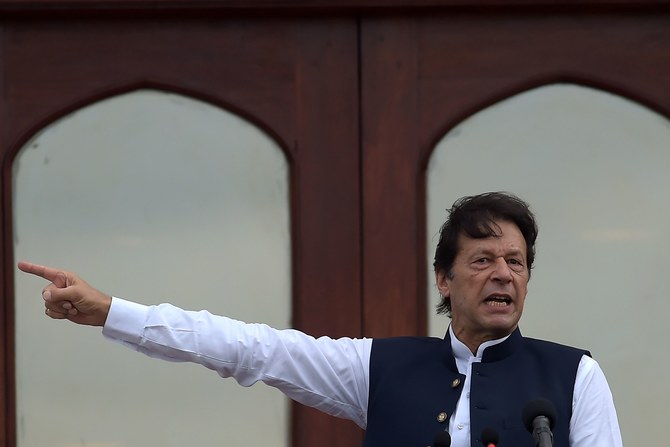
ISLAMABAD: As Pakistan observed its 54th Defense Day on Friday, Prime Minister Imran Khan vowed that Islamabad was prepared to give the “fullest possible” response to India’s actions in disputed Kashmir.
Pakistan celebrates Defense of Pakistan Day on September 6 every year as the anniversary to defend the country’s territory in the 1965 war between Pakistan and arch-rival India.
Tensions have once again flared between the nations since New Delhi on Aug. 5 revoked the constitutional autonomy of the part of Kashmir that it administers, and moved to quell objections by shutting down communications and clamping down on local leaders. Pakistan reacted with fury, cutting trade and transport ties and expelling India’s ambassador.
In a message on the occasion of Defense Day, Khan said: “I have informed the world that Pakistan does not want war, but at the same time, Pakistan cannot remain oblivious to the challenges posed to its security and integrity.”
He added: “We are prepared to give the enemy the fullest possible response.”
Khan said the world community would be responsible for the “catastrophic aftermath” of Indian actions in Kashmir.
“The enemy is once again showing aggressive postures on the Line of Control, it has unleashed reign of terror on innocent and unarmed people of the Occupied Valley after changing the status of Kashmir by abolishing Articles 370 and 35-A in violation of the UN Charter,” Khan said.
At a ceremony in Lahore last week, Khan had said war between nuclear-armed countries was a threat for the entire world but Pakistan would never be the first to start war.
Analysts said the PM’s Defense Day statements on Kashmir reflected a hardening of Pakistan’s position.
“It also reflects heightening tension between the two countries,” author Zahid Hussain told Arab News. “The worsening humanitarian situation in Kashmir has also pushed Imran Khan to up the ante.”
Politics professor Rasul Bakhsh Rais said the Defense Day statement by the PM was both strong and unexpected.
“Until now, Imran Khan has hesitated to hurl threats at India, rather he attempted to allay the fears of war by saying Pakistan will not be the first to start war,” Rais, who teaches at the Lahore University of Management Sciences, said.
“He is showing concern over the month long curfew and reports of atrocities,” he said, adding that another factor at work in hardening Khan’s stance was “a virulent campaign by the opposition parties and some religious groups alleging that Imran is not as aggressive toward India as the situation would demand and that he has ‘sold out Kashmir’.”
Addressing a ceremony at the military headquarters in Rawalpindi to celebrate Defense Day, Army Chief Gen Qamar Bajwa said the Kashmir issue is an “unresolved agenda” of the realization of Pakistan.
“Pakistan’s armed forces are ready to give any sacrifice for the people of Kashmir… and we and we are prepared to go till any extent,” the chief said. “Pakistan will never leave them (people of Kashmir) alone.”
President Arif Alivi in his message to the nation said September 6 dawned every year with “remembrance of national spirit and for renewal of our resolve to lay down our lives for our beloved motherland.”
He reiterated Pakistan’s will to continue to support the people of Kashmir in their right to self-determination.
“Pakistanis will not rest or sleep, nor acquiesce or give up, until India ceases its horrendous human rights violation ... and the Kashmiris achieve their legitimate right to self-determination as per the United Nations Security Council Resolutions,” Pakistan’s Foreign Minister Shah Mahmood Qureshi said.


![]()

On Defense Day, PM Khan warns of ‘fullest possible’ response over Kashmir
On Defense Day, PM Khan warns of ‘fullest possible’ response over Kashmir
- Says world community will be responsible for “catastrophic aftermath” of failing to act on Kashmir
- Analysts say PM’s latest statements reflect a hardening of Pakistan’s position on Indian actions in disputed valley
Latest updates



© 2026 SAUDI RESEARCH & PUBLISHING COMPANY, All Rights Reserved And subject to Terms of Use Agreement.