Pakistan, UAE agree to boost cooperation in policing, anti-terror financing

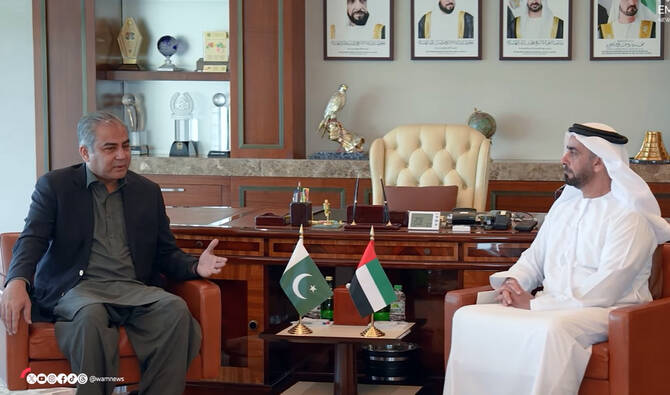
The screengrab taken from a video shows Pakistan’s Interior Minister Mohsin Naqvi meeting UAE Deputy Prime Minister and Minister of the Interior Lt. Gen. Sheikh Saif bin Zayed Al-Nahyan (right) in Abu Dhabi, UAE, on July 10, 2025. (Screengrab/WAM/File)
Short Url
Updated 06 February 2026
Follow

Pakistan, UAE agree to boost cooperation in policing, anti-terror financing

  • Pakistani and Emirati interior ministers discuss exchange programs, joint strategy to counter ‘online terrorism’
  • Both sides also in talks over mutual legal assistance agreement to curb money laundering, illegal offshore holdings

KARACHI: Pakistan and the United Arab Emirates (UAE) have agreed to strengthen their cooperation in policing and anti-terror financing, the Pakistani interior ministry said on Friday.

The statement followed a meeting between Pakistani Interior Minister Mohsin Naqvi and his Emirati counterpart Lt. Gen. Sheikh Saif bin Zayed Al-Nahyan on the sidelines of the World Governments Summit 2026 in Dubai.

Pakistan and the UAE share close defense, economic, diplomatic and people-to-people relations. The Gulf country is Pakistan’s third-largest trading partner after China and the US, and home to more than 1.5 million Pakistani expatriates.

During their meeting, the Pakistani and the Emirati interior ministers agreed to increase bilateral cooperation in areas of mutual interest, according to the Pakistani interior ministry.

“Exchange programs will prove beneficial in making practical use of the UAE’s policing system,” the ministry said, citing the two interior ministers.

“A decision was made to formulate a joint strategy to prevent online terrorism and terrorism financing.”

The development comes days after Pakistan’s National Accountability Bureau (NAB) said it was in talks with counterparts in the UAE to curb money laundering and illegal offshore asset holdings through mutual legal assistance.

NAB’s move is part of Pakistan’s broader efforts to curb the flow of ill-gotten money outside the country by reaching such agreements with foreign governments.

“A team of NAB officials will travel to Dubai in the coming weeks to sign an MoU with the UAE Accountability Authority (UAEAA) for joint cooperation against corruption,” NAB’s Director General (Operations) Amjad Majeed Aulakh said, adding that both sides have already held several rounds of talks to finalize the agreement.

Pakistan, which for years remained on the Financial Action Task Force’s (FATF) list of countries with vulnerable financial systems, is also trying to strengthen its capacity to handle sophisticated financial crimes through artificial intelligence-assisted tools, blockchain analysis and digital forensics, the official said.


Pakistan court directs authorities to form medical board to assess Imran Khan’s eye condition

Updated 11 sec ago
Follow

Pakistan court directs authorities to form medical board to assess Imran Khan’s eye condition

  • Islamabad High Court rejects jailed ex-PM’s request for immediate transfer to private hospital
  • Medical board comprising doctors from PIMS and Shifa to submit report on possible transfer

ISLAMABAD: A Pakistani high court on Thursday directed authorities to form a medical board of government doctors to assess whether jailed former prime minister Imran Khan needs to be transferred to a hospital, his party said, following a rejection of his request to be moved to a private facility for treatment.

The development comes after the Pakistan Institute of Medical Sciences (PIMS) said last week that Khan’s vision had “improved remarkably” since he was given an Anti-VEGF injection amid concerns related to his eyesight.

Anti-VEGF injections are commonly used to treat retinal vein occlusion and other retinal vascular disorders by reducing swelling and abnormal blood vessel growth inside the eye. Prior to the development, the ex-premier had complained of rapid deterioration in vision in one of his eyes.

“The Islamabad High Court has rejected Imran Khan’s request for immediate transfer to Shifa International Hospital,” the Pakistan Tehreek-e-Insaf (PTI) party said in a post on X.

“The court directed that the Chief Commissioner immediately constitute a medical board comprising doctors from PIMS and Shifa Hospital,” it continued. “The medical board will submit a report, on the basis of which the Chief Commissioner will decide whether a hospital transfer is to take place or not.”

The PTI said the court’s decision had raised questions over the judiciary’s independence.

“Delaying a medical emergency and handing it over to administrative discretion is a violation of human rights,” it said. “The issue of Imran Khan’s health is not just about one individual but reflects the entire judicial and state system.”

The 74-year-old cricketer-turned politician has been in prison since August 2023 in cases that he and his party say are politically motivated.

Khan was taken to PIMS for a medical procedure earlier this year, as his party questioned the transparency of the medical update and demanded independent access to his care.

Khan was removed from office in April 2022 through a parliamentary vote of no confidence that he says was orchestrated at the behest of the former administration in Washington by his political rivals with backing from the military. His allegation has been denied by all parties involved.

Since his imprisonment, Khan has faced multiple convictions and ongoing legal proceedings that authorities say follow due process, while his party describes them as efforts to sideline him from politics.