DUBAI: Iran will from Friday begin developing centrifuges to speed up the enrichment of uranium, as the next step in scaling back its nuclear commitments, President Hassan Rouhani said on Wednesday.
Under its 2015 nuclear agreement with world powers, Iran was allowed to keep restricted quantities of first-generation centrifuges at two nuclear plants.
But the successful development of more advanced centrifuges would enable it to produce material for a potential nuclear bomb several times faster.
“From Friday, we will witness research and development on different kinds of centrifuges and new centrifuges and also whatever is needed for enriching uranium in an accelerated way,” Rouhani said a televised speech.
“All limitations on our Research and Development will be lifted on Friday.”
Iran says it is only enriching uranium to fuel nuclear power plants.
Rouhani also said Iran would take all necessary steps to protect its rights and interests, and called the centrifuge development the “third step” in scaling back its commitment to the nuclear deal.
The agreement lifted economic sanctions in 2016 in exchange for Iran agreeing to circumscribe its nuclear activities. The United States quit it last year and re-imposed sanctions.
It allowed Iran to keep 1,044 first-generation centrifuges at its Fordow uranium enrichment plant and operate another 5,060 of a similar type for 10 years at a second nuclear plant at Natanz.
Also under the deal, Tehran can continue to conduct enrichment Research and Development (R&D) without accumulating enriched uranium, including work with certain types of advanced centrifuges.
The European Union urged Iran to refrain from steps that could undermine the nuclear deal.
Rouhani’s statement came as Iranian officials appeared to give a guarded welcome to a French proposal to save the atomic pact by offering Iran about $15 billion in credit lines until the end of the year if Tehran comes fully back into compliance.
Rouhani said talks with European powers were moving forward, raising hopes of at least a pause in a diplomatic confrontation between Iran and the West that has stoked already heightened tensions across the region.
Iran emerged from years of economic isolation after agreeing a deal with world powers in 2015 to curb its nuclear development program in exchange for sanctions relief. However, US President Donald Trump pulled out of the deal last year, arguing it did not go far enough, and reimposed sanctions.
Tehran responded with two separate moves that breached some of the terms of the deal, although it says it still aims to save the pact.
Rouhani had threatened to take further measures by Sept. 5 unless France and the other European signatories of the pact did more to protect Iran from the impact of the US penalties.
“I think it is unlikely that we will reach a result with Europe by today or tomorrow ... Europe will have another two months to fulfil its commitments,” Rouhani said, according to state TV.
“The talks between Iran and European countries are moving forward ... but we have yet to reach a conclusion,” he added.
Iran would continue with plans to breach the pact further and accelerate its nuclear activity, Rouhani said, without giving a fresh deadline.
“The third step (in reducing Iran’s commitments) will be the most important one and it will have extraordinary effects,” state TV reported him as saying.
Iran’s vital crude oil sales have plummeted by more than 80% under the US sanctions.
The remaining signatories of the deal have been working to save an agreement that they say will bring Iran back into the international fold and prevent Tehran from developing a nuclear bomb.
Iran has repeatedly said its nuclear program is for electricity generation and other peaceful purposes.
Iran’s Deputy Foreign Minister Abbas Araqchi appeared to back the main terms of the French proposal in a statement on Wednesday.
“Our return to the full implementation of the nuclear accord is subject to the receipt of $15 billion over a four-month period, otherwise the process of reducing Iran’s commitments will continue,” the semi-official news agency Fars quoted Araqchi as saying.
“Either Europe has to buy oil from Iran or provide Iran with the equivalent of selling oil as a credit line guaranteed by Iran’s oil revenues, which in some sense means a pre-sale of oil,” Araqchi added.
Government spokesman Ali Rabie said Iran would stick to its nuclear commitments “if France can get the approval of the US and announces it.” He added: “If they cannot get the approval, then we will take the third step.”
The United States would have the economic clout to block any credit line for Iran. Washington has not commented on the proposal which would contradict its stated policy of imposing “maximum pressure” to force Tehran to rein in its nuclear and missile programs as well as what the White House views as its destabilising regional behavior.
Iran’s English-language Press TV issued a short report stating: “Iran has rejected a $15 billion loan offered by EU” — though Western and Iranian sources had described the French plan as the offer of a credit line, not a loan. Precize details of the plan have not been made public.


![]()

Rouhani says Iran to develop centrifuges for faster uranium enrichment
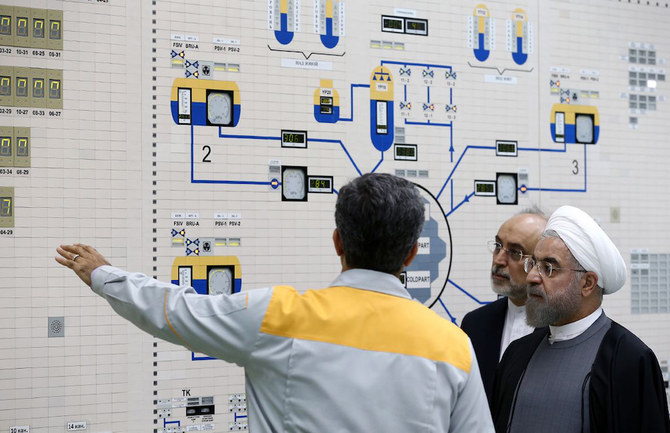
Rouhani says Iran to develop centrifuges for faster uranium enrichment
- Iran will give EU another two months to salvage nuclear deal, Rohani says
- France proposed to save the atomic pact by offering Iran about $15 bn in credit lines


Latest updates


© 2026 SAUDI RESEARCH & PUBLISHING COMPANY, All Rights Reserved And subject to Terms of Use Agreement.