

Centuries-old statues discovered at ancient Hindu temple in Karachi

1 / 6
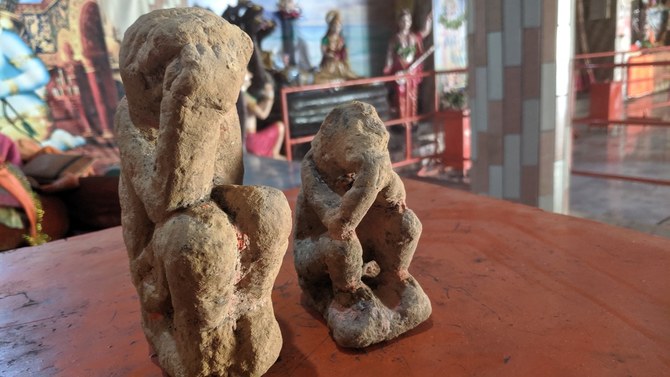
Newly discovered statues of the Hindu god Vanar at the Panchmukhi Hanuman Mandir, situated in the Solider Bazar area of Karachi. Photograph taken on Sept. 3, 2019. (AN Photo)
2 / 6
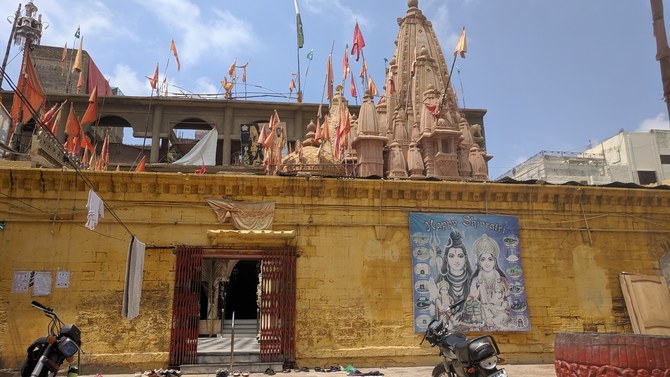
The Panchmukhi Hanuman Mandir, situated in the Solider Bazar area of Karachi, Pakistan is being renovated this year following a tough legal battle. Photograph taken on Sept. 3, 2019. (AN Photo)
3 / 6
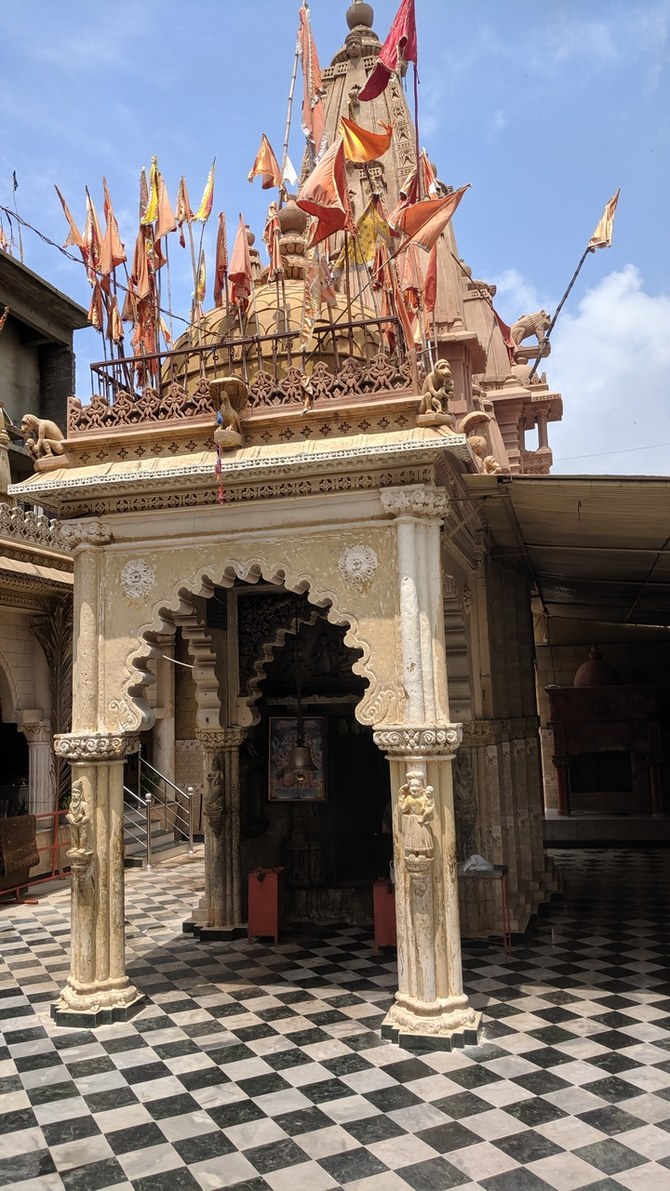
The Panchmukhi Hanuman Mandir, situated in the Solider Bazar area of Karachi, Pakistan, is being renovated this year following a tough legal battle. Photograph taken on Sept. 3, 2019. (AN Photo)
4 / 6
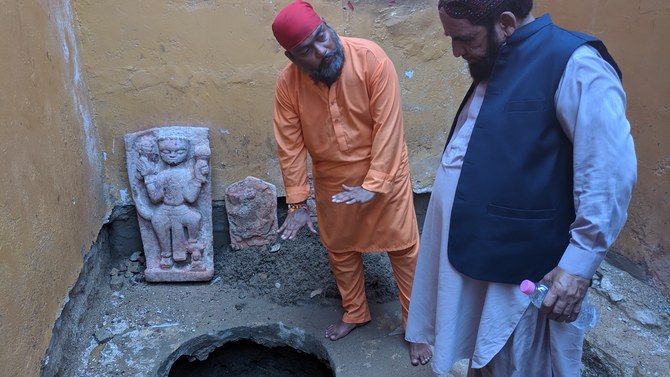
The caretaker of Karachi city’s Panchmukhi Hanuman Mandir, Shri Ram Nath Maharaj (R), briefs the director of the heritage department for Sindh province, Muhammad Shah Bukhari, who examines newly discovered statues. Photograph taken on Sept. 3, 2019. (AN Photo)
5 / 6
The caretaker of Karachi city’s Panchmukhi Hanuman Mandir, Shri Ram Nath Maharaj (R), briefs the director of the heritage department for Sindh province, Muhammad Shah Bukhari, who examines newly discovered statues. Photograph taken on Sept. 3, 2019. (AN Photo)
6 / 6
Expansion work is ongoing at the Panchmukhi Hanuman Mandir in the Solider Bazar area of Karachi, Pakistan. Photograph taken on Sept. 3, 2019. (AN Photo)
Updated 03 September 2019
Follow

Centuries-old statues discovered at ancient Hindu temple in Karachi

  • Panchmukhi Hanuman Mandir in the port city’s Soldier Bazar area is said to be at least 1,500 years old
  • Statues of major Hindu deities were discovered during expansion work at the temple last week

KARACHI: Last week, during expansion work at an ancient Hindu temple in Pakistan’s port city of Karachi, caretakers discovered a rare treasure: up to three-hundred-year-old statues of the Hindu deities Hanuman, Ganesh Bhagwan, Shri Mata, Vanar and Shiva Linga.
A reflection of the diverse history and culture of the South Asian country, the Panchmukhi Hanuman Mandir in Karachi’s Soldier Bazar area is said to be at least 1,500 years old and was declared a national heritage under the Sindh Cultural Heritage (Preservation) Act 1994. The temple holds special significance as the only shrine in the world that houses what Hindus believe to be a divinely-revealed statue of Hanuman that is not man-made.
Expansion works at the 2,600-square-feet property first began in 2006 but resumed this year, leading to the discovery of the new statues.
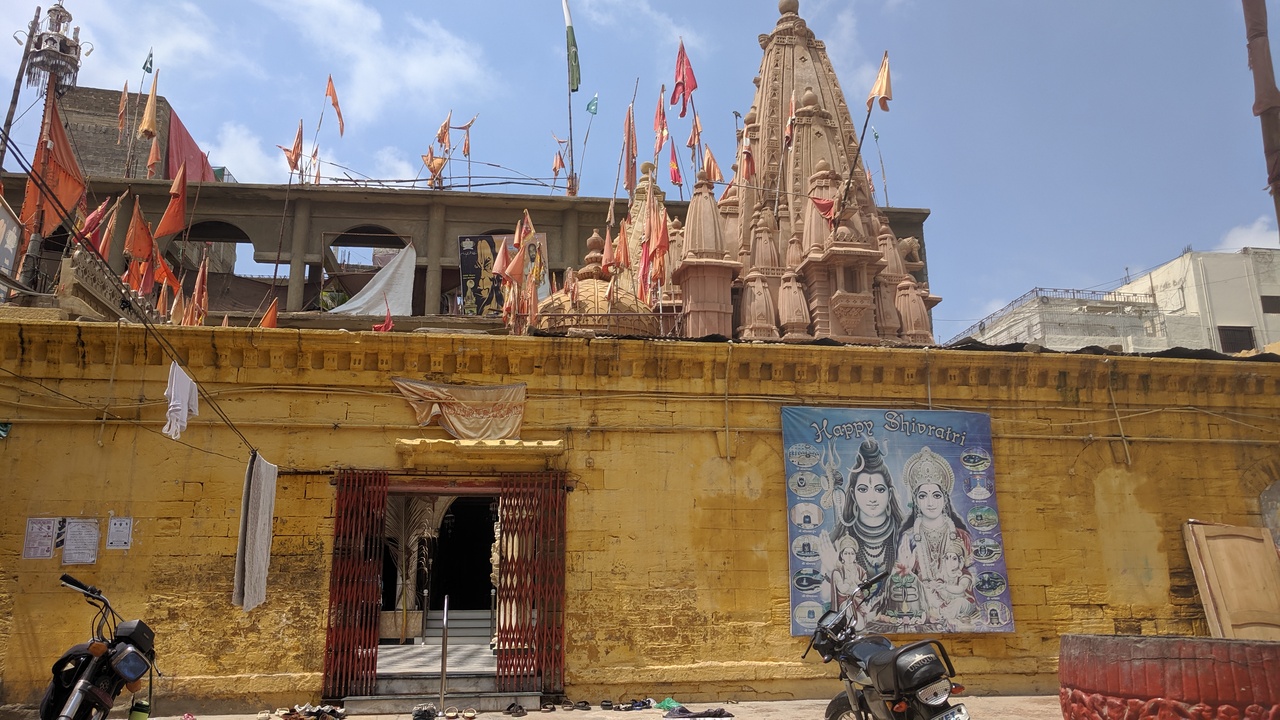


The Panchmukhi Hanuman Mandir, situated in the Solider Bazar area of Karachi, Pakistan is being renovated this year following a tough legal battle. Photograph taken on Sept. 3, 2019. (AN Photo)

“Our team will determine the exact age of the artifacts; however the usage of gizri stones tells us that they are at least 300 years old,” Sindh Director Heritage Muhammad Shah Bukhari told Arab News. “Archaeologists can determine the accurate age of the statues by studying the stone, its size and other specifications.”
Shri Ram Nath Maharaj, the caretaker of the temple, said he discovered the statues while digging the land adjacent to the temple during expansion.
“Experts can better tell us about the age but these statues can be as old as the temple itself,” Nath said.
Minority communities in Pakistan are often targeted by right-wing groups and successive governments have in the past been reluctant to embrace the country’s non-Muslim heritage.
But recent attempts to improve Pakistan’s image and open the country to tourism and pilgrimages have included overtures to minority communities by the past government of Prime Minister Nawaz Sharif and the new government of cricketer-turned-politician Imran Khan.
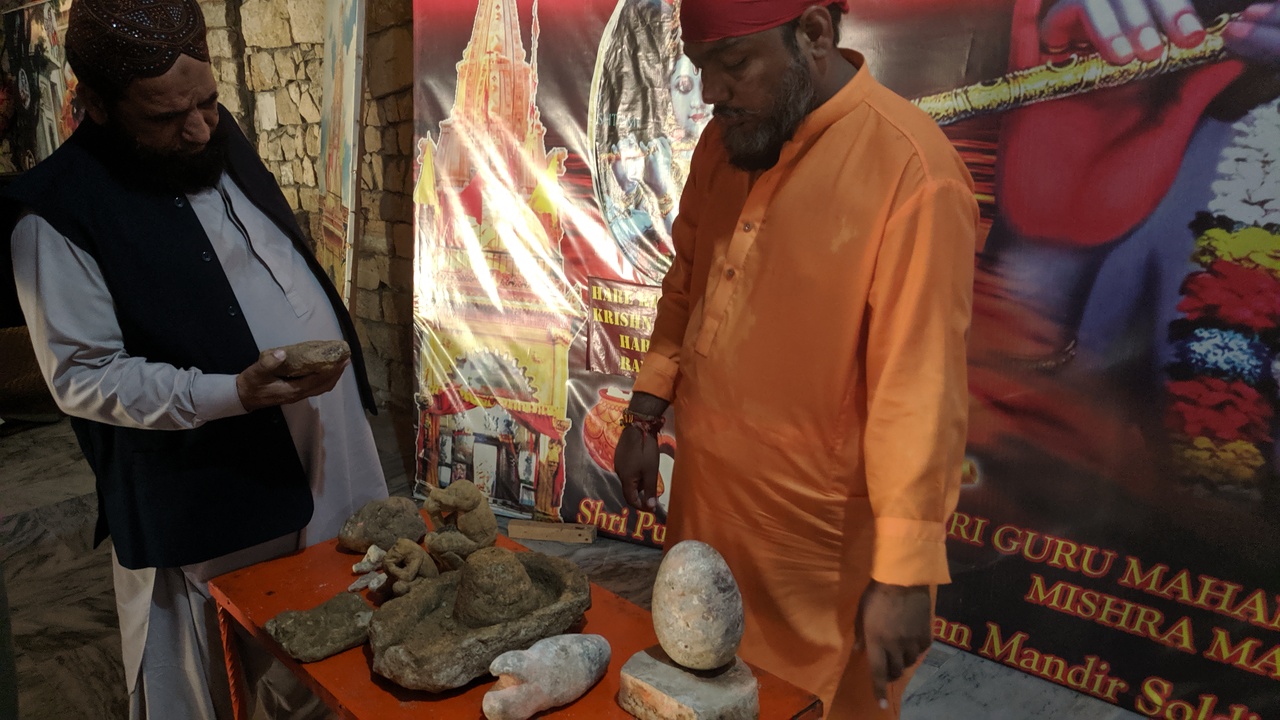


The caretaker of Karachi city’s Panchmukhi Hanuman Mandir, Shri Ram Nath Maharaj (R), briefs the director of the heritage department for Sindh province, Muhammad Shah Bukhari, who examines newly discovered statues. Photograph taken on Sept. 3, 2019. (AN Photo)

In January 2017, Sharif inaugurated the restoration of Hindu temples at Katas Raj in Punjab province. In November that year, Khan inaugurated the remains of a 1,700-year-old sleeping Buddha image in Haripur in Khyber Pakhtunkhwa, a northwestern province his political party had ruled under the previous government. The region was once the center of Buddhist civilization that took root under the Mauryan king Ashoka 2,300 years ago.
Nath said the Sindh heritage department would help in the proper restoration and perseveration of the recovered statues and hoped they would complete their work before September 29 when the annual, nine-night Navratri Hindu festival kicks off at the temple, marked with celebrations involving prayer, music and dance among men and women.
The festival is famous for being high-spirited and Christians and Muslims are also known to take part.
“The people are eager to see their gods,” Nath said. “Navratri will be a great occasion to behold them.”


Pakistan mulls space-based monitoring to support port expansion, maritime safety

Updated 10 sec ago
Follow

Pakistan mulls space-based monitoring to support port expansion, maritime safety

  • Minister says satellite technology could aid port planning and environmental protection
  • Islamabad seeks to modernize ports as it eyes transshipment role, Central Asian trade

KARACHI: Pakistan is considering the use of space-based monitoring systems to support port expansion, maritime safety and environmental protection, the country’s maritime affairs minister said on Wednesday, as he visited the headquarters of the national space agency.

The visit comes as Islamabad seeks to position itself as a transshipment hub by upgrading cargo handling, streamlining import and export processes and offering its southern ports on the Arabian Sea to landlocked Central Asian states as trade gateways.

“Advanced space-based monitoring systems can play a vital role in safeguarding seas, improving maritime management and strengthening responses to environmental threats,” Maritime Affairs Minister Muhammad Junaid Anwar Chaudhry said, according to a statement released after his visit.

Chaudhry was briefed on satellite-based assessments identifying potential sites for new ports, as well as tools for maritime traffic monitoring and disaster response.

Pakistan has been working to expand and modernize its port infrastructure to improve efficiency and attract regional cargo flows, particularly as it seeks to enhance connectivity through its coastline along the Arabian Sea.

During the visit, officials from the Pakistan Space and Upper Atmosphere Research Commission (SUPARCO) outlined the use of high-resolution satellite imagery, artificial intelligence and digital modelling to monitor ports, track cargo dwell time, detect oil spills and support search-and-rescue operations at sea.

“We can benefit from continuous monitoring of coastal ecosystems to assess water quality, sediment dispersion and overall environmental health,” Chaudhry said, adding that data-driven approaches were essential for informed policymaking in the maritime sector.

He also highlighted the growing risks posed by climate change, including rising sea levels, coastal erosion and extreme weather events, and said stronger cooperation between maritime authorities and scientific institutions was needed to protect coastal communities and infrastructure.

SUPARCO officials said the agency was ready to develop artificial intelligence-based solutions for ports and maritime operations, including systems to address customs-related inefficiencies and improve emergency response times.
The minister said the ministry and SUPARCO would move toward formalizing cooperation through a structured framework to support joint initiatives.