

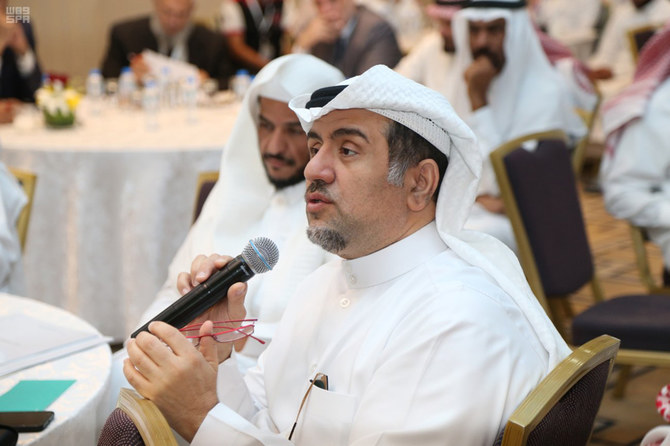
More than 150 specialists discuss proposed Saudi mosque construction code

1 / 3
The idea of establishing the code was a result of unfavorable practices pursued in some mosques. (SPA)
2 / 3
The idea of establishing the code was a result of unfavorable practices pursued in some mosques. (SPA)
3 / 3
The idea of establishing the code was a result of unfavorable practices pursued in some mosques. (SPA)
Updated 31 August 2019
Follow

More than 150 specialists discuss proposed Saudi mosque construction code

  • The planned code aims to achieve modern construction to meet visitors’ needs, establish aesthetic and functional aspects to reflect mosques’ sanctity, and optimize energy efficiency

RIYADH: The Saudi Ministry of Islamic Affairs, Call and Guidance concluded on Thursday the Mosque Construction Code workshop, which kicked off on Wednesday.

It was held under the patronage of Sheikh Dr. Abdullatif Al-Asheikh, minister of Islamic affairs, call and guidance, and was inaugurated by his deputy, Dr. Youssef bin Saeed.

More than 150 construction specialists and academics from across the Kingdom participated. Themes discussed included urban planning and techniques for building mosques, architectural design, operation and maintenance, and provisions and regulations regarding construction.

Dr. Mohammed bin Saleh bin Saeed, the ministry’s undersecretary for mosques’ affairs, said the idea of establishing the code was a result of unfavorable practices pursued in some mosques.

He said the code aims to achieve modern construction to meet visitors’ needs, establish aesthetic and functional aspects to reflect mosques’ sanctity, and optimize energy efficiency.

Bin Saeed noted the support and follow-up of the minister and his deputy, which he said contributed to the workshop’s success.

Dr. Mishary bin Abdullah Al-Naim, secretary-general of the Abdullatif Al-Fozan Award for Mosque Architecture, said all elaborated drafts will be compatible and consistent with the Saudi building code, and will be reviewed and studied by the award.

The mosque construction code will be established, agreed upon and adopted by six specialized committees in concert with the ministry and the award.

The committees will be represented by the Ministry of Islamic Affairs, Call and Guidance, the Ministry of Municipal and Rural Affairs, the Ministry of Energy, the Saudi Building Code National Committee, experts from Saudi universities and specialists in code-making.

Al-Naim said a similar workshop will be held to discuss the final drafts reached by the committees, to ensure their applicability and check if there any recommendations and remarks by participating experts and specialists.

He thanked the Ministry of Islamic Affairs, Call and Guidance for its support for the workshop.

He said this reflects the ministry’s keenness to serve mosque visitors and worshippers, in line with the aspirations of the Kingdom’s leadership.



SDAIA president says Saudi Arabia is building an integrated AI ecosystem

Updated 9 sec ago
Follow

SDAIA president says Saudi Arabia is building an integrated AI ecosystem

RIYADH: Saudi Data and Artificial Intelligence Authority President Abdullah Al-Ghamdi says that Saudi Arabia is moving steadily to establish artificial intelligence as a trusted national capability, the Saudi Press Agency reported.

Guided by the objectives of Saudi Vision 2030, Al-Ghamdi said the goal is to use AI to help develop government services, enhance competitiveness, build human capacity and improve quality of life through a comprehensive strategy based on three main pillars that unlock the potential of this technology and achieve sustainable developmental impact.

“The first pillar focuses on building human capacity and enhancing readiness to engage with AI technologies,” he said.

The second pillar is building an integrated national AI ecosystem that drives expansion and innovation by developing advanced digital infrastructure that enables various sectors to adopt AI applications efficiently, consistently and with effective governance, Al-Ghamdi said.

The third pillar, he said, is governance that ensures responsible and measurable AI through a national framework aligned with international standards.

This came during Al-Ghamdi’s speech at a high-level ministerial session held on Thursday on the sidelines of the AI Impact Summit 2026 in New Delhi.

He is heading the Saudi delegation, and the session saw broad participation from heads of state, decision-makers and technology leaders from around the world.

Al-Ghamdi also had a meeting with Indian Prime Minister Narendra Modi on Thursday evening, discussed AI cooperation and expressed his gratitude for hosting the summit and for the hospitality extended to the participants.