

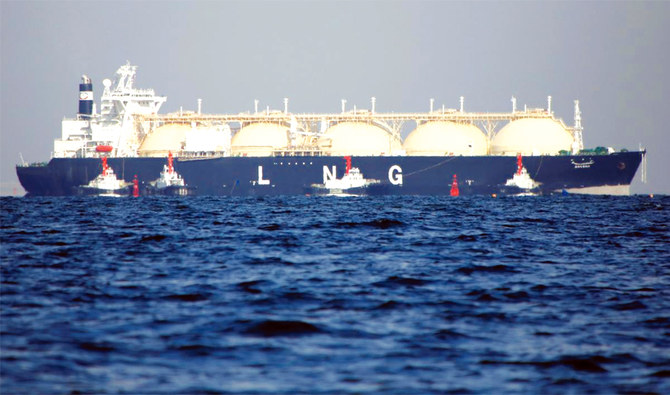
Japan imports first LNG from China as utilities try to cut costs

The shipment shows the increasing flexibility of the Asian LNG market. (Reuters)
Updated 29 August 2019
Follow

Japan imports first LNG from China as utilities try to cut costs

  • Prices for spot LNG in Asia have sunk to near record lows in recent weeks as a wave of new supply from the US and Australia comes on to the market

TOKYO: Japan imported its first cargo of liquefied natural gas (LNG) from China in July as utilities from the world’s biggest buyer of the fuel seek out new suppliers and try to lower costs amid tough competition at home.

The shipment illustrates the increasing flexibility of the Asian LNG market. China has become the world’s second-largest LNG buyer amid a surge in domestic gas usage. However, the country has started to re-export shipments amid a lull in summer gas consumption and Japanese buyers are scooping up the cargoes to reduce their fuel expenses.

The cargo of 70,560 tons of LNG was shipped from the Hainan LNG Terminal, which is operated by state-owned CNOOC, to Chita near Nagoya, where Toho Gas jointly operates an LNG terminal with JERA, according to a source familiar with the matter.

It was delivered at $5.68 per million British thermal units (mmBtu), below Japan’s average import cost of $9.50 per mmBtu for LNG during July, according to Ministry of Finance data released on Thursday.

Toho Gas declined to comment when contacted by Reuters. CNOOC did not immediate reply for a request for comment.

A search through Japan’s official trade statistics shows it is the first LNG cargo from China since 1988, when the Japanese government started publishing import and export figures.

Prices for spot LNG in Asia have sunk to near record lows in recent weeks as a wave of new supply from the US and Australia comes on to the market.

The decline in spot market prices for liquefied natural gas (LNG) is pushing Japanese utilities in Japan to be more aggressive in price reviews built into traditional long-term contracts linked to oil prices.

They are also buying more LNG on the spot market as part of this shift in approach. Japanese utilities have previously favored stability of supply over price, partly because they could pass on the costs to consumers.

The liberalization of Japan’s energy markets means the old guard gas and electric utilities are losing customers to new entrants and they are trying to cut costs.

With summer temperatures peaking, Japanese electric utilities have also been rushing to replenish stocks of the fuel to use to generate power for air conditioning.

Hokuriku Electric has bought a spot LNG cargo for delivery in November, while Hokkaido Electric is seeking a cargo for delivery the same month, industry sources told Reuters this week.


Finance minister announces launch of National Privatization Strategy

Updated 11 sec ago
Follow

Finance minister announces launch of National Privatization Strategy

RIYADH: Saudi Arabia’s Minister of Finance and Chairman of the National Center for Privatization Mohammed bin Abdullah Al-Jadaan highlighted the Council of Economic and Development Affairs’ approval to conclude the Kingdom’s privatization program, noting that it had successfully completed its initiatives in line with the approved plan.

Al-Jadaan explained that since its launch, the privatization program has achieved a number of milestones, most notably the establishment of the NCP, which has created over 200 approved projects with total investments estimated at SR800 billion ($213.4 billion).

The program, he added, has also facilitated the signing of nearly 90 contracts, ranging from ownership transfer agreements to public-private partnership deals across multiple sectors.

In addition, it has contributed to strengthening the role of the private sector, improving the efficiency of government asset operations, and developing a legislative and regulatory environment that supports investment, thereby promoting economic diversification and enhancing the Kingdom’s competitiveness.

The minister announced the launch of the National Privatization Strategy, which was approved by the Council of Ministers on Nov. 25.

The initiative aims to enhance the quality and efficiency of infrastructure, improve public services for the Kingdom’s residents, strengthen the private sector’s role in sustainable economic development, and enable the government to focus on its legislative, supervisory, and regulatory functions, while reinforcing financial sustainability, all in line with the country’s Vision 2030.

Al-Jadaan said: “Saudi Arabia seeks to establish a high-quality, efficient future infrastructure capable of delivering world-class public services to citizens, residents, and visitors, while reinforcing the Kingdom’s position as a global reference in public-private partnerships.”

The strategy aims to raise satisfaction levels with public services across 18 target sectors, create tens of thousands of specialized jobs, exceed 220 public-private partnership contracts by 2030, and increase private sector capital investments to more than SR240 billion by 2030.

The NPS has established five main programs to empower and advance the privatization system, along with 42 executive initiatives to achieve its objectives and the Vision 2030 targets related to privatization.

It also includes an executive program dedicated to identifying and prioritizing key privatization opportunities, with over 145 high-priority opportunities already identified, representing attractive investment prospects for the private sector.
