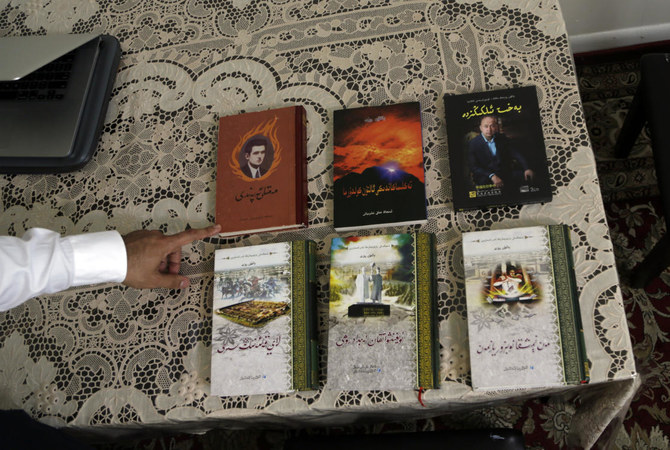
STRASBOURG: Europe's top rights body, the Council of Europe, has nominated a jailed academic from China's Uighur minority, Ilham Tohti, for one of the continent's top human rights awards.
The economics professor who was sentenced to life in prison in 2014 after being convicted of separatism, "has worked for over 20 years on the situation of the Uighur minority and on fostering inter-ethnic dialogue and understanding in China," the Council's parliamentary assembly said in a statement after meeting Monday in Prague.
Tohti is one of three nominees for the 2019 Vaclav Havel prize, along with Tajik human rights lawyer Buzurgmehr Yorov and a youth group promoting post-war reconciliation in the Balkans.
The winner of the 60,000-euro prize will be announced on September 30 in Strasbourg, home of the 47-country Council of Europe which founded the the European Court of Human Rights.
Tohti has also been nominated by US lawmakers for the Nobel Peace Prize.
His nomination for the European prize comes as China's treatment of the Uighurs -- a Muslim, Turkic-speaking minority concentrated in China's tightly-controlled northwestern Xinjiang region -- comes under growing scrutiny.
Rights groups and experts say more than one million mostly Muslim ethnic minorities have been interned in re-education camps in Xinjiang.
China initially denied the existence of the camps before later admitting to running what it called "vocational education centres", which it presented as necessary to combat religious extremism and boost employment.
Last month, Beijing said "most" of those being held had now returned home, without providing details.
Previous winners of the Vaclav Havel prize, named after the late Czech dissident and former president, include Nobel laureate Nadia Murad, a Yazidi activist who survived torture and rape by the Islamic State, and Oyub Titiyev, a Chechen rights activist who spent 18 months in a Russian jail.

Uighur intellectual nominated for top European rights award
- Tohti is one of three nominees for the 2019 Vaclav Havel prize
- The economics professor who was sentenced to life in prison in 2014 after being convicted of separatism
Fourth Palestine Action activist ends hunger strike in UK prison
- Amy Gardiner-Gibson began eating again after 49 days of protest
- Govt rejects claims it ignored prison safety protocols
LONDON: A fourth Palestine Action activist imprisoned in the UK has ended her hunger strike.
Amy Gardiner-Gibson, who also uses the name Amu Gib, began eating again after 49 days of fasting, the campaign group Prisoners for Palestine said.
Qesser Zuhrah, another activist, ended her hunger strike last week after 48 days but said she might resume it next year, Sky News reported.
Four Palestine Action activists have now ended their hunger strikes while in prison, while four others are continuing to fast.
All of them are in prison on remand, awaiting trial for a series of high-profile alleged break-ins and criminal damage.
Palestine Action was proscribed as a terrorist organization and banned earlier this year.
On Tuesday, Swedish climate activist Greta Thunberg was arrested in central London at a rally in support of the hunger strikers.
The protesters are demanding that weapons factories in Britain with ties to Israel be shut down, as well as the removal of Palestine Action’s proscription.
They are also calling for immediate bail to be given to imprisoned pro-Palestine activists and an end to the alleged mistreatment of prisoners in custody.
Seven imprisoned members of Palestine Action have been transferred to hospital over the course of the hunger strike campaign. Doctors have highlighted concerns about the long-term impact of fasting on the activists.
Lawyers representing the group on Monday initiated legal action against the government over its alleged failure to follow prison safety regulations.
The government, however, has rejected this accusation, Sky News reported.
A Ministry of Justice spokesperson said: “Ministers do not intervene in individual cases. Where individuals are on remand, doing so would risk prejudicing ongoing legal proceedings and undermine the independence of the justice system.
“Concerns about welfare and process can be raised through established legal and administrative channels, including prison governors and ultimately the prison and probation ombudsman.
“Healthcare decisions are taken independently by qualified NHS professionals and appropriate care and oversight frameworks remain in place.”
The activists still on hunger strike include Heba Muraisi and Teuta Hoxha. Hoxha has been on remand for 13 months and her family told Sky News they feared she would die in prison.
Another of the activists, Kamran Ahmad, is believed to have been on hunger strike for 45 days and hospitalized three times.
Lewie Chiaramello, who has Type 1 diabetes, is on day 31 of his strike and taking part by fasting every other day.