BIARRITZ, France/BEIJING: US President Donald Trump on Monday predicted a trade deal with China after positive gestures by Beijing, calming global markets that have been roiled by new tariffs from the world’s two largest economies.
Trump said after a G7 summit of world leaders in Biarritz, France, that he believed China was sincere about wanting to reach a deal, citing what he described as increasing economic pressure on Beijing and job losses there.
Chinese Vice Premier Liu He, who has been leading the talks with Washington, said on Monday that China was willing to resolve the trade dispute through “calm” negotiations and opposed any increase in trade tensions.
Trump cited Liu’s comments as a positive sign, underscoring his seniority, and repeated his assertion that Chinese officials had contacted US trade counterparts overnight and offered to resume negotiations, a claim China declined to confirm.
“I think they want to make a deal very badly. I think that was elevated last night. The vice chairman of China came out, he said he wants to see a deal made,” Trump said.
“The longer they wait the harder it is to put back, if it can be put back at all,” Trump said at a news conference with French President Emmanuel Macron. “I don’t think they have a choice.”
Macron said an agreement would help dispel uncertainty that has been weighing on global markets. He said Trump had told other G7 leaders that he wanted to strike a deal with China.
Trump said he was more upbeat about the prospects for an agreement than in the recent past.
Days after referring to President Xi Jinping as an enemy, Trump heaped praise on his Chinese counterpart in separate remarks twice on Monday, alternately calling him a “great leader” and a “brilliant man.”
In Beijing, Foreign Ministry spokesman Geng Shuang said he had not heard that a phone call between the two sides had taken place. However, China’s Commerce Ministry typically releases statements on trade calls. It did not respond to a request for comment.
When pressed on whether a call had taken place, Trump emphasized Liu’s comments. US Treasury Secretary Steven Mnuchin said there had been contact between the two sides but declined to say with whom.
Hu Xijin, editor of the state-controlled Global Times newspaper, tweeted: “Based on what I know, Chinese and US top negotiators didn’t hold phone talks in recent days. The two sides have been keeping contact at technical level, it doesn’t have significance that President Trump suggested. China didn’t change its position. China won’t cave to US pressure.”
The increasingly bitter trade war between the world’s two largest economies worsened on Friday with both sides levelling more tariffs on each other’s exports.
Trump announced an additional duty on some $550 billion of targeted Chinese goods, hours after China unveiled retaliatory tariffs on $75 billion worth of US goods.
On Sunday, the White House said Trump regretted not raising the tariffs even more. But Trump also appeared to back off of his threat to order US companies out of China.
Vice Premier Liu, Xi’s top economic adviser said at a conference in southwestern Chongqing: “We are willing to resolve the issue through consultations and cooperation in a calm attitude and resolutely oppose the escalation of the trade war.
“We believe the escalation of the trade war is not beneficial for China, the United States, nor to the interests of the people of the world.”
The trade war has damaged global growth and raised market fears the world economy will tip into recession.
The Chinese Foreign Ministry spokesman said China would retaliate if Trump enforced the latest US tariffs.
Wall Street rebounded on Monday after the comments by Trump and Liu, with all 11 sectors in the benchmark S&P 500 index .SPX moving higher following the index’s worst run of weekly losses on Friday.
“The sentiment today is conciliatory, the president is trying to walk back,” said Art Hogan, chief market strategist at National Securities in New York.
China’s yuan, which had fallen to an 11-year low before Trump’s first comments, recovered somewhat. The US dollar strengthened after falling to a 2-1/2 year low against the Japanese yen.
The two sides were due to meet in September in Washington, but it was unclear whether the new tariff tit-for-tat would alter those plans.
The United States accuses China of economic sins including intellectual property theft, currency manipulation and forced technology transfer by US companies to their Chinese partners as a requirement for doing business in China. China denies the US allegations.
Beijing and Washington were close to a deal last spring but US officials said China backed away from an agreed text over a reluctance to change laws to address US complaints.
The trade war has affected businesses all over the world and disrupted supply chains. Trump has urged US companies to move their operations out of China, but it was not clear how or whether his efforts to order such a move would work.
He said on Monday if a deal emerged, US companies should stay in China or leave if it did not.
Liu said: “We welcome enterprises from all over the world, including the United States, to invest and operate in China.”
Mnuchin said Trump could order companies out of China under the International Emergency Economic Powers Act if he declared a national emergency.
France’s Macron and German Chancellor Angela Merkel, who met with Trump at the G7, both said it was in everyone’s interest for China and the United States to reach a deal. Germany’s economy, which is heavily dependent on exports, is facing a recession, according to some economists.


![]()

Trump says China trade deal coming, Beijing calls for resolution of dispute
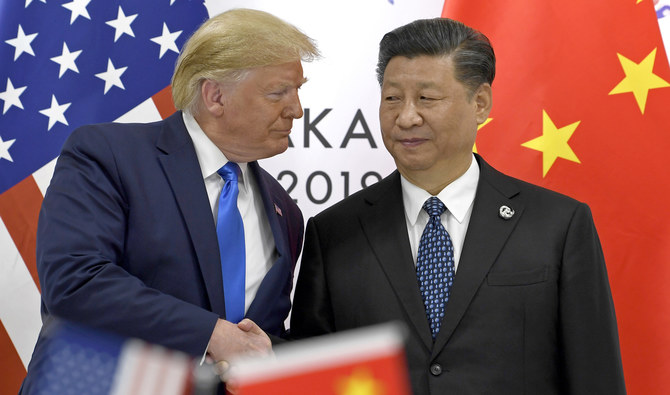
Trump says China trade deal coming, Beijing calls for resolution of dispute
- Trump: China has no choice but to make trade deal
- China opposed to increase in trade tensions -vice premier


Latest updates


Recommended


© 2026 SAUDI RESEARCH & PUBLISHING COMPANY, All Rights Reserved And subject to Terms of Use Agreement.