

Putin, Erdogan in new deal on Idlib

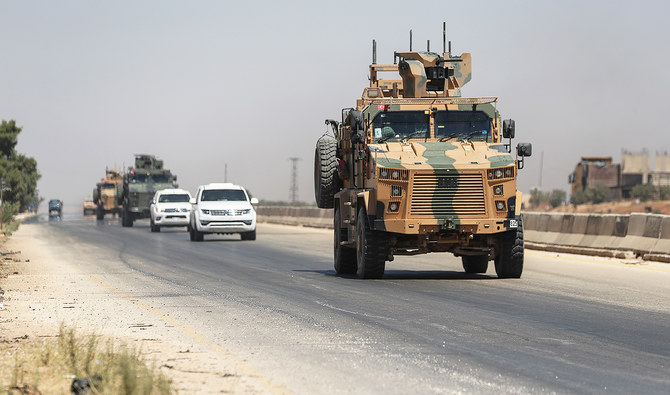
Erdogan said on Tuesday more than 500 civilians had been killed the new attack, which violated last year’s agreement and should halt immediately. (AFP)
Updated 27 August 2019
Follow

Putin, Erdogan in new deal on Idlib

  • We can stabilize northern Syria, two presidents insist after crisis summit in Moscow

ANKARA: Russian and Turkish leaders Vladimir Putin and Recep Tayyip Erdogan moved on Tuesday to paper over the cracks of their conflicting interests in Syria with a joint pledge to “stabilize” the northern province of Idlib.

The two presidents had “reached an understanding on how, and what we can do, to solve these issues in Syria,” Erdogan said after talks in Moscow.

Moscow and Ankara agreed nearly a year ago to de-escalate tensions in Idlib to prevent a bloodbath in Syria’s last opposition stronghold. However, Assad regime forces backed by Russian airstrikes launched a new offensive in April to drive out militants led by Hayat Tahrir Al-Sham, Syria’s former Al-Qaeda affiliate.

Erdogan said on Tuesday more than 500 civilians had been killed the new attack, which violated last year’s agreement and should halt immediately. “It is unacceptable for the regime to rain death on civilians from the air and on the ground under the pretext of fighting terrorism,” he said.
However, Putin insisted the offensive was necessary to uproot militants who used the area as a base to target Russian bases in Syria. “The de-escalation zone cannot serve as a refuge for militants and a platform for launching new attacks,” he said.
Nevertheless, he added: “We understand Turkey’s concern about the security of its southern border and view it as Turkey’s legitimate interest.”

It was clear from their talks that Erdogan and Putin disagree on how to implement their agreement last year in Sochi, analyst Timur Akhmetov told Arab News.

“Turkey seems to have asked for more time to eliminate terrorists in Idlib in its own way, but Russia says Hayat Tahrir Al-Sham is still capable of attacking its positions,” said Akhmetov, a researcher at the Russian International Affairs Council.

“They will try to work something out until their next summit in Turkey.”

Before their talks on Tuesday, Putin and Erdogan visited an airshow outside Moscow, where they inspected Russia’s new Sukhoi Su-35 fighter jet. “There was a lot of interest from our Turkish partners,” Putin said.
The purchase of Russian fighters by Turkey, a NATO member, would further anger Washington after Erdogan bought Russia’s S-400 missile defense system.
In retaliation, the US removed Turkey from its F-35 fighter jet program.

As a result, “more Russian arms sales to Turkey are probably inevitable,” Dr. Theodore Karasik, senior adviser at Gulf State Analytics in Washington, told Arab News.

“The interest by the Turks in the Su-57 signals how Ankara is looking more closely at Russian weapons systems as opposed to Western systems,” he said. “The more Turkey buys from Russia, the less interoperable the equipment becomes with NATO. Turkey cannot keep buying equipment from Russia in this manner because it becomes a security issue within NATO itself. This raises the question of where Turkey sits in the alliance.”


New strikes light up the night in Tehran as Israel vows ‘many surprises’

Updated 58 min 3 sec ago
Follow

New strikes light up the night in Tehran as Israel vows ‘many surprises’

DUBAI: The Iran war exploded further late Saturday as pillars of flame rose above an oil storage facility in Tehran, and Israeli Prime Minister Benjamin Netanyahu promised “many surprises” for the next phase of the week-old conflict.
Israel’s military confirmed that it hit the fuel storage facilities in Tehran. Associated Press video showed the horizon glowing against the night sky above Tehran.
It appeared to be the first time a civil industrial facility has been targeted in the war. State media blamed “an attack from the US and the Zionist regime” at the facility that supplies the capital and neighboring provinces in the north.
Meanwhile, Israeli air strikes killed eight people in southern Lebanon, the Lebanese Health Ministry said, and local media reported that an Israeli drone hit a hotel in Beirut, killing four and wounding 10 others.
The Israeli military said early Sunday that it targeted commanders of the Lebanese branch of Iran’s Revolutionary Guards’ Quds Force in Beirut. The deaths come on top of at least 47 others killed in Saturday’s Israeli strikes.
Strikes and drone attacks in Kuwait, Iraq and Saudi Arabia also caused havoc and some additional deaths.
Earlier in the day, Iranian President Masoud Pezeshkian apologized for attacks on “neighboring countries,” even as his country’s missiles and drones flew toward Gulf Arab states and hard-liners asserted that Tehran’s war strategy would not change.
A rift between politicians looking to de-escalate the war and others committed to battling the United States and Israel could complicate any diplomatic efforts. Conflicting Iranian statements came from two of the three members of the leadership council overseeing Iran since Supreme Leader Ayatollah Ali Khamenei was killed in the war’s opening airstrikes.
Pezeshkian, who is a member of the council, also dismissed US President Donald Trump’s call for Tehran to surrender unconditionally, saying: “That’s a dream that they should take to their grave.”
Trump threatened that Iran would be “hit very hard” and more “areas and groups of people” would become targets, without elaborating. Already, the conflict has rattled global markets and left Iran’s leadership weakened by hundreds of Israeli and American airstrikes.
“We’re not looking to settle,” Trump told reporters Saturday aboard Air Force One. “They’d like to settle. We’re not looking to settle.”
He described the ongoing US operations in Iran as an “excursion” and said issues such as rising gas prices and the safety of Americans would improve once the conflict ends.
Iran makes varying statements on attacks
Pezeshkian’s message, seemingly recorded in a hurry, underlined the limited powers exercised by the theocracy’s leaders over the paramilitary Revolutionary Guard, which controls the hundreds of ballistic missiles targeting Israel and other countries. It answered only to Khamenei and appears to be picking its own targets.
Pezeshkian’s statement said Iran’s leadership council had been in touch with the armed forces and “from now on, they should not attack neighboring countries or fire missiles at them, unless we are attacked by those countries. I think we should solve this through diplomacy.”
The US strikes have not come from the Gulf Arab governments under attack, but from US bases and vessels in the region.
But hard-line judiciary chief Gholam Hossein Mohseni-Ejei, another member of the three-man leadership council, suggested that war strategy will not change.
“The geography of some countries in the region — both overtly and covertly — is in the hands of the enemy, and those points are used against our country in acts of aggression. Intense attacks on these targets will continue,” he posted on X.
As long as US bases are present in the region, “the countries will not enjoy peace,” Iran’s Parliament speaker and a former Revolutionary Guard general, Mohammad Bagher Ghalibaf, said on X.
Iran’s UN mission later suggested, without offering evidence, that strikes on nonmilitary sites “may have resulted from interception by US electronic defense systems.”
Late Saturday, top Iranian security official Ali Larijani asserted in an address carried by state media that “our leaders are united on this issue and have no disagreements with one another.”
He also said the leadership council has requested that “arrangements be made” to convene the Assembly of Experts to choose the next supreme leader, but did not say when.
Trump says the Kurds won’t be involved
Trump said he has ruled out having Kurds join the war, even though Kurdish fighters in the region are willing to assist in efforts to topple the Iranian government.
“The war is complicated enough without having ... the Kurds involved,” Trump told reporters.
Days ago, Kurdish officials told the AP that Kurdish-Iranian dissident groups based in northern Iraq were preparing for a potential cross-border military operation in Iran and that the US had asked Iraqi Kurds to support them.
The US and Israel have targeted Iran’s military capabilities, leadership and nuclear program. The war’s stated goals and timelines have repeatedly shifted as the US has at times suggested it seeks to topple Iran’s government or elevate new leadership.
The fighting has killed at least 1,230 people in Iran, more than 290 in Lebanon and 11 in Israel, according to officials in those countries. Six US troops have been killed.
Incoming missiles from Iran had people heading to bomb shelters again across Israel, with no reports of casualties.
Missile lands at US Embassy compound in Iraq
Three Iraqi security officials said a missile landed on the helicopter landing pad in the US Embassy complex in Baghdad. They spoke on condition of anonymity because they were not authorized to comment publicly. An embassy spokesperson declined to comment. There were no reports of casualties.
It was the first reported strike to land in Baghdad’s heavily fortified Green Zone since the Iran war began. Iran and allied Iraqi militias have launched dozens of attacks on US military bases and other facilities in Iraq since then.
Iraq’s caretaker Prime Minister Mohammed Shia Al-Sudani called the embassy attack a “terrorist act” carried out by “rogue groups.”
Strikes target other Gulf countries
US allies in the Gulf have said the Trump administration did not give them adequate time to prepare for the war.
Hours after Pezeshkian’s apology, the United Arab Emirates said debris from an aerial interception fell onto a vehicle and killed a driver. Four people have now been killed in the UAE since the war began. Authorities have said all were foreign nationals.
Sirens sounded earlier Saturday in Bahrain as Iran targeted the island kingdom. Saudi Arabia said it destroyed drones headed toward its vast Shaybah oil field and shot down a ballistic missile launched toward Prince Sultan Air Base, which hosts US forces.
In Kuwait, authorities said a wave of drones targeted critical infrastructure, including fuel tanks at Kuwait International Airport and a government building in Kuwait City. At least two people were killed by strikes in Iraq’s semi-autonomous Kurdish region.