Indonesia to move capital from sinking Jakarta to Borneo

1 / 3
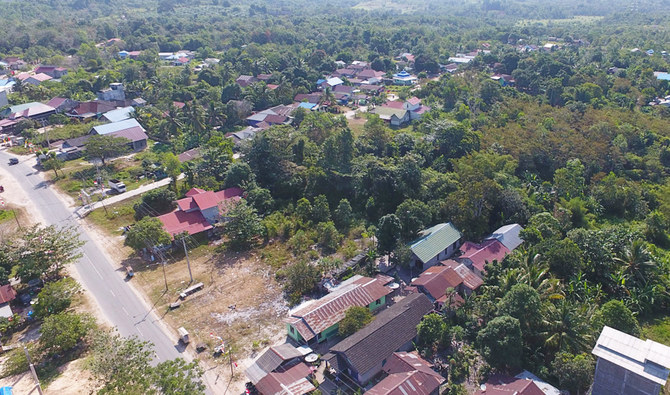
This aerial picture taken on August 16, 2019 by news outlet Tribun Kaltim shows a general view of Samboja, Kutai Kartanegara, one of two locations proposed by the government for Indonesia's new capital. (AFP)
2 / 3
This aerial picture taken on August 16, 2019 by news outlet Tribun Kaltim shows a general view of Samboja, Kutai Kartanegara, one of two locations proposed by the government for Indonesia's new capital. (AFP)
3 / 3
This aerial picture taken on July 31, 2019 by news outlet Tribun Kaltim shows a view of the area around Samboja, Kutai Kartanegara, one of two locations proposed by the government for Indonesia's new capital. (AFP)
Updated 27 August 2019
Follow

Indonesia to move capital from sinking Jakarta to Borneo

  • Infrastructure improvement has been Widodo’s signature policy and helped him win a second term in April elections

JAKARTA, Indonesia: Indonesia’s president says the country’s capital will move from overcrowded, sinking and polluted Jakarta to a site in sparsely populated East Kalimantan province on Borneo island, known for rainforests and orangutans.
President Joko Widodo said Monday intense studies over the past three years had resulted in the choice of the location on the eastern side of Borneo island.
The new capital city, which has not yet been named, will be in the middle of the vast archipelago nation and already has relatively complete infrastructure because it is near the cities of Balikpapan and Samarinda, Widodo said.
He said the burden has been become too heavy on Jakarta on Java island as the center of government, finance, business, trade and services as well as the location of the country’s largest airport and seaport.
Widodo said the decision was made not to move the capital elsewhere on Java because the country’s wealth and people are highly concentrated there and should be spread out.
Currently 54% of the country’s nearly 270 million people live on Java, the country’s most densely populated area.
“We couldn’t continue to allow the burden on Jakarta and Java island to increase in terms of population density,” Widodo said at a news conference in the presidential palace. “Economic disparities between Java and elsewhere would also increase.”
In an interview with The Associated Press last month, Widodo said he wants to separate the center of government from the country’s business and economic center in Jakarta.
Jakarta is an archetypical Asian mega-city with 10 million people, or 30 million including those in its greater metropolitan area. It is prone to earthquakes and flooding and is rapidly sinking due to uncontrolled extraction of ground water. The ground water and rivers are highly contaminated. Congestion is estimated to cost the economy $6.5 billion a year.
Mineral-rich East Kalimantan was once almost completely covered by rainforests, but illegal logging has removed many of its original growth. It is home to only 3.5 million people and is surrounded by Kutai National Park, known for orangutans and other primates and mammals.
Widodo said the relocation of the capital to a 180,000-hectare (444,780-acre) site will take up a decade and cost as much as 466 trillion rupiah ($32.5 billion), of which 19% will come from the state budget and the rest will be funded by cooperation between the government and business entities and by direct investment by state-run companies and the private sector.
He said the studies determined that the best site is between two districts, North Penajam Paser and Kutai Kertanegara, an area that has minimal risk of disasters such as floods, earthquakes, tsunamis, forest fires, volcanic eruptions or landslides in the seismically active nation.
Indonesia’s founding father and first president, Sukarno, once planned to relocate the capital to Palangkaraya in Central Kalimantan province.
Infrastructure improvement has been Widodo’s signature policy and helped him win a second term in April elections.
Decades of discussions about building a new capital on Borneo island moved forward in April when Widodo approved a general relocation plan. He appealed for support for the move in an annual national address on the eve of Indonesia’s independence day on Aug. 16.
He said Monday that his government is still drafting a law on the new capital which will need to be approved by Parliament.


Myanmar, Afghan hopeful scholars mourn UK study visa ban

Updated 4 sec ago
Follow

Myanmar, Afghan hopeful scholars mourn UK study visa ban

  • Myanmar, Afghanistan, Sudan and Cameroon citizens will be barred from obtaining university visas
  • Britain’s travel block is “really painful” for Afghan women hoping to escape to an education abroad, said one female

YANGON, Myanmar: Aspiring students are lamenting Britain’s ban on education visas for their war-weary countries — dashing dreams of bettering themselves and their home nations.
Myanmar, Afghanistan, Sudan and Cameroon citizens will be barred from obtaining university visas, London announced this week, saying asylum applications by visiting students had “rocketed” nearly 500 percent from 2021 to 2025.
“It’s like the country is punishing the weak, the most vulnerable people,” said one woman from Myanmar.
She was preparing for a scholarship interview for a master’s in climate change finance when her plans were upended by Downing Street’s decree on Wednesday.
“I could not focus the whole morning,” the 28-year-old told AFP from Yangon, speaking on condition of anonymity for security reasons in a country riven by civil war since a 2021 military coup.
“I can’t picture my future.”
Like in much of the developed world, immigration has become a divisive issue in Britain.
Efforts to beat back arrivals mirror the sweeping travel bans issued by US President Donald Trump which have shut out citizens of Myanmar, Sudan and Afghanistan.
Since the chaotic military withdrawal of Britain, the United States and other NATO nations in 2021, Afghanistan has been ruled by a resurgent Taliban government which has banned women over age 12 from attending school.
Britain’s travel block is “really painful” for Afghan women hoping to escape to an education abroad, said one female child social worker in Ghazni province, who asked to remain anonymous for security reasons.
She has now canceled her plans to study for a master’s in both the US and the UK.
“Now I am trying to be hopeful, but I think it would also be a mistake,” said the 27-year-old.
In the summer of 2024, Arefa Mohammadi fled to neighboring Pakistan, living in limbo as she applied to universities.
She got an offer to study public health in England but now cannot accept it.
“It was truly shocking for me,” said the 24-year-old.
“This situation put me in a place where I haven’t any goals, because all my goals and all my futures are unpredictable.”

- ‘Cruel and short-sighted’ -
In Kabul, a 39-year-old man faces similar heartbreak.
He was accepted to study specialist subjects related to water management at three universities in England and Scotland.
“When I was a child I witnessed several challenges like flash floods, water scarcity, environmental neglect, inefficient irrigation systems,” he said, asking to remain anonymous for security reasons. “To address these challenges I made my application.”
“I hoped to acquire modern knowledge. It’s impossible to acquire in Afghanistan,” he added.
Some 33 million people in the country face severe water shortages, aid agencies say, a result of compounding multi-year droughts, climate change and infrastructure battered by decades of war.
Britain’s Labour government made the decision to curb visas as the right-wing Reform UK party surges in opinion polls with its hard-line stance against immigration.
The UK Home Office said almost 135,000 asylum seekers had entered the country through legal routes since 2021.
Activist organization Burma Campaign UK called the visa ban “exceptionally cruel and shortsighted.”
“The opportunity to come to the UK to study is life-changing for the individual student but also an investment in the future of Myanmar,” said program director Zoya Phan in a statement.
One exiled Myanmar journalist has been living over the border in Thailand after escaping the military rule which has clamped down on press freedoms.
“When the military coup happened I was just 22, so I had a lot of dreams,” she said. “But over the past five years there have been a lot of struggles — I couldn’t complete my dreams.”
Every year since the junta takeover she applied for further education to buoy her spirits.
But she received an email Thursday morning canceling her place to study for a master’s at a London university.
“Everything is gone,” she said. “My UK dream is all disappeared.”