

Israeli drone strikes on Lebanon ‘equal to declaration of war,’ Aoun tells UN

1 / 2
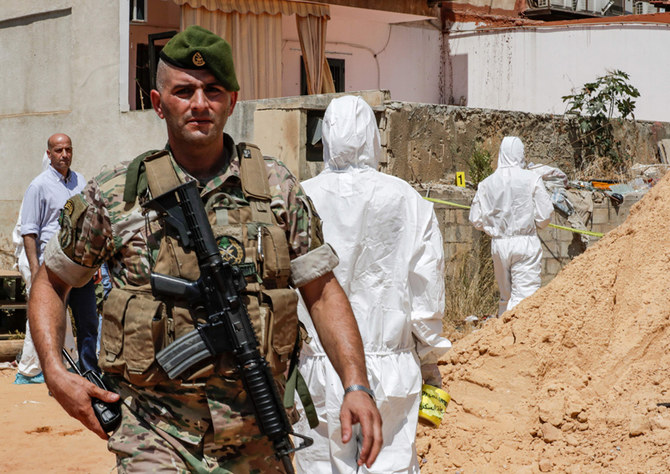
A Lebanese army soldier walks past military intelligence forensic investigators of inspecting the scene where two drones came down in the vicinity of a media center of the Shiite Hezbollah movement earlier in the day, in the south of the capital Beirut on August 25, 2019. (AFP / ANWAR AMRO)
2 / 2
Lebanese President Michel Aoun on Monday said Israel's drone strikes in Lebanon is tantamount to a declaration of war. (Hussein Malla/Pool via REUTERS/File Photo)
Updated 27 August 2019
Follow

Israeli drone strikes on Lebanon ‘equal to declaration of war,’ Aoun tells UN

  • Drones targetted Hezbollah-linked base in Bekaa Valley and and southern Lebanon
  • UN spokesman Stephane Dujarric said the UN took note of Aoun’s statements

BEIRUT: Three Israeli airstrikes on a Palestinian base in eastern Lebanon near the border with Syria were “equal to a declaration of war,” Lebanese President Michel Aoun said on Monday.

The three drone attacks a few minutes apart early on Monday hit a base near Qusaya in the Bekaa Valley of a Syrian-backed group known as the Popular Front for the Liberation of Palestine-General Command, an ally of Hezbollah.

The strikes came a day after an Israeli drone crashed in a Hezbollah stronghold in southern Beirut, and another exploded and crashed nearby. The attacks violated the UN Security Council resolution that ended the 2006 war between Israel and Hezbollah, Aoun told the UN Special Coordinator for Lebanon, Jan Kubis.

“What happened is equal to a declaration of war and gives us the right to defend our sovereignty, independence, and the safety of our land,” Aoun said. “We are people who seek peace and not war, and we don’t accept that anyone threatens us through any means.”

UN spokesman Stephane Dujarric said the UN took note of Aoun’s statements and repeated its appeal to stop violations of the Security Council resolution and implement all its provisions.

“The UN calls on the parties to exercise maximum restraint, both in action and in rhetoric,” Dujarric said.

Lebanese diplomatic expert Riyad Tabarah said the drone incidents in the southern Beirut suburbs were mysterious. “This kind of drone is usually used to target people and not places,” he told Arab News.

“Israel has been using these drones lately in Syria and Iraq to kill Iranians. These drones do not usually explode in the skies. The Israeli technology does not work this way. Plus, there is a difference between the places where the first drone crashed and the second exploded.

“Israeli media said that, according to the images on Lebanese TV channels, the drone that was downed was Iranian, and not made in Israel.”

He said that increasing Israeli pressure against Hezbollah and Iran came from the US, which could not exert this pressure directly. Israel was acting on behalf of the US, to force Iran to come to the negotiating table, he said.

Meanwhile, Israeli drones continued on Monday to fly over the Bekaa Valley and also southern Lebanon, where the United Nations Interim Force in Lebanon (UNIFIL) patrols the border with Israel.

“Our mission is limited to the south of Lebanon,” UNIFIL spokesman Andrea Teneneti told Arab News.  “The Lebanese authorities are handling this part with the relevant authorities.

“We are issuing reports regarding the air violations and focusing on preventing any tensions in the south. Our mission is confined to the south ... and the situation there is stable and calm, just as it was before.”


Fledgling radio station aims to be ‘voice of the people’ in Gaza

Updated 15 February 2026
Follow

Fledgling radio station aims to be ‘voice of the people’ in Gaza

  • The electricity crisis is one of the most serious and difficult problems in the Gaza Strip, says Shereen Khalifa Broadcaster

DEIR EL-BALAH: From a small studio in the central city of Deir El-Balah, Sylvia Hassan’s voice echoes across the Gaza Strip, broadcast on one of the Palestinian territory’s first radio stations to hit the airwaves after two years of war.

Hassan, a radio host on fledgling station “Here Gaza,” delivers her broadcast from a well-lit room, as members of the technical team check levels and mix backing tracks on a sound deck. “This radio station was a dream we worked to achieve for many long months and sometimes without sleep,” Hassan said.

“It was a challenge for us, and a story of resilience.”

Hassan said the station would focus on social issues and the humanitarian situation in Gaza, which remains grave in the territory despite a US-brokered ceasefire between Israel and Hamas since October.

“The radio station’s goal is to be the voice of the people in the Gaza Strip and to express their problems and suffering, especially after the war,” said Shereen Khalifa, part of the broadcasting team.

“There are many issues that people need to voice.” Most of Gaza’s population of more than 2 million people were displaced at least once during the gruelling war.

Many still live in tents with little or no sanitation.

The war also decimated Gaza’s telecommunications and electricity infrastructure, compounding the challenges in reviving the territory’s local media landscape. “The electricity problem is one of the most serious and difficult problems in the Gaza Strip,” said Khalifa.

“We have solar power, but sometimes it doesn’t work well, so we have to rely on an external generator,” she added.

The station’s launch is funded by the EU and overseen by Filastiniyat, an organization that supports Palestinian women journalists, and the media center at the An-Najah National University in Nablus, in the occupied West Bank.

The station plans to broadcast for two hours per day from Gaza and for longer from Nablus. It is available on FM and online.

Khalifa said that stable internet access had been one of the biggest obstacles in setting up the station, but that it was now broadcasting uninterrupted audio.

The Gaza Strip, a tiny territory surrounded by Israel, Egypt, and the Mediterranean Sea, has been under Israeli blockade even before the attack on Oct. 7, 2023, which sparked the war. Despite the ceasefire, Israel continues to strictly control the entry of all goods and people to the territory.

“Under the siege, it is natural that modern equipment necessary for radio broadcasting cannot enter, so we have made the most of what is available,” she said.