

Korea test-fires ‘super-large multiple rocket launcher'

1 / 2
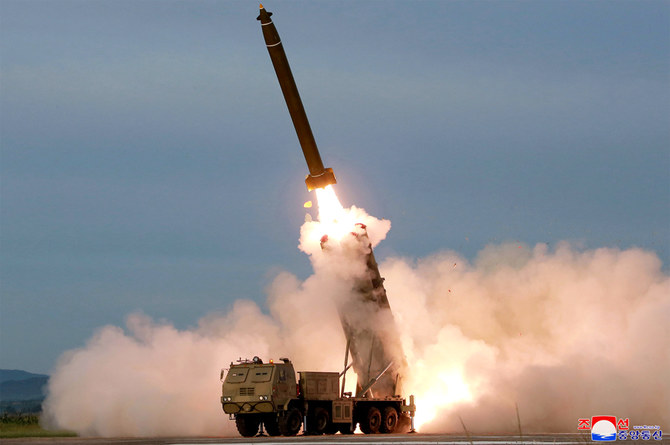
This picture released on August 25 by North Korea's official Korean Central News Agency (KCNA) shows the test-firing of a 'newly developed super-large multiple rocket launcher', at an undisclosed location. (AFP)
2 / 2
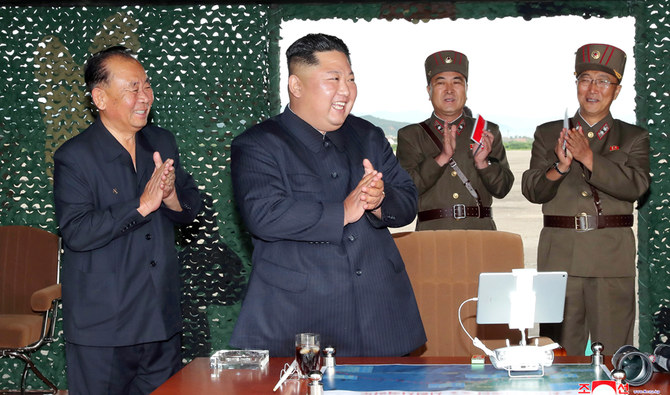
North Korean leader Kim Jong Un attends the test of a multiple rocket launcher in this undated photo released on August 25, 2019 by North Korea's Korean Central News Agency (KCNA). (Reuters)
Updated 25 August 2019
Follow

Korea test-fires ‘super-large multiple rocket launcher'

  • Kim likes testing missiles, says US president
  • Denuclearization talks in trouble

SEOUL: North Korea test-fired a new type of multiple rocket launch system late Saturday into the sea off its east coast, state media reported.

It was the seventh test in a month, as negotiations to scrap the North’s nuclear arsenal flounder.

The North’s official Korean Central News Agency (KCNA) said on Sunday that the latest weapons’ test was on a newly developed “super-large multiple rocket launcher.”

The country’s leader Kim Jong-un oversaw the test and called the device a “great weapon.”

North Korea must step up its development of strategic and tactical weapons to counter the “ever-mounting military threats and pressure offensive of hostile forces,” KCNA reported Kim as saying while he oversaw the testing.

One of the short-range weapons has been identified as a KN-23, a mobile short-range ballistic missile based on the technology of Russia’s Iskander missile, which could hit targets across the South after evading missile interceptors operated by South Korea’s military. Pyongyang maintains that joint South Korea-US military drills are a provocation.

South Korea officials urged the North to stop hostile acts.

“We express strong concern that the North continues to test-fire short-range projectiles despite the South Korea-US military drills ending,” a presidential spokesman told reporters on Saturday. “We urge the North to halt such hostile acts that raise military tensions.”

Despite worries about the North’s provocations that could harm the security of South Korea where 28,500 US armed forces personnel are stationed, US President Donald Trump again touted his friendship with Kim.

“Kim Jong-un has been pretty straight with me, I think, and we’re going to see what’s going on, we’re going to see what’s happening,” he told reporters in Washington before heading to the G-7 summit in France on Friday night. “He likes testing missiles, but we never restricted short-range missiles.”

Trump and Kim held a surprise meeting in the Demilitarized Zone in June and agreed to resume working-level denuclearization negotiations within a month, but such a meeting has yet to be held.

In a further sign that nuclear disarmament talks are barely holding together, the North blamed US Secretary of State Mike Pompeo for complicating the talks, calling him a “diehard toxin.”

“He is truly impudent enough to utter such thoughtless words which only leave us disappointed and skeptical as to where we can solve any problem with such a guy,” North Korea’s Foreign Minister Ri Yong-ho said on Friday in a statement carried by KCNA, referring to Pompeo’s recent remarks in which he said sanctions would be kept until the North took concrete steps to bin nuclear weapons.

US Special Representative Stephen Biegun for North Korea was in Seoul last week to discuss ways to get negotiations back on track but it is not clear if he contacted his North Korean counterpart.

Biegun’s efforts were overshadowed by South Korea’s surprising decision to sever military ties with Japan. 

On Thursday, the presidential Blue House announced it would pull out of an intelligence-sharing agreement with Japan, a key pillar of the US-led trilateral alliance in East Asia to check the influence of China and Russia.

The intelligence pact, called the General Security of Military Information Agreement (GSOMIA), has benefited South Korea’s military to collect key information on North Korean nuclear and missile activities, as Japan operates seven spy satellites while South Korea has no such strategic assets.

The decision to end GSOMIA came amid escalating trade disputes over Japan’s restriction of exporting chip-making materials to South Korea following disputes arising from Japanese colonial rule.


Trump administration labels 3 Muslim Brotherhood branches as terrorist organizations

Updated 13 January 2026
Follow

Trump administration labels 3 Muslim Brotherhood branches as terrorist organizations

  • The State Department designated the Lebanese branch a foreign terrorist organization
  • “These designations reflect the opening actions of an ongoing, sustained effort to thwart Muslim Brotherhood chapters’ violence,” Rubio said

WASHINGTON: President Donald Trump’s administration has made good on its pledge to label three Middle Eastern branches of the Muslim Brotherhood as terrorist organizations, imposing sanctions on them and their members in a decision that could have implications for US relationships with allies Qatar and Turkiye.
The Treasury and State departments announced the actions Tuesday against the Lebanese, Jordanian and Egyptian chapters of the Muslim Brotherhood, which they said pose a risk to the United States and American interests.
The State Department designated the Lebanese branch a foreign terrorist organization, the most severe of the labels, which makes it a criminal offense to provide material support to the group. The Jordanian and Egyptian branches were listed by Treasury as specially designated global terrorists for providing support to Hamas.
“These designations reflect the opening actions of an ongoing, sustained effort to thwart Muslim Brotherhood chapters’ violence and destabilization wherever it occurs,” Secretary of State Marco Rubio said in a statement. “The United States will use all available tools to deprive these Muslim Brotherhood chapters of the resources to engage in or support terrorism.”
Rubio and Treasury Secretary Scott Bessent were mandated last year under an executive order signed by Trump to determine the most appropriate way to impose sanctions on the groups, which US officials say engage in or support violence and destabilization campaigns that harm the United States and other regions.
Muslim Brotherhood leaders have said they renounce violence.
Trump’s executive order had singled out the chapters in Lebanon, Jordan and Egypt, noting that a wing of the Lebanese chapter had launched rockets on Israel after Hamas’ Oct. 7, 2023, attack in Israel that set off the war in Gaza. Leaders of the group in Jordan have provided support to Hamas, the order said.
The Muslim Brotherhood was founded in Egypt in 1928 but was banned in that country in 2013. Jordan announced a sweeping ban on the Muslim Brotherhood in April.
Nathan Brown, a professor of political science and international affairs at George Washington University, said some allies of the US, including the United Arab Emirates and Egypt, would likely be pleased with the designation.
“For other governments where the brotherhood is tolerated, it would be a thorn in bilateral relations,” including in Qatar and Turkiye, he said.
Brown also said a designation on the chapters may have effects on visa and asylum claims for people entering not just the US but also Western European countries and Canada.
“I think this would give immigration officials a stronger basis for suspicion, and it might make courts less likely to question any kind of official action against Brotherhood members who are seeking to stay in this country, seeking political asylum,” he said.
Trump, a Republican, weighed whether to designate the Muslim Brotherhood a terrorist organization in 2019 during his first term in office. Some prominent Trump supporters, including right-wing influencer Laura Loomer, have pushed his administration to take aggressive action against the group.
Two Republican-led state governments — Florida and Texas — designated the group as a terrorist organization this year.