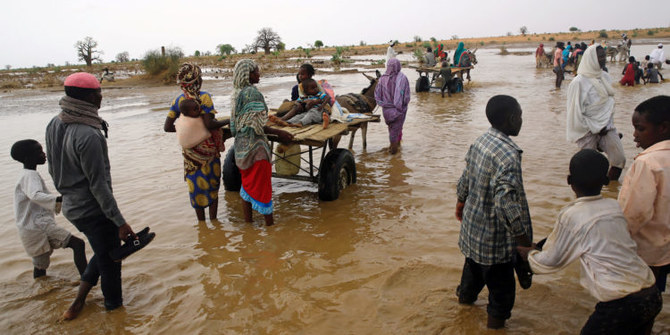
Sudan flood death toll reaches 62: state media

Sudan has been reeling from fresh floods since July. (File/Reuters)
Updated 25 August 2019
Follow

Sudan flood death toll reaches 62: state media

  • Sudan has been hit by torrential rains since the start of July
  • Nearly 200,000 people in at least 15 states across the country have been affected

KHARTOUM: Heavy rainfall and flash floods have killed 62 people in Sudan and left 98 others injured, the official SUNA news agency reported on Sunday.
Sudan has been hit by torrential rains since the start of July, affecting nearly 200,000 people in at least 15 states across the country including the capital Khartoum.
The worst affected area is the White Nile state in the south.
Flooding of the Nile river remains "the biggest problem", SUNA said, citing a health ministry official.
On Friday the United Nations said 54 people had died due to the heavy rains.
It said more than 37,000 homes had been destroyed or damaged, quoting figures from the government body it partners with in the crisis response.
"Humanitarians are concerned by the high likelihood of more flash floods," the UN said, adding that the rainy season was expected to last until October.
The floods are having a lasting humanitarian impact on communities, with cut roads, damaged water points, lost livestock and the spread of water-borne diseases by insects.
The UN Office for the Coordination of Humanitarian Affairs said an extra $150 million were needed from donors to respond to surging waters, in addition to the $1.1 billion required for the overall humanitarian situation in Sudan.


Gaza fuel running short after Israel closes borders amid Iran war

Updated 2 sec ago
Follow

Gaza fuel running short after Israel closes borders amid Iran war

CAIRO/JERUSALEM: Gaza is rapidly running out of its limited fuel supply and stocks of food staples may become tight, officials say, after Israel blocked the ​entry of fuel and goods into the war-shattered territory, citing fighting with Iran.
Israel’s military closed all Gaza border crossings on Saturday after announcing air strikes on Iran carried out jointly with the United States. Israeli authorities say the crossings cannot be operated safely during war and have not said how long they would be shut.
Few days’ worth of supplies
Gaza is wholly ‌dependent on fuel ‌brought in by trucks from Israel ​and ‌Egypt ⁠and a ​lack ⁠of fresh supplies would put hospital operations at risk and threaten water and sanitation services, local officials say. Most Palestinians in Gaza are internally displaced after Israel’s two-year war with Hamas militants.
“I expect we have maybe a couple of days’ running time,” said United Nations official Karuna Herrmann, who directs fuel distribution in Gaza.
Amjad ⁠Al-Shawa, a Palestinian aid leader in Gaza, ‌who works with the UN and NGOs, ‌estimated fuel supplies could last three or ​four days, while stocks ‌of vegetables, flour, and other essentials could also soon run out ‌if the crossings remain shut.
Reuters was unable to independently verify those estimates.
Israel’s COGAT military agency, which controls access to Gaza, said that enough food had been delivered to the territory since the start of ‌an October truce to provide for the population.
“(The) existing stock is expected to suffice for ⁠an extended period,” ⁠COGAT said, without elaborating. It declined to comment on potential fuel shortages.
The truce was part of broader US-backed plan to end the war that involves reopening the Rafah border crossing with Egypt, increasing the flow of aid into the enclave, and rebuilding it.
Hamada Abu Laila, a displaced Palestinian in Gaza, said the closures were stoking fear of a return of famine, which gripped parts of the enclave last year after Israel blocked aid deliveries for 11 weeks.
“Why is it our fault, in ​Gaza, with regional wars ​between Israel, Iran, and America? It is not our fault,” Abu Laila said.