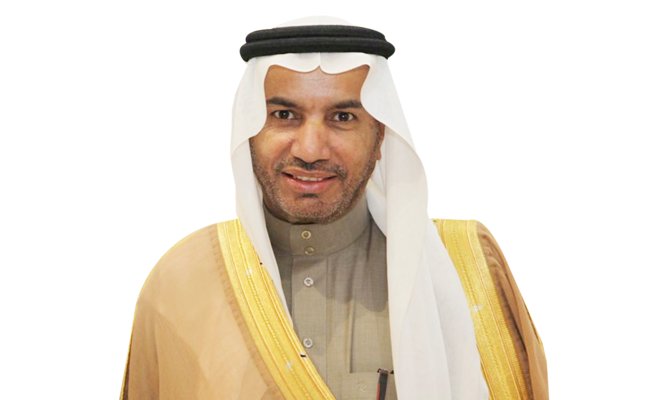
Dr. Rashid bin Mohammed Al-Zahrani, deputy governor of the Technical and Vocational Training Corp.

Dr. Rashid bin Mohammed Al-Zahrani
Updated 24 August 2019
Follow

Dr. Rashid bin Mohammed Al-Zahrani, deputy governor of the Technical and Vocational Training Corp.

Dr. Rashid bin Mohammed Al-Zahrani has been the deputy governor of the Technical and Vocational Training Corp. (TVTC) since 2013. 

He has held several managerial and leadership positions at various government institutions. Before his latest appointment, he was the chairman of the TVTC in Makkah. 

Al-Zahrani is currently heading the Saudi delegation to the 45th edition of WorldSkills, the world championships of vocational skills, in Kazan, Russia.

The competition started in 1950 after the Spanish Workers Union organized the first national vocational competition in Madrid.

Al-Zahrani said: “The competition will see the participation of 1,300 experts from 63 countries in 56 categories. The Saudi delegation will compete in the aircraft maintenance and welding categories after specialists trained them.”

He previously worked as a geotechnical engineer at the High Commission for the Development of Riyadh. He also worked as a teaching assistant at the Technical College in Abha before moving to the US to pursue his postgraduate degrees.

He received a master’s degree in civil engineering and a Ph.D. in geotechnical engineering from the University of Pittsburgh, Pennsylvania.

Al-Zahrani returned to Abha as an assistant professor of civil engineering at the department of civil and architectural technology. He then became the head of the department before being appointed dean of the college.

Following his time in Abha, he moved to the Jazan region to become dean of its technical college and regional chairman of the TVTC. 


Tech executive highlights importance of localizing Saudi Arabia’s AI infrastructure

Updated 8 sec ago
Follow

Tech executive highlights importance of localizing Saudi Arabia’s AI infrastructure

  • Lawrence Yu: Our investment in Saudi Arabia is built around concrete commitments, such as $2 billion strategic investment from Alat
  • Lawrence Yu: If your data centers, servers, and equipment are built and operated in Saudi Arabia, your AI remains yours. It’s secure, inspectable, and fully under local control

RIYADH: Artificial intelligence and data sovereignty took center stage at a Riyadh event on Tuesday, highlighting Saudi Arabia’s push toward locally built digital infrastructure.

Lawrence Yu, head of MEA regional headquarters Saudi Arabia, told Arab News at Lenovo Tech World that the company’s expansion in the Kingdom is supported by long‑term commitments focused on localization and capability building.

The headquarters will be located in Al-Majdoul Tower in Riyadh.

“Our investment in Saudi Arabia is built around concrete commitments, such as $2 billion strategic investment from Alat,” Yu said.

He added that this includes the hiring and training of 100 Saudi engineers, and the launch of a first‑of‑its‑kind manufacturing facility scheduled to open in mid‑2026.

“If your data centers, servers, and equipment are built and operated in Saudi Arabia, your AI remains yours. It’s secure, inspectable, and fully under local control.”

Yu said localizing AI infrastructure is increasingly important as governments and enterprises seek greater ownership of sensitive data and national digital systems.

These initiatives underpin the establishment of Lenovo’s regional headquarters in Riyadh, which will oversee operations across the Middle East and Africa.

Yu added that beyond infrastructure, Saudi Arabia is being positioned as a producer rather than a consumer of advanced technology, helping reshape what “Made in Saudi” represents globally.

“Saudi Arabia should be known for designing, creating and producing world‑class technology,” Yu said.

“When people use a product made here, by Saudi nationals, it changes the perception of the country.”

A central theme of Lenovo Tech World was AI readiness, particularly the need for physical infrastructure capable of supporting large‑scale deployment across government and enterprise sectors.

Yu said that while AI is often discussed in terms of software, its success ultimately depends on advanced hardware that can keep pace with rapid technological change.

“AI does not just work on its own. It needs hardware, and that hardware must continuously evolve with the technology,” he said.

Reliance on outdated or externally hosted infrastructure can limit performance, security, and long‑term sustainability, added Yu.

Locally available infrastructure allows organizations to upgrade systems faster, operate at scale, and retain control over critical workloads.

Producing AI-ready PCs and AI-ready servers in the Kingdom supports Saudi Arabia’s ambition to build sovereign AI capabilities and ensures that national AI initiatives are powered by future-ready infrastructure aligned with Vision 2030.

Yu said collaboration with the Ministry of Investment and Alat has been instrumental in enabling localization and alignment with national priorities.

Lenovo’s upcoming factory in the Special Integrated Logistics Zone near King Khalid International Airport is expected to open in mid‑2026 and will support advanced manufacturing and AI‑ready infrastructure development in the Kingdom.

Reflecting on Saudi Arabia’s technology transformation, Yu said long‑term success depends on clear strategy, strong partnerships, and disciplined execution.

“To make Vision 2030 real, you need strategy, trusted partners, and execution,” Yu said.