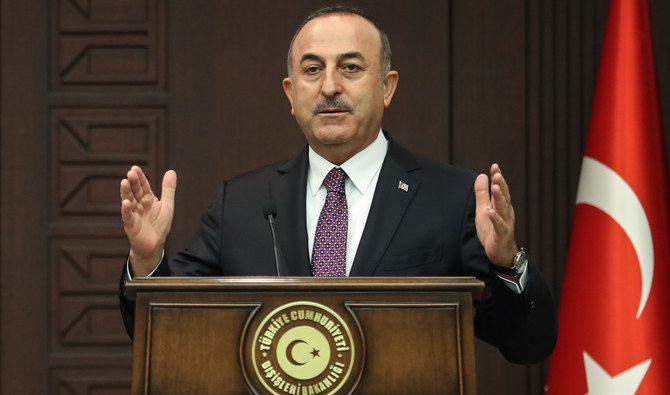
BEIRUT: Turkish Foreign Minister Mevlut Cavusoglu on Friday said Ankara wants “a political solution to the Syrian crisis,” and that its soldiers “will not leave the besieged observation post south of Idlib” after Syrian regime forces took control of the area.
The recent advances by Bashar Assad’s forces have put Turkish troops stationed in the region in the firing line and displaced hundreds of thousands of people, threatening Ankara’s hopes of preventing a fresh wave of refugees on its southern border.
Speaking at a press conference in Lebanon, Cavusoglu said: “We are not there because we are unable to leave but because we do not want to.”
He denied that the Turkish forces are isolated in Morek, where their largest observation post is based. He said: “This post is not encircled, and no one can isolate it. The Syrian regime forces are leading activities in the vicinity of this post, we are discussing this with Russia and Iran.”
His comments followed a telephone conversation between Russian President Vladimir Putin and Turkish President Recep Tayyip Erdogan. According to the Anatolia Agency, Erdogan told Putin that the “developments in Idlib would cause a major humanitarian crisis” and “undermine the process of reaching a settlement in Syria and pose a serious threat to Turkish national security.”
Cavusoglu met with Lebanese President Michel Aoun, Parliament Speaker Nabih Berri, Prime Minister Saad Hariri, and Foreign Minister Gebran Bassil.
Rafic Chlala, the media adviser to Aoun, told Arab News: “The Turkish official gave a presentation on the current military developments in Idlib, and a view of the future was delivered, but he did not ask anything from Lebanon.”
During a joint press conference with Bassil, Cavusoglu said: “Turkey will exchange experiences with Lebanon to return Syrian refugees to their country. Ankara understands Beirut’s suffering from the refugee crisis.”
He added: “Syrian refugees are afraid of returning to their country. This fear must be dispelled, and the international community should give greater importance to meeting the basic needs of Syrians.”
Lebanon hosts over 1 million Syrian refugees, according to the UN High Commissioner for Refugees. Beirut estimates the real figure is over 1.5 million.
Cavusoglu proposed “to organize a joint forum with Lebanon, Jordan and Iraq on the return of Syrians and invite the international community to participate.”
During his meeting with Cavusoglu, Aoun said: “The international community’s continued disregard for the need for Syrian refugees to return to their country raises many questions.”
According to his media office, Aoun said the return of displaced people to their homes remains a common concern for Lebanon and Turkey. He reiterated that the provision of international assistance to refugees inside Syria is an important incentive for their return.
Aoun added: “Until now, Syrian refugees who have returned to Syria under the supervision of the Lebanese General Security did not suffer any persecution. The process of returning refugees will continue in turn.”
Cavusoglu said that Turkey shares Lebanon’s stance in supporting the return of refugees.
He told Aoun that Turkey will vote for Lebanon to establish the Human Academy for Encounter and Dialogue when the item is submitted to the UN on Sept. 13.
Berri’s media office said that talks with Cavusoglu included “the general situation in the region, the need to uphold the legitimate rights of the Palestinian people, the importance of a political solution in Syria that ensures its unity and sovereignty and the return of refugees.”
Cavusoglu said: “Turkey views Lebanon as a neighbor and a sister country. The stability and growth of this country are very important for us and the region. We will continue to support Lebanon, and many Turkish energy companies want to invest there.”
The Turkish president will visit Moscow on Tuesday for a meeting with his Russian counterpart, the presidency said in a statement, days after a Turkish convoy was hit by an airstrike in Syria.
Kremlin spokesman Dmitry Peskov confirmed the Putin-Erdogan meeting on Aug. 27 to the Russian agencies.


![]()

Turkey vows not to quit besieged army post in Syria
Turkey vows not to quit besieged army post in Syria
- Calls for a ‘political solution’ to the crisis

Latest updates


Recommended


© 2026 SAUDI RESEARCH & PUBLISHING COMPANY, All Rights Reserved And subject to Terms of Use Agreement.