

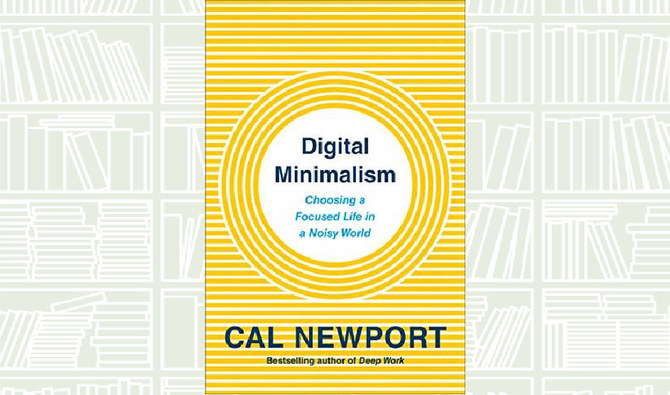
What We Are Reading Today: Digital Minimalism by Cal Newport

Updated 23 August 2019
Follow

What We Are Reading Today: Digital Minimalism by Cal Newport

  • Digital minimalists are all around us

Minimalism is the art of knowing how much is just enough. Digital minimalism applies this idea to our personal technology. It is the key to living a focused life in an increasingly noisy world.

In this timely and enlightening book, the bestselling author of Deep Work introduces a philosophy for technology use that has already improved countless lives, according to a preview published on goodreads.com.

Digital minimalists are all around us. They are the calm, happy people who can hold long conversations without furtive glances at their phones. They can get lost in a good book, a woodworking project, or a leisurely morning run. They can have fun with friends and family without the obsessive urge to document the experience.

Drawing on a diverse array of real-life examples, from Amish farmers to harried parents to Silicon Valley programmers, Newport identifies the common practices of digital minimalists and the ideas that underpin them. 

He shows how digital minimalists are rethinking their relationship to social media, rediscovering the pleasures of the offline world, and reconnecting with their inner selves through regular periods of solitude.

He then shares strategies for integrating these practices into your life, starting with a 30-day “digital declutter” process that has already helped thousands feel less overwhelmed and more in control.


What We Are Reading Today: Island at the Edge of the World

Photo/Supplied
Updated 30 January 2026
Follow

What We Are Reading Today: Island at the Edge of the World

  • Pitts has gone deeper than any other writer in cutting through the miasma of misperceptions that shrouds the island, even if his work sometimes bogs down in numbing detail

Author: Mike Pitts

In his ‘Island at the Edge of the World,’ British archeologist Mike Pitts delves into the misconceptions and legends surrounding a complex ancient culture.
The book is a work of historical revisionism that re-examines the history of Rapa Nui, or Easter Island, using new archeological evidence, a fresh reading of 18th-century European accounts, and the long-overlooked work of early 20th-century anthropologist Katherine Routledge
Pitts’ investigation offers authoritative new insights into what really happened on the island.
Pitts has gone deeper than any other writer in cutting through the miasma of misperceptions that shrouds the island, even if his work sometimes bogs down in numbing detail.
Many questions still remain, but this is the most compelling and comprehensive account yet published of the extraordinary story of Easter Island.