

Russia to send ‘Fedor’ its first humanoid robot into space

1 / 2
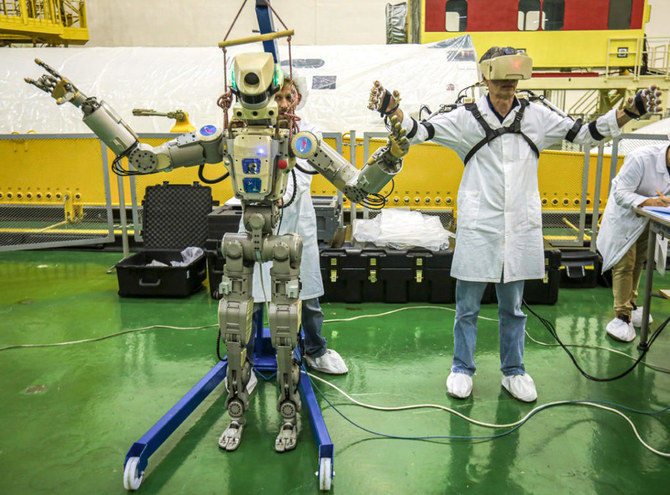
This handout picture taken on July 26, 2019 and released by the official website of the Russian State Space Corporation ROSCOSMOS on August 21, 2019 shows Russian humanoid robot Skybot F-850 (Fedor) being tested ahead of its flight on board Soyuz MS-14 spacecraft at the Baikonur Cosmodrome in Kazakhstan. (AFP)
2 / 2
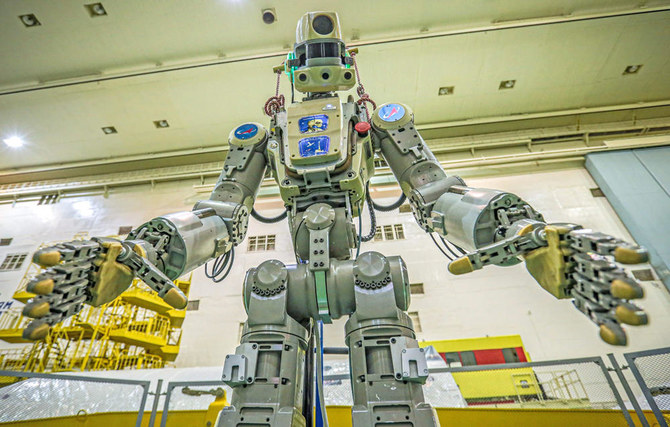
This handout picture taken on July 26, 2019 and released by the official website of the Russian State Space Corporation ROSCOSMOS on August 21, 2019 shows Russian humanoid robot Skybot F-850 (Fedor) being tested ahead of its flight on board Soyuz MS-14 spacecraft at the Baikonur Cosmodrome in Kazakhstan. (AFP)
Updated 22 August 2019
Follow

Russia to send ‘Fedor’ its first humanoid robot into space

  • Fedor was to blast off in a Soyuz rocket at 6:38 am Moscow time (0338 GMT) from Russia’s Baikonur cosmodrome
  • Fedor is not the first robot to go into space

MOSCOW: Russia was set to launch on Thursday an unmanned rocket carrying a life-size humanoid robot that will spend 10 days learning to assist astronauts on the International Space Station.
Named Fedor, for Final Experimental Demonstration Object Research with identification number Skybot F850, the robot is the first ever sent up by Russia.
Fedor was to blast off in a Soyuz rocket at 6:38 am Moscow time from Russia’s Baikonur cosmodrome in Kazakhstan, dock with the space station on Saturday and stay till September 7.
The Soyuz spacecraft is normally manned on such trips, but on Thursday no humans will be traveling in order to test a new emergency rescue system.
Instead of cosmonauts, Fedor will sit in a specially adapted pilot’s seat.

The silvery anthropomorphic robot stands one meter 80 centimeters tall (5 foot 11 inches) and weighs 160 kilograms (353 lbs).
Fedor has Instagram and Twitter accounts that describe it as learning new skills such as opening a bottle of water. In the station, it will trial those manual skills in very low gravity.
“That’s connecting and disconnecting electric cables, using standard items from a screwdriver and a spanner to a fire extinguisher,” the Russian space agency’s director for prospective programs and science, Alexander Bloshenko, said in televised comments.
Fedor copies human movements, a key skill that allows it to remotely help astronauts or even people on Earth carry out tasks while they are strapped into an exoskeleton.
Such robots will eventually carry out dangerous operations such as space walks, Bloshenko told RIA Novosti state news agency.
On the website of one of the state backers of the project, the Foundation of Advanced Research Projects, Fedor is described as potentially useful on Earth for working in high radiation environments, de-mining and tricky rescue missions.
On board, the robot will perform tasks supervised by Russian cosmonaut Alexander Skvortsov, who joined the ISS last month, and will wear an exoskeleton in a series of experiments scheduled for later this month.

Robonaut 2, Kirobo
Space agency chief Dmitry Rogozin showed pictures of the robot to President Vladimir Putin this month, saying it will be “an assistant to the crew.”
“In the future we plan that this machine will also help us conquer deep space,” he added.
Fedor is not the first robot to go into space.
In 2011, NASA sent up Robonaut 2, a humanoid robot developed with General Motors and a similar aim of working in high-risk environments.
It was flown back to Earth in 2018 after experiencing technical problems.
In 2013, Japan sent up a small robot called Kirobo along with the ISS’s first Japanese space commander. Developed with Toyota, it was able to hold conversations — albeit only in Japanese.


Zelensky says meeting with Trump to happen ‘in the near future’

Updated 56 min 2 sec ago
Follow

Zelensky says meeting with Trump to happen ‘in the near future’

  • Zelensky’s announcement came after he said Thursday he had a “good conversation” with US special envoy Steve Witkoff and Trump’s son-in-law Jared Kushner

KYIV: A meeting with US President Donald Trump will happen “in the near future,” Ukrainian President Volodymyr Zelensky said Friday, signaling progress in talks to end the nearly four-year war between Russia and Ukraine.
“We are not losing a single day. We have agreed on a meeting at the highest level – with President Trump in the near future,” Zelensky wrote on X.
“A lot can be decided before the New Year,” he added.
Zelensky’s announcement came after he said Thursday he had a “good conversation” with US special envoy Steve Witkoff and Trump’s son-in-law Jared Kushner.
Trump has unleashed an extensive diplomatic push to end the war, but his efforts have run into sharply conflicting demands by Moscow and Kyiv.
Zelensky said Tuesday he would be willing to withdraw troops from the country’s eastern industrial heartland as part of a plan to end the war, if Moscow also pulls back and the area becomes a demilitarized zone monitored by international forces.
Though Russian Foreign Ministry spokeswoman Maria Zakharova said Thursday that there had been “slow but steady progress” in the peace talks, Russia has given no indication that it will agree to any kind of withdrawal from land it has seized.
In fact, Moscow has insisted that Ukraine relinquish the remaining territory it still holds in the Donbas — an ultimatum that Ukraine has rejected. Russia has captured most of Luhansk and about 70 percent of Donetsk — the two areas that make up the Donbas.
On the ground, Russian drone attacks on the city of Mykolaiv and its suburbs overnight into Friday left part of the city without power.
Meanwhile, Ukraine said it struck a major Russian oil refinery Thursday using British-supplied Storm Shadow missiles.
Ukraine’s General Staff said its forces hit the Novoshakhtinsk refinery in Russia’s Rostov region. “Multiple explosions were recorded. The target was hit,” it wrote on Telegram.
Rostov regional Gov. Yuri Slyusar said a firefighter was wounded when extinguishing the fire.
Ukraine’s long-range drone strikes on Russian refineries aim to deprive Moscow of the oil export revenue it needs to pursue its full-scale invasion. Russia wants to cripple the Ukrainian power grid, seeking to deny civilians access to heat, light and running water in what Kyiv officials say is an attempt to “weaponize winter.”