

Plastic particles in drinking water present ‘low’ risk — World Health Organization

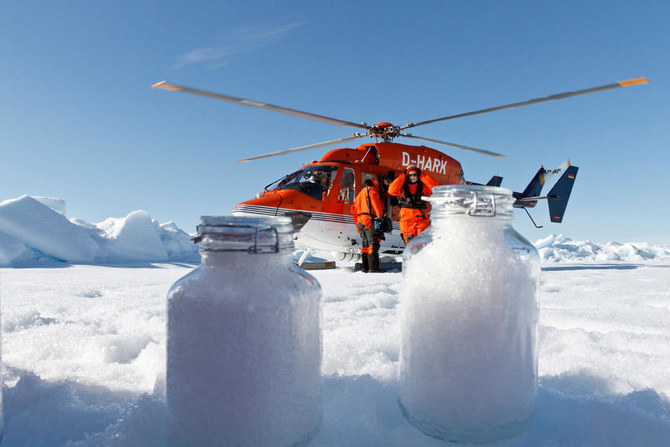
In this August 4, 2017, image courtesy of the Alfred Wegener Institute, scientists from the institute use the helicopter from the icebreaker research vessel Polarstern to collect snow samples in the Arctic. Minute microplastic particles have been detected in the Arctic and the Alps, carried by the wind and later washed out in the snow, according to a study that called for urgent research to assess the health risks of inhalation. (AFP / Kajetan Deja / Alfred-Wegener-Institute)
Updated 22 August 2019
Follow

Plastic particles in drinking water present ‘low’ risk — World Health Organization

  • WHO issues first report on microplastics in drinking water
  • Reassures consumers that risk is low, but says more study needed

GENEVA: Microplastics contained in drinking water pose a “low” risk to human health at current levels, but more research is needed to reassure consumers, the World Health Organization (WHO) said on Thursday.
Studies over the past year on plastic particles detected in tap and bottled water have sparked public concerns but the limited data appears reassuring, the UN agency said its first report on potential health risks associated with ingestion.
Microplastics enter drinking water sources mainly through run-off and wastewater effluent, the WHO said. Evidence shows that microplastics found in some bottled water seem to be at least partly due to the bottling process and/or packaging such as plastic caps, it said.
“The headline message is to reassure drinking water consumers around the world, that based on this assessment, our assessment of the risk is that it is low,” Bruce Gordon of the WHO’s department of public health, environmental and social determinants of health, told a briefing.
The WHO did not recommended routine monitoring for microplastics in drinking water. But research should focus on issues including what happens to chemical additives in the particles once they enter the gastrointestinal tract, it said.
The majority of plastic particles in water are larger than 150 micrometers in diameter and are excreted from the body, while “smaller particles are more likely to cross the gut wall and reach other tissues,” it said.

Health concerns have centered around smaller particles, said Jennifer De France, a WHO technical expert and one of the report’s authors.
“For these smallest size particles, where there is really limited evidence, we need know more about what is being absorbed, the distribution and their impacts,” she said.
More research is needed into risks from microplastics exposure throughout the environment — “in our drinking water, air and food,” she added.
Alice Horton, a microplastics researcher at Britain’s National Oceanography Center, said in a statement on the WHO’s findings: “There are no data available to show that microplastics pose a hazard to human health, however this does not necessarily mean that they are harmless.”
“It is important to put concerns about exposure to microplastics from drinking water into context: we are widely exposed to microplastics in our daily lives via a wide number of sources, of which drinking water is just one.”
Plastic pollution is so widespread in the environment that you may be ingesting five grams a week, the equivalent of eating a credit card, a study commissioned by the environmental charity WWF International said in June. That study said the largest source of plastic ingestion was drinking water, but another major source was shellfish.
The biggest overall health threat in water is from microbial pathogens — including from human and livestock waste entering water sources — that cause deadly diarrheal disease, especially in poor countries lacking water treatment systems, the WHO said.
Some 2 billion people drink water contaminated with faeces, causing nearly 1 million deaths annually, Gordon said, adding: “That has got to be the focus of regulators around the world.”


Uganda army denies seizing opposition leader as vote result looms

Updated 58 min 6 sec ago
Follow

Uganda army denies seizing opposition leader as vote result looms

  • Election day was marred by significant technical problems after biometric machines
  • There were also reports of violence against the opposition in other parts of the country

KAMPALA: Uganda’s army denied claims on Saturday that opposition leader Bobi Wine had been abducted from his home, as counting continued in an election marred by reports of at least 10 deaths amid an Internet blackout.
President Yoweri Museveni, 81, looked set to be declared winner and extend his 40-year rule later on Saturday, with a commanding lead against Wine, a former singer turned politician.
Wine said Friday that he was under house arrest, and his party later wrote on X that he had been “forcibly taken” by an army helicopter from his compound.
The army denied that claim.
“The rumors of his so-called arrest are baseless and unfounded,” army spokesman Chris Magezi told AFP.
“They are designed to incite his supporters into acts of violence,” he added.
AFP journalists said the situation was calm outside Wine’s residence early Saturday, but they were unable to contact members of the party due to continued communications interruptions.
A nearby stall-owner, 29-year-old Prince Jerard, said he heard a drone and helicopter at the home the previous night, with a heavy security presence.
“Many people have left (the area),” he said. “We have a lot of fear.”
With more than 80 percent of votes counted on Friday, Museveni was leading on 73.7 percent to Wine’s 22.7, the Electoral Commission said.
Final results were due around 1300 GMT on Saturday.
Wine, 43, whose real name is Robert Kyagulanyi, has emerged as the main challenger to Museveni in recent years, styling himself the “ghetto president” after the slum areas where he grew up in the capital, Kampala.
He has accused the government of “massive ballot stuffing” and attacking several of his party officials under cover of the Internet blackout, which was imposed ahead of Thursday’s polls and remained in place on Saturday.
His claims could not be independently verified, but the United Nations rights office said last week that the elections were taking place in an environment marked by “widespread repression and intimidation” against the opposition.

- Reports of violence -

Analysts have long viewed the election as a formality.
Museveni, a former guerrilla fighter who seized power in 1986, has total control over the state and security apparatus, and has ruthlessly crushed any challenger during his rule.
Election day was marred by significant technical problems after biometric machines — used to confirm voters’ identities — malfunctioned and ballot papers were undelivered for several hours in many areas.
There were reports of violence against the opposition in other parts of the country.
Muwanga Kivumbi, member of parliament for Wine’s party in the Butambala area of central Uganda, told AFP’s Nairobi office by phone that security forces had killed 10 of his campaign agents after storming his home.