

Appointment of ‘war crime’ Sri Lankan army chief sparks widespread anger

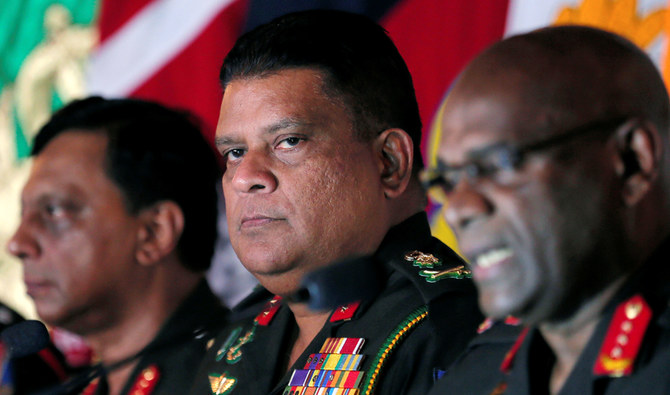
Sri Lankan army chief Shavendra Silva attends a news conference in Colombo, Sri Lanka. (Reuters)
Updated 21 August 2019
Follow

Appointment of ‘war crime’ Sri Lankan army chief sparks widespread anger

  • Allegations against Lt. Gen. Silva ‘serious and credible,’ says US Embassy

COLOMBO: Sri Lanka’s appointment of a controversial wartime commander to a top military post has caused anger, with diplomats, activists and the UN expressing alarm.

Lt. Gen. Shavendra Silva was appointed army commander by President Maithripala Sirisena on Monday. 

Silva, who led the 58th Division of the Sri Lankan Army, has been named in several UN reports for grave violations of international humanitarian law that contributed to war crimes, including the shelling of a hospital.

Armed forces wiped out separatist rebels in 2009 in an operation that ended a decades-long war which killed tens of thousands of people.

The UN has estimated that around 45,000 ethnic Tamil civilians might have been killed in the last months of the war, while other estimates put the number much higher. 

The UN’s High Commissioner for Human Rights Michelle Bachelet condemned the appointment.  “I am deeply troubled by the appointment of Lt. Gen. Shavendra Silva as Commander of the Sri Lankan Army, despite the serious allegations of gross violations of international human rights and humanitarian law against him and his troops during the war.”

The US Embassy in Sri Lanka said the allegations against Silva were “serious and credible.”

HIGHLIGHT

The leader of the National Freedom Front party, Wimal Weeraweansa, denounced the embassy’s remarks and said the US viewed Sri Lanka as one of its colonies.

“This appointment undermines Sri Lanka’s international reputation and its commitments to promote justice and accountability, especially at a time when the need for reconciliation and social unity is paramount,” it said in a statement posted on Twitter.

Dayasiri Jayasekera, general secretary of Sirisena’s Sri Lanka Freedom Party, backed the president’s decision and said the US had no say in domestic affairs.

“During the time of humanitarian operations Silva gave leadership to the 58th battalion to win the war against the Liberation Tigers of the Tamil Eelam,” he said.

The leader of the National Freedom Front party, Wimal Weeraweansa, denounced the embassy’s remarks and said the US viewed Sri Lanka as one of its colonies. “It cannot dictate terms to Sri Lanka, which is an independent democratic country,” he said.

But a spokesman for the Tamil National Alliance, M.A. Sumanthiran, said the move was a “serious affront” to the Tamil people. 

A group seeking accountability for wartime abuses, the International Truth and Justice Project, said the hire was “immensely damaging.”

“After so much bloodshed Sri Lankans need to hold their leaders accountable to stop the repeated cycles of violence,” Yasmin Sooka, the group’s executive director said. “Silva’s promotion, however, sends a message of total impunity.”

Saudi ambassador becomes first foreign envoy to meet Bangladesh’s new PM

Updated 22 February 2026
Follow

Saudi ambassador becomes first foreign envoy to meet Bangladesh’s new PM

  • Tarique Rahman took oath as PM last week after landslide election win
  • Ambassador Abdullah bin Abiyah also meets Bangladesh’s new FM

Dhaka: Saudi Arabia’s ambassador to Dhaka became on Sunday the first foreign envoy to meet Bangladesh’s new Prime Minister Tarique Rahman since he assumed the country’s top office.

Rahman’s Bangladesh Nationalist Party made a landslide win in the Feb. 12 election, securing an absolute majority with 209 seats in the 300-seat parliament.

The son of former Prime Minister Khaleda Zia and former President and BNP founder Ziaur Rahman, he was sworn in as the prime minister last week.

The Saudi government congratulated Rahman on the day he took the oath of office, and the Kingdom’s Ambassador Abdullah bin Abiyah was received by the premier in the Bangladesh Secretariat, where he also met Bangladesh’s new foreign minister.

“Among the ambassadors stationed in Dhaka, this is the first ambassadorial visit with Prime Minister Tarique Rahman since he assumed office,” Saleh Shibli, the prime minister’s press secretary, told Arab News.

“The ambassador conveyed greetings and best wishes to Bangladesh’s prime minister from the king and crown prince of Saudi Arabia … They discussed bilateral matters and ways to strengthen the ties among Muslim countries.”

Rahman’s administration succeeded an interim government that oversaw preparations for the next election following the 2024 student-led uprising, which toppled former leader Sheikh Hasina and ended her Awami League party’s 15-year rule.

New Cabinet members were sworn in during the same ceremony as the prime minister last week.

Foreign Minister Khalilur Rahman is a former UN official who served as Bangladesh’s national security adviser during the interim government’s term.

He received Saudi Arabia’s ambassador after the envoy’s meeting with the prime minister.

“The foreign minister expressed appreciation for the Saudi leadership’s role in promoting peace and stability in the Middle East and across the Muslim Ummah. He also conveyed gratitude for hosting a large number of Bangladeshi workers in the Kingdom and underscored the significant potential for expanding cooperation across trade, investment, energy, and other priority sectors, leveraging the geostrategic positions of both countries,” the ministry said in a statement.

“The Saudi ambassador expressed his support to the present government and his intention to work with the government to enhance the current bilateral relationship to a comprehensive relationship.”

Around 3.5 million Bangladeshis live and work in Saudi Arabia. They have been joining the Saudi labor market since 1976, when work migration to the Kingdom was established during the rule of the new prime minister’s father.

Bangladeshis are the largest expat group in the Kingdom and the largest Bangladeshi community outside Bangladesh and send home more than $5 billion in remittances every year.