



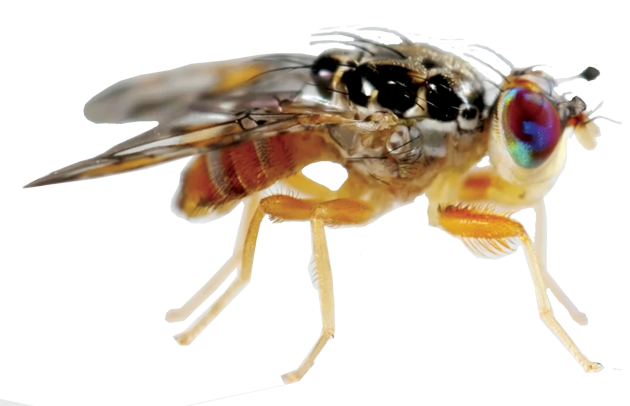
DUBAI: An award-winning startup led by two female Lebanese engineers has created an automated early-warning system that allows Middle East farmers to protect their crops against the Mediterranean fruit fly, one of the world’s most destructive pests.
Fruit flies can devastate entire harvests and have infested over 300 types of vegetables, fruits and nuts globally, causing financial ruin to countless farmers in the Arab world.
However, an ingenious system designed by Nisrine El Turky, a computer engineer and university professor, and Christina Chaccour, an electrical engineer, will tell farmers via text messages and mobile app of the best time to spray pesticides to halt the pests’ advance.
“Many Lebanese farmers weren’t able to export apples because the quality of their produce wasn’t good enough,” said El Turky, co-founder of IO Tree.
“So many I met were desperate to sell a crate of apples for $2 (SR7.50), which is nothing. I wanted to help the sector by better integrating technology.”
Farmers were found spraying too much pesticide to try to kill fruit flies. (Shutterstock)
She began by investigating the difficulties that farmers faced, attending workshops and seminars, and visiting farms. She found the main problem was that farmers were spraying too much pesticide to try to kill fruit flies.
“I found a way that could reduce the use of pesticides and increase production.”
El Turky began working on the IO Tree concept in February 2018 and swiftly built a working prototype, which she showed to Chaccour, who promptly joined the company as a co-founder.
IO Tree’s technology is being tested on farms in Lebanon and the Netherlands. There are two prototype machines — one for indoor use and another for outdoor. The machines can be placed in an orchard, field or greenhouse.
“We need to ensure that the prototype functions in all conditions. Outdoors, there is sun, dust, rain and other weather factors that could disrupt its operation,” said El Turky, who still works up to 10 hours a week as a lecturer at Lebanon’s Notre Dame University.
Using machine learning and artificial intelligence, the machine’s sensors monitor indicators such as temperature and moisture, as well as studying plant stress.
The system can detect and identify pests, providing data on the likely scale of an imminent pest invasion and the best action the farmer should take to combat it. Information is conveyed to the farmer via IO Tree’s app.
“If you’re using pesticides, our app will tell you the best pesticide to use to tackle that problem, the quantity you need and when to spray.”

IO Tree’s sensors use machine learning to measure plant stress. (Supplied photo)
EL Turky said her technology had shown over 90 percent accuracy in identifying medflies.
“Machine learning means that every day the system becomes more accurate,” she said.
“We’re also working on identifying other pests, but medfly is our main target. Once medflies arrive at a farm, they will eat everything.”
IO Tree will enable farmers to use fewer pesticides, reducing environmental damage, while produce will be in better condition and can command a higher sales price.
“By using fewer pesticides, farmers will be better able to preserve biodiversity: Spraying kills a lot more insects than just pests,” she said. IO Tree has initially targeted all types of fruit trees, plus tomatoes and cucumbers, and the product will be launched commercially in September.
“We’re aiming at farmers directly,” said El Turky.
IO Tree’s services will be sold via subscription. After a farmer signs up for one year initially, the company will install its machines at the farm. The number of machines required per acre depends on crop type, crop yield, land topography and other factors.
The company’s initial target market is the Middle East, North Africa and Turkey, though it also plans to expand to Europe and eventually worldwide.
The product’s potential has helped IO Tree win a string of startup competitions. It was selected to represent Lebanon GSVC 2019 (Global Social Venture Competition) at the University of California, Berkeley.
IO Tree also joined Lebanon’s Agrytech accelerator, which provided $44,000 in funding, and schooled the fledgling entrepreneurs in how to create and manage a startup.
• The Middle East Exchange is one of the Mohammed bin Rashid Al-Maktoum Global Initiatives that was launched to reflect the vision of the UAE prime minister and ruler of Dubai in the field of humanitarian and global development, to explore the possibility of changing the status of the Arab region. The initiative offers the press a series of articles on issues affecting Arab societies.




