Saudi civil aviation authority to provide improved Hajj luggage services

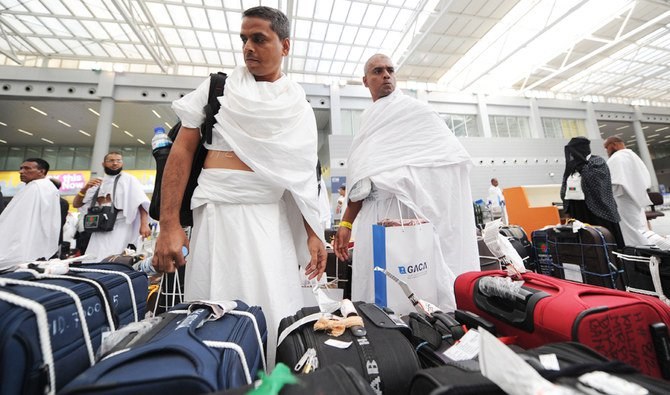
Muslim pilgrims arrive at Jeddah airport in the Saudi capital on July 14,2018. (AFP)
Updated 17 August 2019
Follow

Saudi civil aviation authority to provide improved Hajj luggage services

  • The initiative will make it more convenient for pilgrims to travel and perform Hajj in the coming years
  • Saudi authorities also gave pre-departure immigration facility to pilgrims from a number of countries, including Pakistan

ISLAMABAD: After managing the world’s largest multicultural religious event involving more than 2.4 million Muslims from 130 countries, Saudi Arabia has taken a new initiative to offer improved Hajj luggage services to pilgrims.
According to a report published by the Saudi Press Agency (SPA) on Saturday, the initiative will begin its pilot phase within the next two days and will automatically organize luggage logistics before worshippers arrive at the airport.
The president of the Kingdom’s General Authority for Civil Aviation (GACA), Abdulhadi Al Mansouri, said the idea behind the plan was to improve pilgrims’ services by reducing waiting times at King Abdul Aziz International Airport in Jeddah and Prince Mohammed bin Abdul Aziz International Airport in Madinah.
He added that the initiative would serve about 30,000 pilgrims in the first phase at the airports in Jeddah and Madinah. After this phase was completed, the service would expand to all pilgrims in airports throughout the country.
The Kingdom already extended a pre-departure immigration facility to pilgrims belonging to different countries, including Pakistan, under its ‘Road to Makkah’ program. It also deployed hundreds of young individuals who spoke different languages to assist people from various parts of the world at its airports in Makkah and Madinah.
Saudi Arabia also launched a number of cellphone apps to help pilgrims find emergency service centers, holy sites, currency exchange rates, restaurants and accommodations. Apart from that, it made it easier for people performing Hajj to carry Zamzam water back to their countries.
The new luggage facility at this stage will help people from Indonesia, India and Malaysia, according to the SPA report. It is also likely to make things more convenient for pilgrims to traveling to the Kingdom and performing Hajj in the coming years.


Pakistan vows to play active role against climate change on International Day of Clean Energy 

Updated 26 January 2026
Follow

Pakistan vows to play active role against climate change on International Day of Clean Energy 

  • Governments, civil societies every year mark Jan. 26 as International Day of Clean Energy, calling for inclusive transition to clean power
  • Pakistan ranks among nations most vulnerable to climate change, suffering from erratic weather patterns such as floods, heatwaves, storms

ISLAMABAD: Pakistan will play an active role in global efforts against climate change, President Asif Ali Zardari vowed on Monday as the world marks International Day of Clean Energy today. 

The International Day of Clean Energy is marked every year on Jan. 26 during which governments and civil societies around the world call for awareness on climate change impacts and demand action for a just and inclusive transition to clean energy for the benefit of the people.

Burdened by an energy crisis that has resulted in costly fuel imports over the past couple of years, Pakistan has sought to shift to clean energy to place less burden on its fragile economy. The South Asian country has emerged as one of the world’s fastest growing solar markets, with 12 gigawatts (GWs) of off-grid and over 6GWs of net-metered solar capacity by the end of 2025. In the last fiscal year, renewables accounted for a historic 53 percent of total electricity generation, according to the prime minister’s coordinator on climate change, Romina Khurshid Alam. 

“Pakistan will play an active role in global efforts against climate change,” Zardari was quoted in a statement released by his office. “Investment in safe technologies is essential for the protection of the planet.”
Zardari stressed that clean energy is essential for inclusive development, noting that Pakistan has made the transition toward it a “national priority.”

He said clean energy occupies a central place in the government’s policy framework, adding that Pakistan has set a target of electric vehicles comprising 30 percent of all passenger vehicles and heavy-duty truck sales by 2030. 

The Pakistani president cited air pollution as a major challenge to public health in the country, noting its social and economic costs for the government and the people. 

“Pakistan is committed to building a reliable and sustainable energy system,” he said. 

Pakistan ranks among nations most vulnerable to climate change and has seen erratic changes in its weather patterns that have led to frequent heatwaves, untimely rains, storms, cyclones, floods and droughts in recent years. 

In 2022, monsoon floods killed over 1,700 people, displaced another 33 million and caused over $30 billion losses. Over 1,000 people were killed in floods last year as well due to torrential monsoon rains and floods triggered by climate change impacts and excess water released by Indian dams.