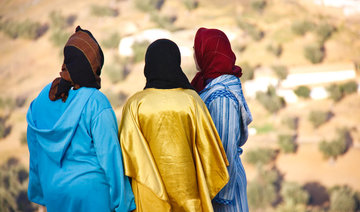
RABAT: Moroccan women seeking to escape harassment at the beach are flocking to Rabat’s vast new public swimming pool instead, but many still eschew swimsuits for fear of voyeurs and disapproving glances.
“Here, there is no harassment and even swearing is forbidden,” said Sanae, a 36-year-old mother who traveled 150 km to take advantage of the new “Grande Piscine” complex, opened on July 4.
“Bathing at the beach is no longer fun for a woman,” she said.
“I was harassed just because I was wearing a bathing suit. Fortunately my husband was there.”
Amal, an 18-year-old student, came to cool off by the pool with her girlfriends. “The beaches have become unpleasant,” she said
Thousands of people are thronging the expansive artificial pools carved into the rocky outcropping of the urban corniche in the Moroccan capital, part of a vast development project dubbed “Rabat, City of Light.”
The aquatic space of 17,000 sq. meters recorded an average of 5,000 visitors per day since its opening, according to an official on the project.
Entrance costs 10 dirhams ($1) — an affordable rate even for less advantaged families that spend summer in the city.
In an increasingly rare sight in Morocco, both young men and women swim and play in the water, while speakers blare out popular music.
It is mainly the sense of security that attracts women in particular: Some 60 security guards and plainclothes police patrol the site, ensuring decorum.
Yet even with the oversight, women are not completely at ease.
Sanae opted to wear shorts and a tank top “because there are a lot of voyeurs.”
She reserves her one-piece swimsuit “for the wild beaches in Morocco or for abroad.”
Like her, many feel “more free” at the pool than at the beach, but prefer to stay clothed and on the deck chairs while their children play in the water under the supervision of lifeguards.
Considered a key tourist asset in Morocco, the numerous beaches on the North African country’s Mediterranean and Atlantic coasts are less inviting for women.
Bathing suits, regardless of their coverage, are considered by some to be offensive, even a sign of “debauchery”.
To swim without the risk of harassment, one must get up early, seek out isolated spots or pay for access to private areas.
“The phenomenon appeared on certain Casablanca beaches in the 90s... Public opinion did not take it seriously and did not react,” sociologist Soumaya Naamane Guessous said.
For her, “it’s a regression mainly related to the spread of Salafist ideas imported from abroad”.
Last summer, a Facebook page called on men to ban women “from going out in indecent attire”.
A campaign was launched on social media to hit back, with women posting photos in bathing suits and using the hashtag #beafreewoman.
“All the men look. It’s annoying. We’re not comfortable”, said Leila, 36, who came with her friend Khadija, 50, on vacation from France.
They too had eschewed bathing suits while by the pool.
Anouar, 32, came from Tangier with his wife -- who wears a veil -- and his daughter.
In his opinion, it is women wearing “disrespectful attire that harass men and families”.
“The trend has become so conservative and so commonplace that women in bathing suits are subject to critical looks or even degrading comments from other women”, Guessous said.
“It’s a mentality that has to change”, the feminist activist said, adding that it’s an attitude that “affects public space in general” in Morocco.
Despite having a reputation for tolerance compared with the rest of the Arab-Muslim world, a study by UN Women in 2017 showed that, for Moroccans, “women who dress provocatively deserve to be harassed”.
The number of women professing this opinion -- 78 percent -- surpassed that of men, at 72 percent.
A law on violence against women adopted in February 2018 included penalties for harassment for the first time, but implementation remains rare.
In early August, a schoolteacher was arrested after he called on social media for three young Belgian women volunteers to be beheaded for wearing shorts while working in the south of the country.Turkey has repeatedly threatened to launch an assault east of the Euphrates river against the YPG, which it says is a “terrorist” offshoot of the outlawed Kurdistan Workers’ Party (PKK), which has waged an insurgency inside Turkey since 1984.
But Washington has worked closely with the YPG in the fight against Daesh.
Little is known about the size of the safe zone and how it will work, but Cavusoglu said there would be observation posts and joint patrols.
He said US President Donald Trump had previously promised it would be 32-km wide.
Turkey previously conducted two offensives into Syria, against Daesh and the YPG, in 2016 and 2018.