WELLINGTON, New Zealand: New Zealand officials admitted Wednesday that they made a mistake by allowing the man accused of killing 51 people at two Christchurch mosques to send a hand-written letter from his prison cell.
The six-page letter from Brenton Tarrant was posted this week on the website 4chan, which has become notorious as a place for white supremacists to post their views. And it comes at a sensitive time, with other alleged killers from El Paso to Norway citing Tarrant as an inspiration.
The letter appears to be written in pencil on a small notepad and is addressed to “Alan” in Russia. Much of it appears to be relatively innocuous, discussing a one-month trip Tarrant says he took to Russia in 2015. But the letter also warns that a “great conflict” is coming and uses language that could be construed as a call to arms.
Corrections Minister Kelvin Davis said in statement that he didn’t believe the prison system should have allowed Tarrant to send the letter.
“I have made myself clear that this cannot happen again,” Davis said.
But Davis also said that all New Zealand prisoners have rights that include the ability to send and receive mail. He said the prison system has the ability to withhold correspondence and withheld some other letters Tarrant had attempted to send or receive.
“We have never had to manage a prisoner like this before — and I have asked questions around whether our laws are now fit for purpose and asked for advice on what changes we may now need to make,” Davis said.
In the letter, dated July 4, Tarrant thanks “Alan” for postage stamps he apparently sent, saying they’re the only two pieces of color in an otherwise gray cell and adds that he’ll have to hide them from the guards.
Tarrant cites Plato and other philosophers and writers as inspiration for his views, and says he “cannot go into any great detail about regrets or feelings as the guards will confiscate my letter if I do” and use it as evidence.
Opposition spokesman David Bennett said Davis needed to demand immediate answers as to how an inflammatory letter could be sent from inside a maximum security prison.
“This man is accused of carrying out one of the most heinous crimes in New Zealand history,” Bennett said in a statement. “New Zealanders will be horrified that Corrections allowed him to send a letter which includes a call to action and has subsequently been posted online.”
Before the March 15 shootings, Tarrant, a 28-year-old Australian white supremacist, posted a 74-page manifesto on the website 8chan in which he outlined his racist views and his beliefs that immigrants were invaders who would replace the white race.
8chan, seen as a more radical offshoot of 4chan, was effectively knocked offline this month after two companies cut off vital technical services in response to claims that the gunman who killed 22 people at a Walmart in El Paso, Texas, posted a racist anti-Latino screed on the site just before the Aug. 3 killings.
Like the Texas gunman, a Norwegian man suspected of killing his stepsister and then storming an Oslo mosque with guns this month is also believed to have found inspiration in Tarrant’s actions.
New Zealand Prime Minister Jacinda Ardern has vowed never to utter Tarrant’s name in order to deny him the publicity she says he craves, making Tarrant’s letter even more of an embarrassment for the government.
It’s not the first misstep by New Zealand authorities in the case. Police initially filed a single representative murder charge against Tarrant but mistakenly named somebody who was still alive before later amending the charge.
Tarrant has pleaded not guilty to terrorism, murder and attempted murder charges following the mosque attacks. He remains in jail ahead of his trial, which has been scheduled for May.

Alleged Christchurch gunman sends letter from prison cell
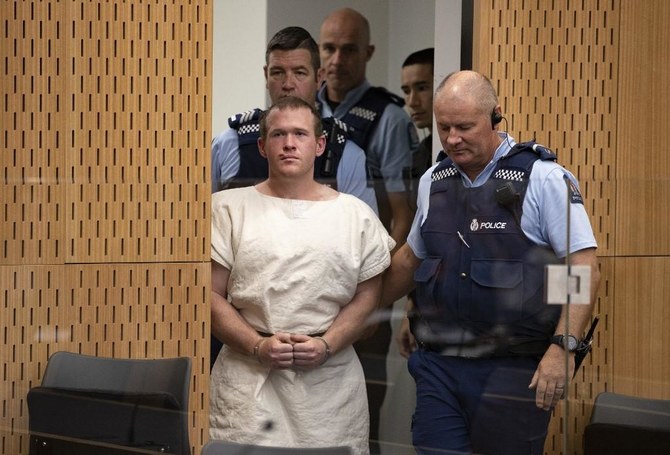
- The letter was published on 4chan
- Tarrant said that a “great conflict” is looming
US envoys juggle two crisis talks, raising questions about prospects for success
- “Trump seems more focused on quantity over quality instead of the difficult detailed work of diplomacy,” said Bruen
- A regional official close to Iran’s leadership said the US team’s double agenda in Geneva reinforced doubts
WASHINGTON/GENEVA/DUBAI: Even for a US president long fixated on deal-making, Donald Trump’s assignment of his favorite envoys to juggle two sets of negotiations – the Iranian nuclear standoff and Russia’s war in Ukraine — in a single day in Geneva has left many in the foreign policy world scratching their heads.
The shuttle diplomacy on Tuesday by US special envoy Steve Witkoff and Trump’s son-in-law Jared Kushner has raised questions not only about whether they are overstretched and outmatched, but about their serious prospects for resolving either of the twin crises, experts say.
Trump, who has frequently boasted about having ended multiple wars and conflicts in the first year of his second four-year term, has made clear he is looking to add more international deals that he can tout in his quest for the Nobel Peace Prize.
But the high-stakes negotiations over the two long-running issues were arranged quickly, and the choice of Geneva as the setting for both was never clearly explained, except for the city’s long history of hosting international diplomacy.
“Trump seems more focused on quantity over quality instead of the difficult detailed work of diplomacy,” said Brett Bruen, who was a foreign policy adviser in the Obama administration and now heads the Global Situation Room strategic consultancy. “Tackling both issues at the same time in the same place doesn’t make a lot of sense.”
Iran was the opening act in a carefully choreographed diplomatic dance in Geneva, where talks took place under high security in two locations on different sides of the Swiss, French-speaking city.
After 3-1/2 hours of indirect discussions between the US team and Iranian Foreign Minister Abbas Araqchi mediated by Oman, both sides indicated that some progress was made, but there was no suggestion that an agreement was imminent in the longstanding dispute over Iran’s nuclear program.
As long as the diplomatic process continues, Trump can keep expanding his massive military buildup near Iran, making clear that use of force remains on the table. That is likely to keep the Middle East on edge, with many fearing that US strikes could escalate into a wider regional war.
’OVERSTRETCH’?
With barely a pause on Tuesday, the US delegates went straight from the Iran talks at Oman’s diplomatic mission to the five-star InterContinental hotel for the first of two days of Russia-Ukraine negotiations over a war that Trump, during the 2024 presidential campaign, had promised to end in a day.
Expectations were low for a breakthrough in the latest round of talks to end Europe’s biggest war since World War Two ended in 1945.
A regional official close to Iran’s leadership said the US team’s double agenda in Geneva reinforced doubts about whether Washington was sincere about either of the diplomatic efforts.
“The approach risks overstretch,” the official, who spoke on condition of anonymity, told Reuters. “It resembles an emergency room with two critically ill patients and a single doctor unable to give either case sustained attention, increasing the likelihood of failure.”
Mohanad Hajj-Ali of the Carnegie Middle East Center in Beirut said there was too much at stake in the Iran crisis for the US to handle diplomacy this way.
“Having a team of Witkoff and Kushner tasked with resolving all the world’s problems is, frankly, a shocking reality,” he said.
Some experts said the two, both from Trump’s world of New York real estate development, lack the depth of knowledge and experience to go up against veteran negotiators like Araqchi and their Russian interlocutors and that they were in over their heads in such complicated conflicts.
Absent from the Geneva meetings was US Secretary of State Marco Rubio, Trump’s top diplomat, who is known as a foreign policy wonk.
Asked for comment, White House spokesperson Anna Kelly said Trump and his team “have done more than anyone to bring both sides together to stop the killing and deliver a peace deal” in Ukraine. She denounced anonymous “critics” of the president’s approach but did not provide answers to Reuters’ specific questions for this story.
’ENVOY FOR EVERYTHING’
Administration officials have long defended Witkoff and Kushner’s roles, citing their skills as dealmakers, the trust Trump puts in them, and the failings over the years of more traditional diplomatic approaches. Witkoff, a longtime Trump friend often called the “envoy for everything” due to his broad remit, played a key role in securing a ceasefire agreement last year between Israel and Hamas in the Gaza war, though progress has stalled toward a more permanent resolution. His diplomatic efforts with Iran and Russia have had little success so far.
In Trump’s first term, Kushner spearheaded the Abraham Accords, under which several Arab states forged landmark diplomatic relations with Israel. But the pact has not advanced much since Trump returned to office nearly 13 months ago.
Kushner and Witkoff’s ability to handle their latest diplomatic tasks has been undercut by Trump’s stripping down of the government’s foreign policy apparatus, both at the State Department and the National Security Council, where many veteran staffers were sent packing, some analysts say.
”We’ve seen a hollowing-out of our diplomatic bench,” said former Obama foreign policy adviser Bruen. “So there’s a question of whether we still have the right people to work on these big issues.”


