MINA: When one thinks of Hajj, the first people to come to mind are the millions of Muslims who come from all corners of the earth to partake in the holiest of all Islamic rites. It is all too easy to forget about the heroes who work tirelessly behind the scenes to make Hajj as safe and organized as possible.
One of the most important groups involved in the safety of pilgrims is the Saudi Civil Defense. Arab News reported back in July that the Civil Defense would dispatch 17,000 officers and 3,000 vehicles to help cover Hajj.
These officers are responsible for numerous tasks, including helping any pilgrim in need, performing crowd control, providing directions, and more. However, due to the sheer mass of pilgrims, they also recruit volunteers to help out.
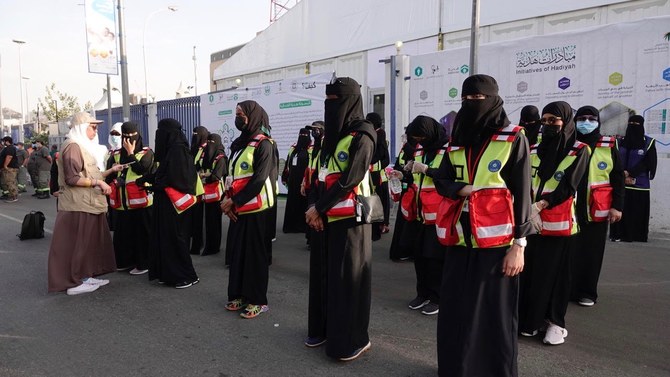
These volunteers, known as the Salaam (Peace) team, are certified by the Ministry of Interior to assist the Civil Defense and are participating in Hajj this year for the third time. One of them, Muneera Al-Draiwish, told Arab News about the various responsibilities that a member of the team has.
“There are 125 of us, separated into about 10 groups. We spread awareness about certain dangerous practices that some pilgrims follow, such as overloading power sockets or leaving their trash in the streets. On Arafat Day, we volunteer as paramedics as well,” she said.
Al-Draiwish added that all volunteers undergo training to be able to assist pilgrims — their first aid training includes basic life support — and to detect safety risks and report infarctions.
She also stressed that while pilgrims may find their instructions annoying, they exist for a good reason. “Even if it seems like we’re trying to make things harder for you, we actually just want to keep you safe,” she said.
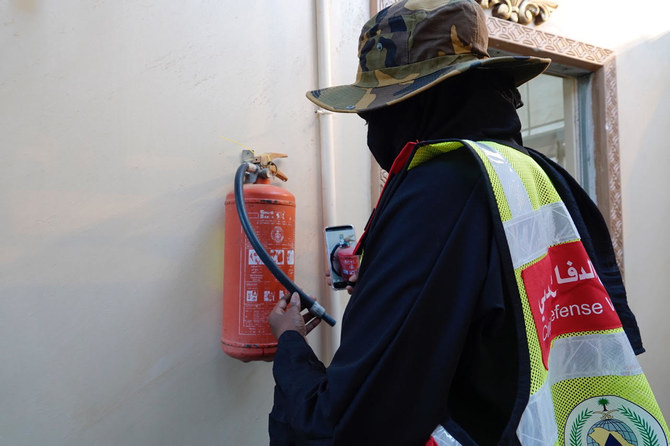
Mashael Al-Fallatah, another volunteer, allowed Arab News to accompany her on an inspection inside one of the camps at Mina, where she scrupulously checked for safety infarctions including overloaded power sockets, overcrowding, expired fire extinguishers, and a lack of clear emergency exit signs.
“We have to check all of these things to make sure they are licensed and conform to safety standards, to ensure safe accommodation for pilgrims,” she said. “The exit signs, for example, should be fluorescent or neon so you can see them in the dark. And an overcrowded room will make it harder for pilgrims to evacuate in case of an emergency. All of these incidents need to be reported and rectified.”
Al-Fallatah says she takes a lot of pride in what she does and told Arab News that she could see the positive results of her and her teammates’ efforts over the past few years. “These pilgrims are guests in my country, and I personally won’t stand to see them put at risk during what should be the greatest experience of their lives,” she explained.
“Things are much better now than they were a few years ago, now that we have a capable team of women to conduct investigations — especially when some of us are mothers and homemakers ourselves,” she added.
Al-Fallatah hopes that those who are planning to perform Hajj will research their options carefully and learn as much as they can about pilgrimage safety before they embark on their journey.
As for those interested in joining their ranks, volunteer Samira Al-Harithy says that the Civil Defense is always looking for people to sign up, and one can easily do so by going to their website or following them on social media.
“We don’t just participate in Hajj, we are also active during the last 10 days of Ramadan, in both Makkah and Madinah,” she said. “It’s a wonderful and fulfilling experience.”


![]()
![]()

The Salaam team: Hajj’s unsung heroes
The Salaam team: Hajj’s unsung heroes
- The whole process of organizing Hajj takes months


Latest updates




© 2026 SAUDI RESEARCH & PUBLISHING COMPANY, All Rights Reserved And subject to Terms of Use Agreement.