

Jordanians enjoy digital Hajj

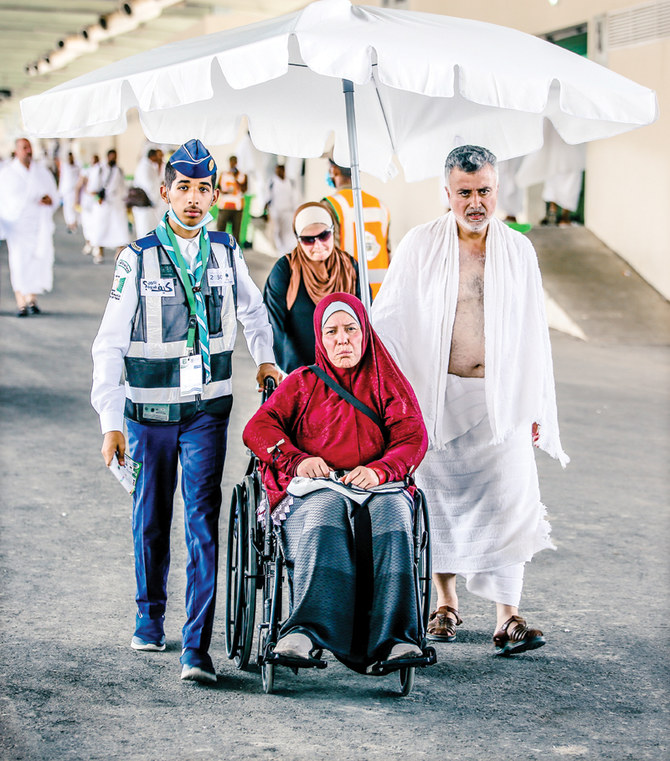
At the dawn of the first day of Eid Al-Adha — the third day of Hajj — hundreds of thousands of pilgrims walked together to Jamarat Al-Aqaba in Mina. (AN photo by Essam Al-Ghalib)
Updated 11 August 2019
Follow

Jordanians enjoy digital Hajj

  • ‘90 percent of all pilgrims today get a visa using the electronic path’

AMMAN: For three years, Dr. Emad Abu Safieh has been filling out online Hajj applications. Every year he fills out two: One for his father Ahmad and his mother Shukrieh, and another for his 71-year old uncle Yousef. 

Safieh, 44, a university professor and dean of the business department at the Arab Open University in Amman, told Arab News that he was happy to help with the posting of Hajj request for his older relatives.

“The site is easy to use; after filling out the details, including contacts and a secondary phone number, a confirmation message is sent to both the basic phone number and the alternative one. Hajj digitalization is happening now and it works well.”

Safieh’s hope to accompany his father did not materialize this year, as only his uncle’s application was accepted. “But at least my dad will go as his companion, and he will also be accompanied by my mother,” Safieh said.

Hajj application digitalization covers both Saudi Arabia’s internal applications and the massive number of visa applications under the title “electronic visa path.” But while the electronic visa path is mostly connected to those wishing to travel by air, companies in countries like Jordan, where the majority of pilgrims prefer the land route, say that the digitization of the Hajj has helped them a lot.

Majdi Batoush, the lead technology officer at Jordan’s Islamic Waqf Department, told Arab News that the electronic path for the Hajj set up by the Saudi Ministry of Hajj has made life much easier for many. “In one site we have all the details and we no longer have to file through loads of paperwork as we used to do in the past.” 

Batoush says that nearly 90 percent of all pilgrims today get a visa using the electronic path created by the Saudi authorities. “Once online, the data can be shared to the benefit of all relevant bodies each as is necessary for their work,” he said.

In one site we have all the details and we no longer have to file through loads of paperwork as we used to do in the past.

Ali Daebess has been working at the Teeba Al-Bawadi Hajj and Umrah Tourist Co. for 19 years. Speaking to Arab News, Daebess explained that the digitalization of the Hajj has made life much easier also for tour companies. “We used to photograph and scan passports five or six times, and we had a ton of paperwork. Now everything is online and much easier.” 
Daebess concedes that most pilgrims are older and are not computer or internet literate. 

“They come to our office and we upload the information for them, we do it for free and it takes a few minutes to post.” The IT specialist, whose company’s Facebook page boasts over 27,000 followers, says that social media has been helpful. “We get a lot of feedback on social media mostly from relatives of pilgrims.”

Although the digital process appears smooth these days, Hajj companies and government officials admit that things were not easy at first. “It was hard at first to adjust and the site was difficult to navigate,” Majdi told Arab News, “but now things are much easier and we are able to process many more applications in a shorter period of time.”


US and Iran slide towards conflict as military buildup eclipses nuclear talks

Updated 28 min 13 sec ago
Follow

US and Iran slide towards conflict as military buildup eclipses nuclear talks

  • Washington building up one of its biggest military deployments in the region since the invasion of Iraq in 2003
  • Iran is expected to submit a written proposal in the coming days, a US official says

Iran and the United States are sliding rapidly towards military conflict as hopes fade for a diplomatic solution to their standoff over Tehran’s nuclear program, officials on both sides and diplomats across the Gulf and Europe say.

Iran’s Gulf neighbors and its enemy Israel now consider a conflict to be more likely than a settlement, these sources say, with Washington building up one of its biggest military deployments in the region since the invasion of Iraq in 2003.

Israel’s government believes Tehran and Washington are at an impasse and is making preparations for possible joint military action with the United States, though no decision has been made yet on whether to carry out such an operation, said a source familiar with the planning.

It would be the second time the US and Israel have attacked Iran in less than a year, following US and Israeli airstrikes against military and nuclear facilities last June.

Regional officials say oil-producing Gulf countries are preparing for a possible military confrontation that they fear could spin out of control and destabilize the Middle East.

Two Israeli officials told Reuters they believe the gaps between Washington and Tehran are unbridgeable and that the chances of a near‑term military escalation are high.

Some regional officials say Tehran is dangerously miscalculating by holding out for concessions, with US President Donald Trump boxed in by his own military buildup - unable to scale it back without losing face if there is no firm commitment from Iran to abandon its nuclear weapons ambitions.

“Both sides are sticking to their guns,” said Alan Eyre, a former US diplomat and Iran specialist, adding that nothing meaningful can emerge “unless the US and Iran walk back from their red lines - which I don’t think they will.”

“What Trump can’t do is assemble all this military, and then come back with a ‘so‑so’ deal and pull out the military. I think he thinks he’ll lose face,” he said. “If he attacks, it’s going to get ugly quickly.”

Two rounds of Iran-US talks have stalled on core issues, from uranium enrichment to missiles and sanctions relief.

When Omani mediators delivered an envelope from the US side containing missile‑related proposals, Iranian Foreign Minister Abbas Araghchi refused even to open it and returned it, a source familiar with the talks said.

After talks in Geneva on Tuesday, Araghchi said the sides had agreed on “guiding principles,” but the White House said there was still distance between them.

Iran is expected to submit a written proposal in the coming days, a US official said, and Araghchi said on Friday he expected to have a draft counterproposal ready within days.

But Trump, who has sent aircraft carriers, warships and jets to the Middle East, warned Iran on Thursday it must make a deal over its nuclear program or “really bad things” will happen.

He appeared to set a deadline of 10 to 15 days, drawing a threat from Tehran to retaliate against US bases in the region if attacked. The rising tensions have pushed up oil prices.

US officials say Trump has yet to make up his mind about using military force although he acknowledged on Friday that he could order a limited strike to try to force Iran into a deal.

“I guess I can say I am considering that,” he told reporters.

The possible timing of an attack is unclear. US Secretary of State Marco Rubio is due to meet Israeli Prime Minister Benjamin Netanyahu on February 28 to discuss Iran. A senior US official said it would be mid-March before all US forces were in place.