LAHORE: On Saturday afternoon, the last ‘friendship’ bus rolled into a quiet terminal in Lahore from Delhi with only three passengers on board, as families divided between Pakistan and India find themselves indefinitely separated by the suspension of all transport services between the two countries following a worsening of bilateral relations this week.
The service, known as the “friendship bus,” has long been seen as a symbolic link between the two countries. Launched in 1999, it has run almost continuously since, and even survived the last crisis between the two countries in February, which brought Delhi and Islamabad to the brink of an all-out war.
On Wednesday, Pakistan announced it would suspend all rail and bus services between the two countries, including the friendship bus service and two cross-border trains— the Samjhota Express and Thar Express, in the wake of India’s decision to revoke special legal status for Jammu and Kashmir.
“My mother belonged to Faridabad, near Delhi. My maternal elders still live there and I used to go there often using the Dosti Bus. The political situation... will make my journey to meet my ancestors impossible,” Begum Elahi, a Lahore-based frequent bus traveler to Delhi, told Arab News.
For Elahi and families like hers, the only cost-effective means of crossing the border into India to reunite with families there has ended, and the alternative are lengthy, expensive flights via transit destinations in the Middle East. Three buses each between Lahore and Delhi would depart their respective terminals every week and then bring passengers back from the other side. The service was available to passengers every day from Monday to Saturday.
“The difficulty is only for the lower and middle class people as the rich from the two countries will take a plane to meet and make Dubai their meeting point. The poor cannot afford this luxury,” Ashiq Hussain, another Lahore-based resident with family in India, told Arab News.
“I met my uncle after 37 years in August 2014, which I think will be the first and last time I meet him, as I do not see the restoration of the service in my lifetime again,” he said.
On Monday, Delhi moved to revoke autonomy of the disputed Kashmir region, which both Pakistan and India lay a claim to, and effectively upped the ante on a dispute that is as old as the countries themselves. As a result, Pakistan downgraded diplomatic relations with its nuclear-armed rival, suspended all bilateral trade, expelled the Indian envoy and has been pressuring the UN and friendly countries to step in.
The last train bound for India left late Friday night following the suspension of the Samjhota express train, which was a favored means of traveling for families divided by the hostile border.
“I always prefer to travel on Samjhota express to meet my in-laws who live in Meerut,” said Abdul Hafiz in Lahore. “The train service is an economical means of transport for lower middle class families going to India for visiting relatives. The suspension will only enhance the distances between us,” he said.
Travelers wanting to cross the border can still do so on foot at the only remaining open border post at Wagah, near Lahore.


For families divided between India and Pakistan, the last friendship bus could mean goodbye forever
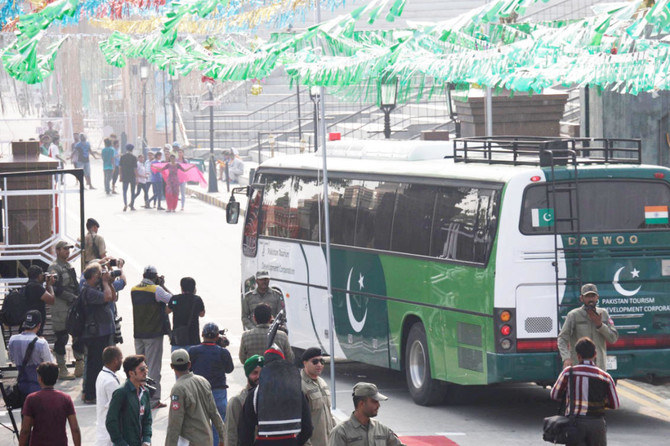
For families divided between India and Pakistan, the last friendship bus could mean goodbye forever

- All transport links between the two countries have been indefinitely suspended
- The only alternative is expensive flights via transit destinations, which the poor cannot afford

Pakistan, Bangladesh explore avenues for cooperation in railways sector
- Islamabad, Dhaka have lately been looking to strengthen institutional linkages to broaden cooperation amid thaw in ties
- Pakistan offers expertise in railway development, rolling stock and manufacturing to visiting Bangladeshi officials
KARACHI: Pakistani and Bangladeshi officials have discussed ways to strengthen cooperation in the railways sector, including technical collaboration and capacity-building, the Pakistani railways ministry said on Saturday, as the two sides explore avenues to expand bilateral ties.
The statement came after a visit of Bangladesh’s Secretary for International Organizations Farhad Islam and High Commissioner to Pakistan Mohammad Iqbal Hussain Khan to the Pakistan Railways Workshop Division in Lahore.
It comes amid Islamabad’s efforts to rebuild relations with Bangladesh since the ouster of former prime minister Sheikh Hasina, with both countries looking to strengthen institutional linkages to broaden their cooperation.
The visiting Bangladeshi officials were welcomed at the Pakistan Railways headquarters and briefed on the overall functioning, technical capabilities and projects, according to the Pakistani railways ministry.
“The delegation was subsequently given a detailed tour of the Mughalpura Locomotive Workshop, where they were briefed on various stages of locomotive maintenance, rehabilitation, and manufacturing processes,” the ministry said.
“The distinguished guests termed their visit as highly informative, productive, and encouraging, and appreciated the technical expertise and professional competence of Pakistan Railways.”
Pakistan and Bangladesh were part of the same country until Bangladesh’s secession following a bloody civil war in 1971, an event that long cast a shadow over bilateral ties.
Both countries have moved closer since August 2024, following the ouster of Hasina who was considered an India ally. While Pakistan-Bangladesh ties warm up, relations between Dhaka and New Delhi remain strained over India’s decision to grant asylum to Hasina.
A short documentary highlighting the working and operational strength of Pakistan Railways workshops was also presented to the Bangladeshi officials during their visit.
“Federal Minister for Railways, Mr. Muhammad Hanif Abbasi, remains fully committed to further strengthening bilateral relations with brotherly country Bangladesh, particularly in the areas of railway development, exchange of expertise, rolling stock, and cooperation in manufacturing sectors,” the railways ministry said.
“Minister has expressed his resolve to take forward railway-to-railway cooperation between the two countries, emphasizing that mutual collaboration in the railway sector can yield substantial benefits for both nations.”


