80 migrants rescued off Libya coast

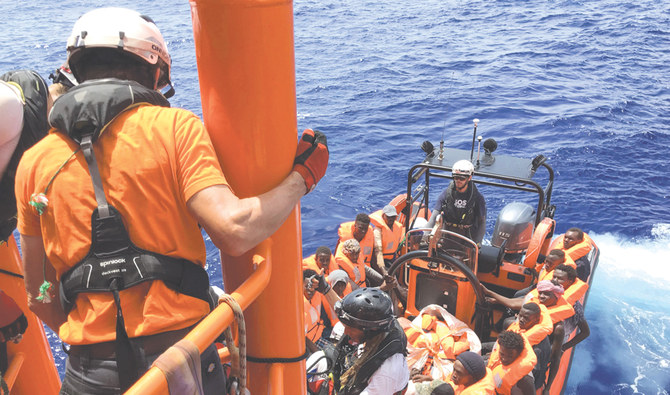
Crew members of the ‘Ocean Viking’ rescue ship, operated by French NGOs SOS Mediterranee and MSF, arrive with rescued migrants on board of a ‘rhib,’ before boarding the rescue vessel on Saturday, following their second rescue operation in the Mediterranean Sea. (AFP)
Updated 10 August 2019
Follow

80 migrants rescued off Libya coast

  • Norway’s minister of justice and immigration, Joran Kallmyr, said on public television that the migrants should be “transported back to Africa, either to Tunisia or Libya”

ON BOARD THE OCEAN VIKING: The Ocean Viking charity ship rescued more than 80 migrants off the coast of Libya on Saturday, according to Doctors without Borders (MSF), which operates the vessel along with the French charity SOS Mediterranee.
The migrants, mainly Sudanese men and adolescents, were picked up after the Ocean Viking rescued 85 people including four children on Friday. The white rubber dinghy was spotted after a plane was seen repeatedly flying over it, MSF mission head Jay Berger said.
European forces regularly patrol the central Mediterranean looking for boats leaving the Libyan coast, particularly during mild weather.
The Ocean Viking sailed toward the area where the plane seemed to be focusing on and found the dinghy, Berger said.
“But the plane never tried to communicate with us,” he added.
Some 170 migrants, all from sub-Saharan Africa, are now on board the Ocean Viking, which left Marseille on Sunday. An AFP journalist is also on board.

Political crisis
Italy’s far-right Interior Minister Matteo Salvini, who has taken a hard line against migrants and this week sparked a political crisis by pulling his support from the country’s governing coalition, has sent a warning to Oslo, where the rescue ship is registered.
“Italy is not legally bound, nor disposed to taken in clandestine, unidentified migrants from on board the Ocean Viking,” he wrote.

HIGHLIGHT

The migrants, mainly Sudanese men and adolescents, were picked up after the Ocean Viking rescued 85 people including four children on Friday.

He has said the same about more than 100 migrants on Spanish charity Proactiva’s Open Arms ship, which Hollywood star Richard Gere boarded on Friday.
Norway’s minister of justice and immigration, Joran Kallmyr, said on public television that the migrants should be “transported back to Africa, either to Tunisia or Libya.”
“They should not be sent to Europe because then this action will be an extension of the refugee route instead of a rescue operation,” Kallmyr said.
Gere, who boarded the Open Arms on Friday, said he had just arrived from the nearby Italian island of Lampedusa.
“We brought as much water and as much food as we possibly can, for everybody on board,” he said.
“Everyone is doing OK now but they were on two boats on the ocean. One of the boats was turned back by the Libyan navy. We don’t know what happened to them.
“The most important thing for these people here is to be able to get to a free port, to be able to get off the boat, to start a new life for themselves.”
Salvini also commented on the American movie star saying he hopes Gere “gets a bit of a suntan.”


Fledgling radio station aims to be ‘voice of the people’ in Gaza

Updated 15 February 2026
Follow

Fledgling radio station aims to be ‘voice of the people’ in Gaza

  • The electricity crisis is one of the most serious and difficult problems in the Gaza Strip, says Shereen Khalifa Broadcaster

DEIR EL-BALAH: From a small studio in the central city of Deir El-Balah, Sylvia Hassan’s voice echoes across the Gaza Strip, broadcast on one of the Palestinian territory’s first radio stations to hit the airwaves after two years of war.

Hassan, a radio host on fledgling station “Here Gaza,” delivers her broadcast from a well-lit room, as members of the technical team check levels and mix backing tracks on a sound deck. “This radio station was a dream we worked to achieve for many long months and sometimes without sleep,” Hassan said.

“It was a challenge for us, and a story of resilience.”

Hassan said the station would focus on social issues and the humanitarian situation in Gaza, which remains grave in the territory despite a US-brokered ceasefire between Israel and Hamas since October.

“The radio station’s goal is to be the voice of the people in the Gaza Strip and to express their problems and suffering, especially after the war,” said Shereen Khalifa, part of the broadcasting team.

“There are many issues that people need to voice.” Most of Gaza’s population of more than 2 million people were displaced at least once during the gruelling war.

Many still live in tents with little or no sanitation.

The war also decimated Gaza’s telecommunications and electricity infrastructure, compounding the challenges in reviving the territory’s local media landscape. “The electricity problem is one of the most serious and difficult problems in the Gaza Strip,” said Khalifa.

“We have solar power, but sometimes it doesn’t work well, so we have to rely on an external generator,” she added.

The station’s launch is funded by the EU and overseen by Filastiniyat, an organization that supports Palestinian women journalists, and the media center at the An-Najah National University in Nablus, in the occupied West Bank.

The station plans to broadcast for two hours per day from Gaza and for longer from Nablus. It is available on FM and online.

Khalifa said that stable internet access had been one of the biggest obstacles in setting up the station, but that it was now broadcasting uninterrupted audio.

The Gaza Strip, a tiny territory surrounded by Israel, Egypt, and the Mediterranean Sea, has been under Israeli blockade even before the attack on Oct. 7, 2023, which sparked the war. Despite the ceasefire, Israel continues to strictly control the entry of all goods and people to the territory.

“Under the siege, it is natural that modern equipment necessary for radio broadcasting cannot enter, so we have made the most of what is available,” she said.