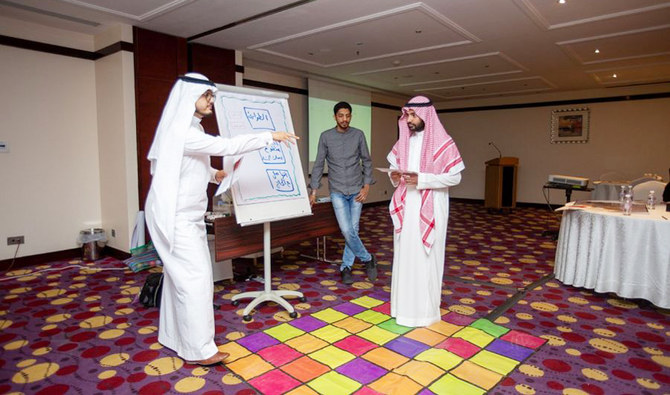
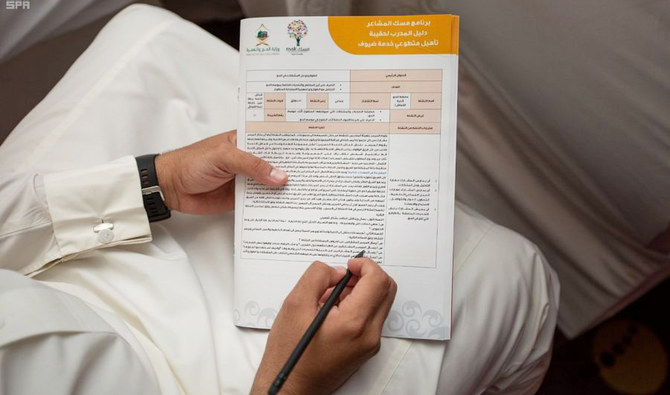
Misk prepares 4,065 volunteers to serve Hajj pilgrims

1 / 4
Volunteers will work under 16 official bodies during Hajj to assist worshippers. (SPA)
2 / 4
Volunteers will work under 16 official bodies during Hajj to assist worshippers. (SPA)
3 / 4
Volunteers will work under 16 official bodies during Hajj to assist worshippers. (SPA)
4 / 4
Volunteers will work under 16 official bodies during Hajj to assist worshippers. (SPA)
Updated 10 August 2019
Follow

Misk prepares 4,065 volunteers to serve Hajj pilgrims

  • The 20-day program took place in 13 cities across Saudi Arabia.

RIYADH: The Center for Initiatives at Prince Mohammed bin Salman bin Abdul Aziz Foundation (Misk) has completed the Misk A-Mashaer program to prepare volunteers for this year’s Hajj season.
The 20-day program took place in 13 cities across Saudi Arabia.
It benefited 4,065 volunteers. They will work under 16 official bodies during Hajj to assist worshippers.
The scale of the pilgrimage presents vast security and logistical challenges, with tens of thousands of safety officers deployed.



Saudi project clears 2,676 explosive devices in Yemen

Updated 22 February 2026
Follow

Saudi project clears 2,676 explosive devices in Yemen

  • Ousama Al-Gosaibi, Project Masam’s managing director, said the initiative had cleared a total of 544,187 mines since it began in 2018

RIYADH: Members of Saudi Arabia’s Project Masam removed 2,108 explosive devices from various regions of Yemen last week.

The total included 2,484 unexploded ordnances, 149 anti-tank mines, 17 anti-personnel mines and 26 improvised explosive devices, according to a recent report.

The explosives were planted indiscriminately and posed a threat to civilians, including children, women and the elderly.

The demining operations took place in Marib, Aden, Jouf, Shabwa, Taiz, Hodeidah, Lahij, Sanaa, Al-Bayda, Al-Dhale and Saada.

Ousama Al-Gosaibi, Project Masam’s managing director, said the initiative had cleared a total of 544,187 mines since it began in 2018.

Teams are tasked with clearing villages, roads and schools to facilitate the safe movement of civilians and delivery of humanitarian aid.

The project trains local demining engineers, provides them with modern equipment, and offers support to Yemenis injured by the devices.