

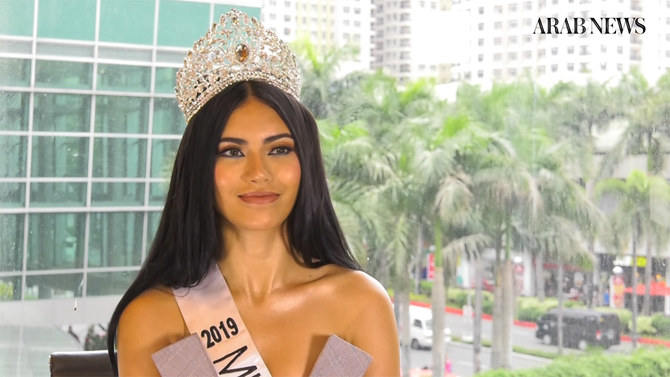


MANILA: She has her father’s eyes and her mother’s hair. And that is good enough for Gazini Christiana Jordi Ganados, 24, who says that even though they are separated, at least on her face her parents are still together.
The half-Palestinian, half-Filipino contender for the Miss Universe pageant this year credits her looks, especially her nose and height, to her Arab-Mediterranean father, whom she hopes to meet some day.
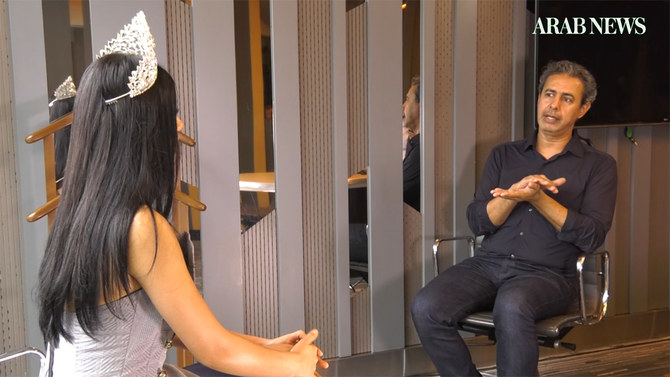
“I’d love to meet him. I have no grudges because that won’t bring me anywhere. But instead I’ll just thank him, and know that he’s still alive,” Ganados told Arab News.
FAST FACTS
- Miss Universe 2019 will take place on Dec. 19.
- Catriona Gray, Miss Universe Philippines 2018, was crowned Miss Universe last year.
- Gazini Christiana Ganados was crowned Miss Universe Philippines 2019 in June.
“I’d be happy to know his side (of the family) and if I have a grandfather or a grandmother. Or maybe I have a stepsister or a brother. I’ve always wanted to have more family since all my life I’ve grown up alone.
While she knows very little about her father Ghassan, Ganados said that besides a photograph, what keeps his memory alive is the fact that she shares her name with him.
“My mother named me after him … My name is Gazini, which is from his name Gazan (from Ghassan); Christiana because my mom is a devout Catholic; Jordi because she told me it means flowing water, and I’m assuming it’s like the Jordan River,” she said.
Born in Dapitan City, in the Philippines’ Zamboanga del Norte province, Ganados began modeling at 15. Her first major break came in the form of a contract with Origin Model Management, which thrust her into the world of glamor and spotlights.
“At 15, I started modeling and supported myself through education. And then I took up nursing care, graduated from it, and then started another course in tourism management,” she said.
By 2014, she had already enlisted to participate in the Miss World Philippines contest, all while setting her sights on the bigger title of Miss Universe.
“I wanted to try another pageant one last time before I embarked on working a stable job … I just gave it my all,” she said.
The hard work paid off in June this year when Ganados beat 40 other Filipinos to win the Miss Philippines title — her ticket to the biggest beauty pageant in the world. It is a dream which she said she has always shared with her single mother.
“I hoped for this day to come, and now I’m Miss Universe Philippines 2019. None of this would’ve been possible without my mother,” she said.
She added that being raised by a single mother “made my foundation very strong.”
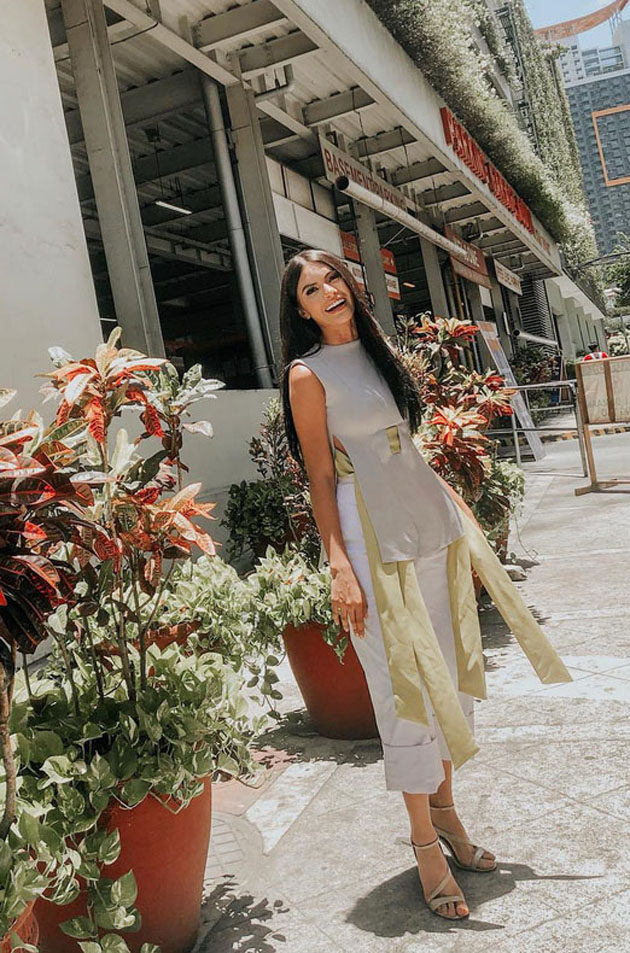
Gazini Christiana Jordi Ganados says she will promote the rights of the elderly if wins the Miss Universe title. (Instagram photo)
Ganados said: “Growing up without a dad has made me a little bit stronger because my mom showed me if men can do something, a woman can do it too … and I’m so proud that I was born and raised by a strong mother.”
If she does win the Miss Universe title, Ganados has committed to promoting the rights of the elderly. “I’m extremely close to my grandparents and therefore want to be an advocate of elderly care. There’s a lack of facilities in our country, and a lot of people can’t work any more because of the age restrictions. I want to incorporate an active lifestyle for elderly people,” she said.
She intends to set up an elderly care center in every province where they can work.
“It’s a place where they can do stitching, or maybe they can create some artwork that can still be sold. And at the same time, they’re earning and still stimulating their mind as well as promoting our local products here in the Philippines. So they’re already earning, plus they’re enjoying being active while aging,” she said.
Ganados said that taking care of the elderly is a major aspect of Filipino culture, something which she shares with her Middle Eastern lineage.
“I’ve heard a lot of good stories about the Middle East: They have a lot of good food. I’ve researched about Palestine on Google. There’s a lot of architecture which is beautiful. I love exploring new cultures and I’m hoping that, maybe some day, I’ll visit,” she said.


