ISLAMABAD: Pakistan’s government said on Tuesday that it was pulling out all stops to implement the Financial Action Task Force’s (FATF) 27-point action plan for anti-money laundering and counter-terrorism measures by ensuring that the actions undertaken are irreversible and sustainable.
Islamabad was formally placed on the FATF’s grey-list in June last year after the 37-member global watchdog found deficiencies in the country’s legal framework to counter-terrorism financing.
The United States had spearheaded the move to place Pakistan on the FATF grey list for its lack of actions against proscribed outfits such as Jaish-e-Mohammad and Jamatud Dawa, both of which were accused of cross border terrorism.
Experts believe that if Pakistan is successful in convincing the US about its recent actions against banned outfits, countering money laundering and terrorism financing, it can have itself removed from the grey list after a final review in October this year.
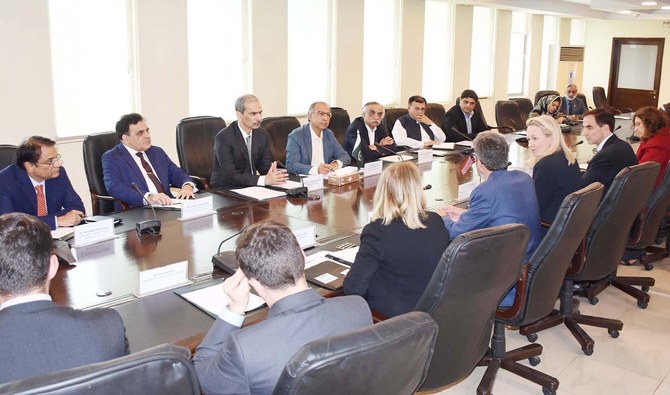
“Pakistan remains committed to enhancing the effectiveness of its AML/CFT Framework, with the objective to ensure that all the actions that are being taken to curb terror financing are irreversible and sustainable,” Abdul Hafeez Shaikh, Adviser to Prime Minister on Finance told a US delegation led by ambassador Alice G. Wells, Acting Assistant Secretary of State for the Bureau of South and Central Asian Affairs.
Shaikh also informed the visiting delegation of the measures undertaken by the government to ensure economic discipline, including the efforts being made toward the implementation of the FATF action plan and the key challenges ahead.
He emphasized the importance of bilateral engagement with the US and the need to encourage entrepreneurs from the private sectors of both the countries for enhanced trade ties.
Shaikh added that over the past three months, the government has taken significant steps to bring financial discipline in the country which included a reduction in current account deficit, focus on increasing revenue generation, measures to reduce fiscal expenditures, reducing fiscal borrowings, efforts to enhance foreign exchange reserves through bilateral and multilateral support, arrangement of a petroleum credit facility with Saudi Arabia and Islamic Development Bank, and an aid program with the International Monetary Fund.
“The US would continue to remain engaged with Pakistan in its economic reforms efforts and help build an environment that facilitates business development between the two countries,” Wells said.
Pakistan is now required to submit a final compliance report on the FATF’s 27-point action plan before August 13, following which the watchdog will decide whether or not to remove Islamabad from the grey-list or downgrade it further.
Dr. Ashfaque Hasan Khan, a senior economist and member of the government’s Economic Advisory Council, said that Wells’ visit to Pakistan is a follow-up of Prime Minister Imran Khan’s recent meetings with President Donald Trump and other top US officials in Washington.
“We have done a lot to implement the FATF’s action plan and this has been briefed to the US team today in detail,” he told Arab News.
Khan expressed hope that Pakistan would be removed from the FATF’s grey list “on the basis of its actions to counter money laundering and terrorism financing, and the US’ support due to our key role in the Afghan peace process.”


![]()

Pakistan took "irreversible" steps to curb terror financing — finance ministry
Pakistan took "irreversible" steps to curb terror financing — finance ministry
- Ministry briefed US delegation on the progress made in implementing FATF plan
- Islamabad hopes to be removed from the global watchdog's grey list by October
Latest updates


© 2026 SAUDI RESEARCH & PUBLISHING COMPANY, All Rights Reserved And subject to Terms of Use Agreement.