

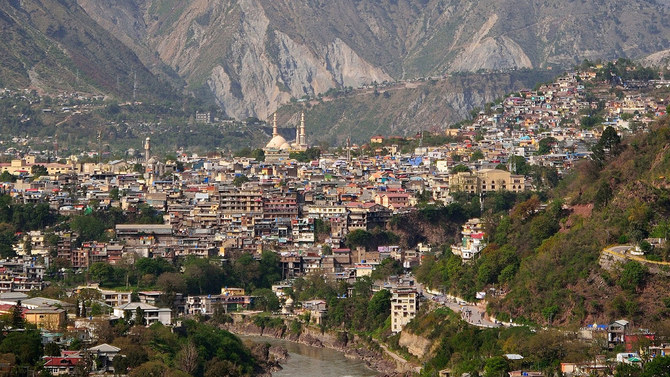



ISLAMABAD/MUZAFFARABAD: Following India’s decision to strip the state of Jammu and Kashmir of autonomy after seven decades, fear and anger gripped Pakistan-administered Kashmir on Tuesday where divided families struggled to reach out to their loved ones under lockdown.
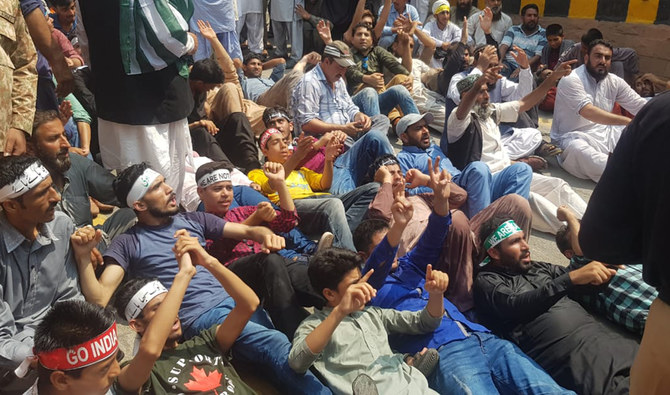
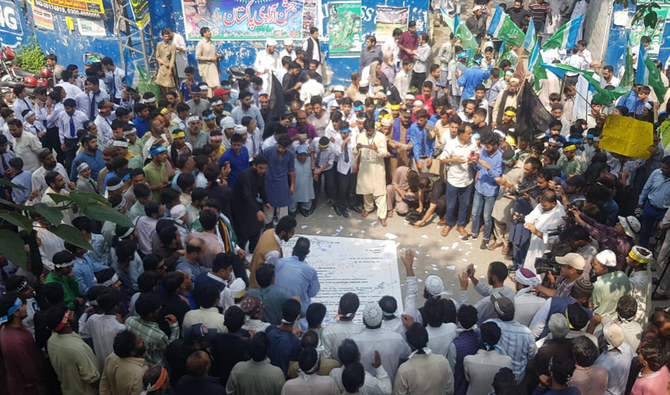
On Monday, hundreds of Kashmiri men, women and students marched from the press club to the office of the United Nations Military Observers and lay on the ground outside its gates in Muzaffarabad, the capital of Azad Jammu and Kashmir in Pakistan.
“India has robbed hundreds and thousands of Kashmiris of their rights and their voice,” Uzair Ahmed Ghazali, a leader of the local organization, Pasban-e-Hurriyat Jammu Kashmir, who participated in the protest said.
“Let me tell you one thing,” he added, “India can do whatever it wants, pass whatever legislation it wants, but it cannot end the disputed nature of Kashmir. Only, we, the Kashmiris, will decide our future.”
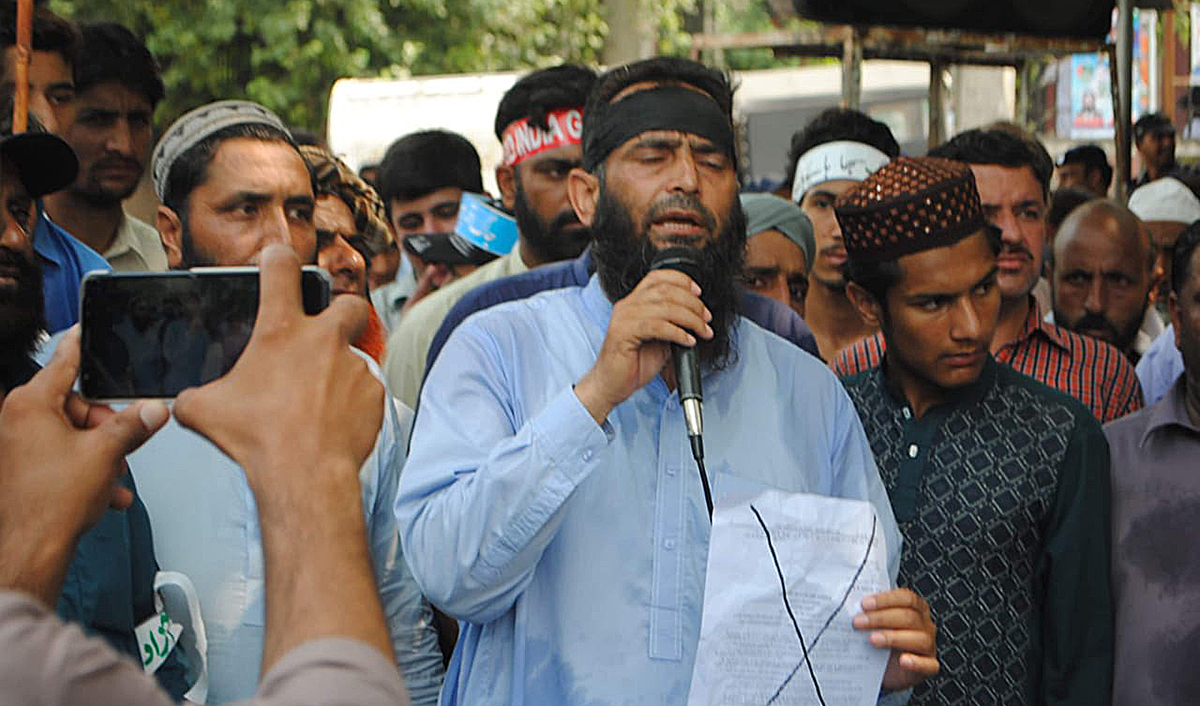
Uzair Ahmed Ghazali. (AN photo by Fayyaz Ahmed)
Ghazali was 15-years-old when he moved from Indian-administered Kashmir to Muzaffarabad in 1990. His mother, two sisters and one brother stayed behind.
For families like Ghazali’s, divided by the Line of Control (LoC) – the de-facto border dividing Kashmir between India and Pakistan – the only means of communication is social media.
The siblings would routinely use WhatsApp or Facebook to check in on one another. “It’s been three days today. I have not been able to talk to my mother or establish any kind of contact with her. I don’t know how she is. I have tried calling, messaging my sister on social media websites, but nothing is working,” he said.
Ahead of the controversial announcement, Internet connections were slowed down in parts of the disputed region, even as telephone lines were cut and local politicians put under house arrest on Sunday. Separately, an extra 10,000 troops were deployed in the Valley.
Nuclear-armed rivals, India and Pakistan, have been locked in a conflict over Kashmir, the only Muslim state in a predominately Hindu India, since 1947. Two years later, Article 370 was included in the Indian constitution to accord special rights to its chunk of Kashmir, which now had autonomy over all other areas except finance, foreign affairs, defense and communications.
A presidential order passed in 1954 under Article 370, known as Article 35A, forbade outsiders from permanently settling in or buying land in the Valley.
On Monday, after 72 years, India revoked the special status, in line with Prime Minister Narendra Modi’s campaign promise, on behalf of the re-elected Hindu nationalist Bharatiya Janata Party (BJP). The same day, Pakistan’s Prime Minister Imran Khan condemned the move, calling it “irresponsible, unilateral and irrational.”
Sardar Muhammad Javed, a journalist who lives less then 10 kilometers from the LoC, in the Tatta Pani area, says there was already a feeling on the Pakistani side that something big was about to happen in Indian-administered Kashmir.
Tensions were rising near the LoC since a couple of weeks due to near daily cross-border shelling, he explained. On Saturday, Pakistan accused Indian of firing banned cluster munitions across the military line, killing two civilians and injuring many others.
“People in my area were confined to their homes,” Javed told Arab News, adding that they were “running short on food, water and medicines.”
“Children are unable to go to schools or colleges and the transportation was shut down as well,” he said.
Yet, a small protest was held in Tatta Pani on Monday, he added, where effigies of Modi and a blown-up copy of the notification revoking the special status were burnt. Young men took to the streets carrying black flags and chanting: “Hai haq humara, Azadi(Independence is our right),” while another banner read: “We would resist India’s move to convert the Muslim majority into minority in Jammu and Kashmir.”
“So many families are divided by the LoC. At the moment, there is only anxiety and fear in the region. Families cannot reach their loved ones on the other side. There only source of information is the media,” Javed said.
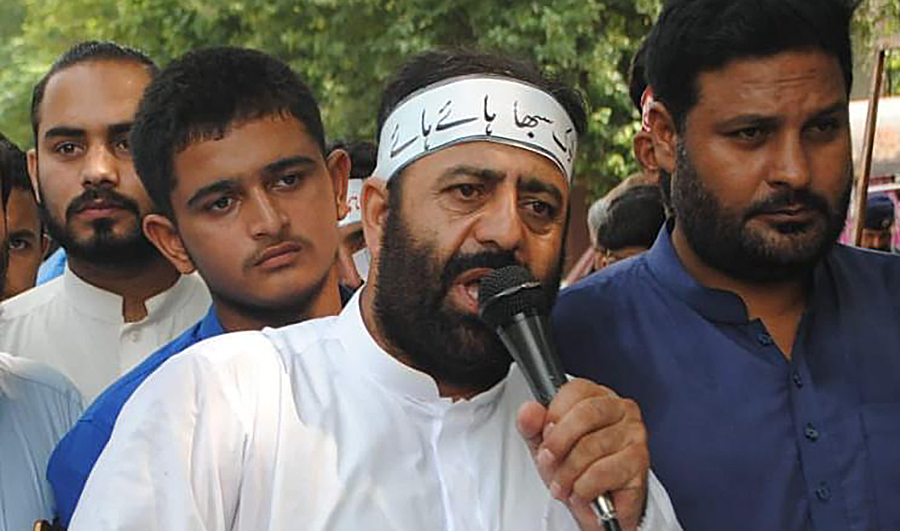
Mushtaq Ul Islam. (AN photo by Fayyaz Ahmed)
Mustaq ul Islam last spoke to his brothers, who live in Indian-administered Kashmir, on Sunday. One of his brother described the situation outside his window. “He told me it was terrible seeing so many soldiers roaming the streets with heavy weaponry. He had not felt this scared in a while.”
Islam says he has repeatedly pleaded with his family to move to Pakistan.
“But they never listen. They tell me their struggle is for independence. They don’t want to run away especially now. Now, when it is a do or die moment. Our biggest fear is that just like the Israelis gradually turned the majority of Palestinians into a religious minority by creating more and more Jewish settlements over the lands owned by the Palestinians, similarly India will turn the majority Muslim Kashmiri population into a ethnic minority by bringing in more and more Hindus from all over India, giving them special incentives to live, invest and establish businesses.”


