

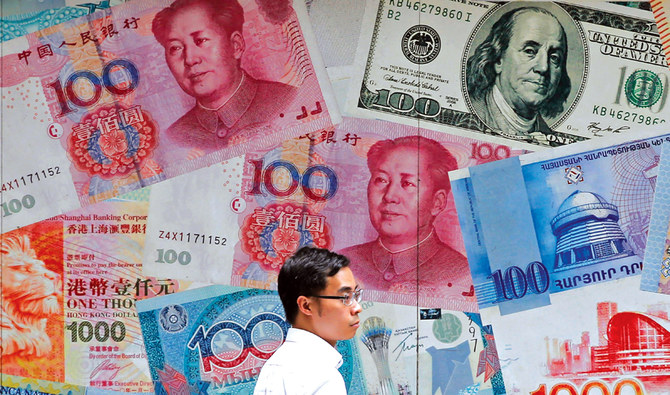

SHANGHAI: China’s decision to let its currency weaken against the dollar Monday sent global markets diving further into the red and provoked a Twitter tirade from US President Donald Trump.
The deteriorating picture appeared to worsen as official Chinese media reported Beijing ceased purchases of American farm exports.
The Chinese yuan fell to its lowest level against the dollar since August 2010 in morning trading on Monday, fueling speculation that Beijing is allowing currency depreciation to counter threatened US tariffs.
US President Donald Trump reacted angrily later in the day, accusing China of deliberately and improperly weakening its currency.
“China dropped the price of their currency to an almost a historic low. It’s called ‘currency manipulation.’ Are you listening Federal Reserve?” he said on Twitter, calling the change “a major violation” which would “greatly weaken China.”
Near 1335 GMT, the offshore currency weakened to 7.1114 to the dollar — the worst since 2010 — days after Trump announced a plan to impose fresh tariffs on another $300 billion in Chinese goods, sharpening trade war tensions between the world’s two biggest economies.
The onshore yuan also tumbled, hitting 7.0536 in Monday morning trade to reach its lowest level since 2008.
Global equity markets were in selloff mode, with major indices in Asia, Europe and the United States down two percent or more.
The Dow Jones Industrial Average was down about 840 points around 1850 GMT.
Both the onshore and offshore yuan breached the 7.0 level against the dollar for the first time in nine years, which investors see as a key threshold in currency value.
Trump has frequently accused China of artificially depreciating its currency in order to support its exports — charges long denied by Beijing.
So far the US Treasury Department has not formally accused China of currency manipulation.
Trump jolted global stock markets last week when he announced more tariffs just a day after US and Chinese trade negotiators revived talks aimed at ending the year-long trade dispute.
The extra 10 percent duties Trump plans to implement from September 1 would mean he has now targeted virtually all of the roughly $550 billion in goods America buys from China every year.
Official news agency Xinhua said Monday the new tariffs “seriously violated the consensus” that Trump had reached with Chinese President Xi Jinping in June.
China on Friday had threatened to retaliate against any new US tariffs — it has already imposed its own duties on $110 billion worth of American goods, almost all of the American products it imports.
The yuan is not freely convertible and the government limits its movement against the US dollar to a two percent range on either side of a central parity rate which the People’s Bank of China (PBOC) sets each day to reflect market trends and control volatility.
The daily central rate was at 6.9225 per dollar on Monday, 0.33 percent weaker from Friday.
“It appears that the tariffs hike suggests the return of tit-for-tat moves and a suspension of trade talks, and the PBOC sees no need to keep the yuan stable in the near term,” Ken Cheung, a senior currency strategist at Mizuho Bank, told Bloomberg News.
In a statement on Monday morning, the PBOC said the exchange rate against the US dollar had been “affected by unilateralism and trade protectionism measures and the imposition of tariff increases on China.”
The central bank said the yuan remained “stable and strong against the basket of currencies” and said it would “resolutely crack down on short-term speculation and maintain stable operation of the foreign exchange market and stabilize market expectations.”
It went on to say that it had the “experience, confidence and ability to keep the RMB exchange rate basically stable at a reasonable and balanced level.”
Julian Evans-Pritchard, senior China economist with Capital Economics, said the PBOC has “effectively weaponized the exchange rate” by linking the currency with the US trade war.
“Given that their goal is presumably to offset some of the impact from additional US tariffs, they are likely to allow the currency to weaken further, probably by 5-10 percent over the coming quarters,” said Evans-Pritchard.


