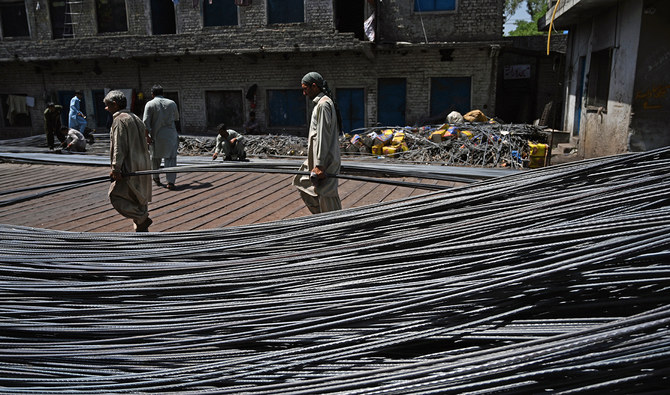
KARACHI: With the formal approval of Saudi investors, Pakistan’s first local iron-ore steel mill project, under the Punjab Mineral Company (PMC), would be set up in Chiniot within a span of two years, Dr. Samar Mubarakmand, Pakistan’s nuclear scientists and chairman of PMC, told Arab News on Monday.
The PMC project topped the list of the four potential projects selected by the federal government for Saudi investment under the recently agreed investment strategy.
Pakistan and Saudi Arabia had signed $21 billion worth of projects including $11 billion oil refinery and petrochemical complex during the visit of Saudi Crown Prince, Muhammad Bin Salman, in February this year.
“When the government informed us that Saudis are interested in investing in mining sector, all the provinces came up with proposals. Punjab government presented the proposal drafted by PMC for steel mill to be set up in Chiniot,” Dr. Mubarakmand added.
The decision to select the projects was held last week in a meeting chaired by Shahzad Syed Qasim, Special Assistant to the Prime Minister on Coordination of Marketing and Development Resources.
Dr. Mubarakmand said, “the next step would be that Saudi investors will take detailed presentation of the project, visit the site, and inspect the existing facilities.”
“The Germans working on the project and our people would give presentation. Upon confirmation of investment, the steel mill would be set up within two years’ time. Mining and setting up of steel mills will continue simultaneously, Dr. Mubarakmand noted.
Top international consulting firms have been engaged through competitive bidding to complete the tasks on global best practices to facilitate the investors, he said.
All the international companies have confirmed the presence of the deposits of iron ore in the area, added the official.
Dr. Mubarakmand informed that the steel mill can have the capacity of 1 million ton. “The existing deposits of iron ore are enough to last for 50-60 years. Besides, the coal that would be used by the steel mill has also been measured by conducting a feasibility study,” he added.
Other projects that were picked for Saudi investment include Barite-Lead-Zinc project, development of metallic mineral resources in Chagai in southern Baluchistan province and coal gasification in Thar area of Sindh.
Dr. Mubarakmand and his team had initiated a pilot project of underground gasification back in 2012 but a change in the political regime led to the abandonment of the project.
“Brand new machinery is still lying there ready for use. If the government decides to restart the project, we will produce gas immediately,” he told Arab News adding that “we can also produce diesel by setting up a diesel plant.”
The gas can be utilized for power generation or domestic supply for cooking purposes, he suggested.
The provincial governments being major stakeholders in Pakistan-Saudi investment strategy, the federal government has asked them to come up with proposals and identify opportunities for potential investment in respective areas.


Pakistan to build first local iron-ore steel mill with Saudi investment
Pakistan to build first local iron-ore steel mill with Saudi investment

- Pakistan, KSA signed MoUs worth $21 bn for cooperation in multiple sectors during the crown prince’s visit this year
- The project is one of the four countrywide ventures picked for Saudi investment

Pakistan, Qatar resolve to boost strategic, economic cooperation at Doha talks
- Both countries urge dialogue on Afghanistan amid renewed border tensions between Islamabad and Kabul
- Discussions focus on bilateral trade and investment, energy, defense, manpower and labor and culture
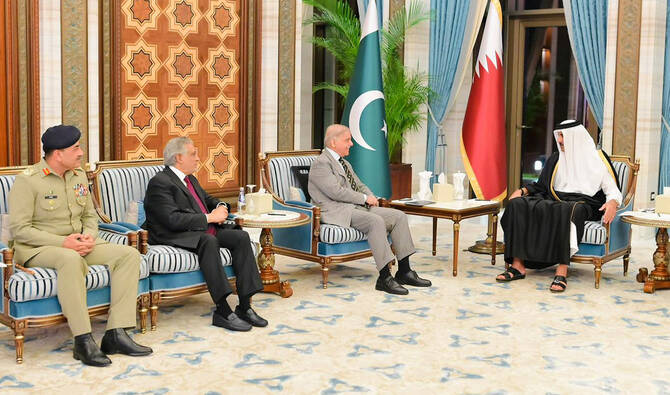
ISLAMABAD: Pakistan and Qatar on Tuesday agreed to deepen their strategic and economic cooperation during high-level talks between Prime Minister Shehbaz Sharif and his Qatari counterpart Sheikh Mohammed bin Abdulrahman bin Jassim Al Thani, Sharif’s office said.
Sharif visited Qatar along with a high-level delegation on the invitation of Qatari emir Sheikh Tamim bin Hamad Al Thani. The Pakistan premier also held meetings with Qatar’s trade and defense minister to discuss cooperation in various domains.
The visit came at a time when Pakistan is seeking closer economic engagement with Gulf partners amid its broader push to stabilize the economy and attract investment, while maintaining security and defense cooperation with key regional states.
During their meeting in Doha, PM Sharif and Qatar’s Sheikh Mohammed discussed bilateral relations and exchanged views on regional and international developments, according to the Pakistan prime minister’s office.
“They reaffirmed the strong brotherly relations between Pakistan and Qatar and expressed satisfaction at the growing momentum in political, economic and institutional ties,” Sharif’s office said.
“Discussions focused on enhancing cooperation in the fields of trade and investment, energy, defense, manpower and labor and culture, with both sides stressing the importance of their task force to accelerate cooperation in all these areas.”
Pakistan and Qatar maintain strong trade and investment ties. In 2022, the office of Qatar’s emir said the Qatar Investment Authority planned to invest $3 billion in Pakistan, targeting sectors including transport, aviation, education, health, media, technology and labor.
Nearly 300,000 Pakistanis live and work in Qatar, according to Pakistan’s foreign office, with many employed in health, education, engineering and public services, as well as construction and transport. The two countries engage through forums such as the Bilateral Political Consultations and the Joint Ministerial Commission.
Sharif said he had productive discussions with Qatar’s emir Sheikh Tamim bin Hamad Al Thani on how the two sides could transform their brotherly ties into mutually beneficial economic relationships.
“We also took stock of the regional situation,” he said. “Pakistan and Qatar will continue to work together for peace and stability in the region and beyond.”
DIALOGUE WITH AFGHANISTAN
Earlier, Sharif and Qatar’s Deputy PM Sheikh Saoud Al-Thani discussed the situation in Afghanistan and called for dialogue to support regional stability.
The meeting took place amid renewed tensions after Islamabad carried out airstrikes last week on what it described as Tehreek-e-Taliban Pakistan (TTP) targets inside Afghanistan. Kabul said the strikes killed civilians and vowed to respond to what it called a violation of its sovereignty.
“Regional developments were also discussed, in particular the situation in Iran and Afghanistan,” Sharif’s office said in a statement. “Both sides emphasized the importance of dialogue, de-escalation and collective efforts to promote peace and stability in the region.”
This was the second time in less than six months that Pakistan conducted airstrikes in Afghanistan. The last strikes triggered heavy, weeklong clashes between the neighbors along their border before Qatar and Turkiye mediated a ceasefire between them in Oct. last year.
Separately, Sharif held meetings with Qatar’s State Minister for Trade Dr. Ahmed bin Mohammed Al-Sayed and a delegation of the Qatar Businessmen Association (QBA), highlighting Pakistan’s investment-friendly reforms.
He invited QBA members to explore opportunities in infrastructure, logistics, energy, agriculture, technology and export-oriented manufacturing, his office said.


