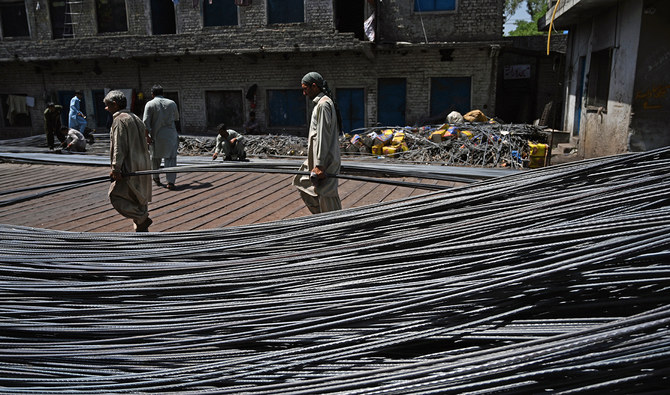
KARACHI: With the formal approval of Saudi investors, Pakistan’s first local iron-ore steel mill project, under the Punjab Mineral Company (PMC), would be set up in Chiniot within a span of two years, Dr. Samar Mubarakmand, Pakistan’s nuclear scientists and chairman of PMC, told Arab News on Monday.
The PMC project topped the list of the four potential projects selected by the federal government for Saudi investment under the recently agreed investment strategy.
Pakistan and Saudi Arabia had signed $21 billion worth of projects including $11 billion oil refinery and petrochemical complex during the visit of Saudi Crown Prince, Muhammad Bin Salman, in February this year.
“When the government informed us that Saudis are interested in investing in mining sector, all the provinces came up with proposals. Punjab government presented the proposal drafted by PMC for steel mill to be set up in Chiniot,” Dr. Mubarakmand added.
The decision to select the projects was held last week in a meeting chaired by Shahzad Syed Qasim, Special Assistant to the Prime Minister on Coordination of Marketing and Development Resources.
Dr. Mubarakmand said, “the next step would be that Saudi investors will take detailed presentation of the project, visit the site, and inspect the existing facilities.”
“The Germans working on the project and our people would give presentation. Upon confirmation of investment, the steel mill would be set up within two years’ time. Mining and setting up of steel mills will continue simultaneously, Dr. Mubarakmand noted.
Top international consulting firms have been engaged through competitive bidding to complete the tasks on global best practices to facilitate the investors, he said.
All the international companies have confirmed the presence of the deposits of iron ore in the area, added the official.
Dr. Mubarakmand informed that the steel mill can have the capacity of 1 million ton. “The existing deposits of iron ore are enough to last for 50-60 years. Besides, the coal that would be used by the steel mill has also been measured by conducting a feasibility study,” he added.
Other projects that were picked for Saudi investment include Barite-Lead-Zinc project, development of metallic mineral resources in Chagai in southern Baluchistan province and coal gasification in Thar area of Sindh.
Dr. Mubarakmand and his team had initiated a pilot project of underground gasification back in 2012 but a change in the political regime led to the abandonment of the project.
“Brand new machinery is still lying there ready for use. If the government decides to restart the project, we will produce gas immediately,” he told Arab News adding that “we can also produce diesel by setting up a diesel plant.”
The gas can be utilized for power generation or domestic supply for cooking purposes, he suggested.
The provincial governments being major stakeholders in Pakistan-Saudi investment strategy, the federal government has asked them to come up with proposals and identify opportunities for potential investment in respective areas.


Pakistan to build first local iron-ore steel mill with Saudi investment
Pakistan to build first local iron-ore steel mill with Saudi investment

- Pakistan, KSA signed MoUs worth $21 bn for cooperation in multiple sectors during the crown prince’s visit this year
- The project is one of the four countrywide ventures picked for Saudi investment

Pakistan defense minister discusses regional, global developments with counterparts in Munich
- The high-powered meeting of government leaders, diplomats comes shortly before Russia’s war on Ukraine enters its fifth gruelling year
- Bruised by President Donald Trump’s comments, European leaders at summit have pledged to shoulder more of the burden of shared defenses
ISLAMABAD: Pakistan’s Defense Minister Khawaja Asif on Friday met his Italian and Albanian counterparts to discuss bilateral cooperation and regional and global developments on the sidelines of the Munich Security Conference, the Pakistani embassy in Germany said.
The high-powered Munich meeting of government leaders, diplomats, defense and intelligence chiefs comes shortly before Russia’s full-scale war on Ukraine is set to enter its fifth gruelling year.
Bruised by President Donald Trump’s designs on Greenland and his often hostile comments about America’s traditional bedrock allies, European leaders at the conference have pledged to shoulder more of the burden of shared defenses.
Asif met his Italian counterpart Guido Crosetto during the conference, running from Feb. 13 till Feb. 15, with both sides agreeing to enhance bilateral ties, according to the Pakistani embassy.
“Asif met the Defense Minister of Republic of Albania, Mr. Pirro Vengu, on the sidelines of the 62nd Munich Security Conference,” the Pakistani embassy said on X.
“Discussed matters related to enhancing bilateral cooperation in the wake of recent regional and international developments.”
The development came as US Secretary of State Marco Rubio was set to address European leaders on Saturday as they try to step up their autonomy in defense while salvaging transatlantic ties badly strained under President Trump.
German Chancellor Friedrich Merz acknowledged a “rift” had opened up between Europe and the United States, fueled by culture wars, but issued an appeal to Washington: “Let’s repair and revive transatlantic trust together.”
“In the era of great power rivalry, even the United States will not be powerful enough to go it alone,” said the conservative leader, who has ramped up defense spending in the top EU economy.
Macron said a new framework was needed to deal with “an aggressive Russia” once the fighting in Ukraine ends.
Ukrainian President Volodymyr Zelensky, who has been in Munich since Friday and meeting multiple allies, was expected to address the meeting on Saturday. No Russian officials have been invited.
Kremlin critic Mikhail Khodorkovsky said he feared “a new cold war” between Europe and Russia in the coming decade, making reopening dialogue with Moscow essential.
“If it makes sense to talk, we are willing to talk,” said Merz, but he also charged that “Russia is not yet willing to talk seriously.”