

Iran’s Zarif says US failed to build coalition in the Gulf

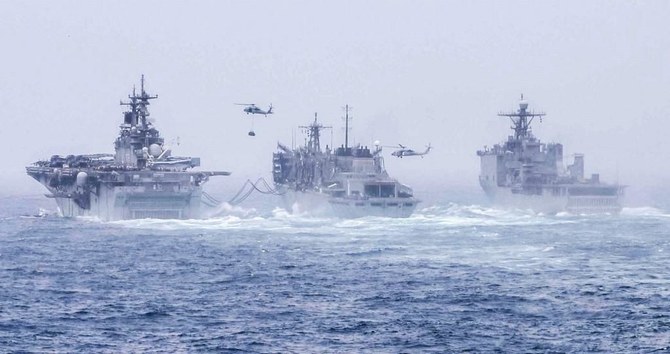
US navy ships conducting a replenishment-at-sea evolution with fast combat support ship in the Arabian Sea. (File/AFP)
Updated 05 August 2019
Follow

Iran’s Zarif says US failed to build coalition in the Gulf

  • Zarif said US allies are too ashamed of it
  • He also refused to meet with Trump

TEHRAN: The United States is unable to build a naval coalition to escort tankers in the Gulf because its allies are too “ashamed” to join it, Iran’s foreign minister said Monday.

“Today the United States in alone in the world and cannot create a coalition. Countries that are its friends are too ashamed of being in a coalition with them,” Mohammad Javad Zarif told a news conference in Tehran.

“They brought this situation upon themselves, with lawbreaking, by creating tensions and crises.”

Iran and the United States have been locked in a battle of nerves since May 2018 when President Donald Trump withdrew the US from a landmark 2015 deal placing limits on Iran’s nuclear program and began reimposing sanctions.

Tensions soared after the Trump administration stepped up a US campaign of “maximum pressure” against Iran, with drones downed and tankers mysteriously attacked in Gulf waters.

In response, the United States has been seeking to form a coalition whose mission — dubbed Operation Sentinel — it says is to guarantee freedom of navigation in the strategic Gulf waters.

However, it has been struggling to build such a coalition, with European countries reticent and believed to be concerned about being dragged into a possible conflict.

Asked on Monday about reports that he had been invited to meet Trump in the White House, Zarif said he had turned it down despite the threat of sanctions against him.

“I was told in New York I would be sanctioned in two weeks unless I accepted that offer, which fortunately I did not,” said the Iranian minister.

The New Yorker magazine reported on Friday that Senator Rand Paul met Zarif in the US on July 15 and had Trump’s blessing when he extended an invitation to the Iranian minister to go to the White House.

The United States imposed sanctions against Zarif on Wednesday, targeting any assets he has in America and squeezing his ability to function as a globe-trotting diplomat.


Elderly Palestinian shot dead in Rafah

Updated 5 sec ago
Follow

Elderly Palestinian shot dead in Rafah

  • Death toll from Israel’s aggression on Gaza rises to 71,795 since start of assault in October 2023

GAZA: An elderly Palestinian man was killed by Israeli fire in Rafah on Sunday afternoon, bringing the number of fatalities since morning to two, according to local and medical sources.

The sources reported that Khaled Hammad Dahleez, 63, was shot dead by an Israeli drone northwest of Rafah.

Earlier in the day, another man was killed and several others injured in a drone strike north of Wadi Gaza, in the central Gaza Strip, the Palestinian News Agency reported.

BACKGROUND

On Saturday, at least 31 Palestinians, including children and women, were slaughtered in a series of Israeli airstrikes on several locations across the enclave — one of the deadliest days since the start of the ceasefire agreement on Oct. 11, 2025.

On Saturday, at least 31 Palestinians, including children and women, were slaughtered in a series of Israeli airstrikes on several locations across the war-ravaged enclave — one of the deadliest days since the start of the ceasefire agreement on Oct. 11, 2025.

Since the ceasefire took effect on Oct. 11, the number of people killed has risen to 523, with 1,433 injuries recorded, while 715 bodies have been recovered during the same period.

Medical sources said on Sunday the death toll from Israel’s aggression on the Gaza Strip had risen to 71,795 Palestinians killed and 171,551 injured since the start of the assault in October 2023.

The sources reported that 26 fatalities and 68 injuries were brought to Gaza hospitals over the past 48 hours, noting that numerous victims were trapped under rubble or in the streets, with ambulance and rescue crews unable to reach them.

The ceasefire’s first phase called for the exchange of all hostages held in Gaza for hundreds of Palestinians held by Israel, a surge in humanitarian aid and a partial pullback of Israeli troops.

The second phase is more complicated. It calls for installing a new Palestinian committee to govern Gaza, deploying an international security force, disarming Hamas, and taking steps to begin rebuilding.

Hamas has so far ‌rejected disarmament and Israel has repeatedly indicated that if the Islamist militant group is not disarmed peacefully, it will use force to make it do so.