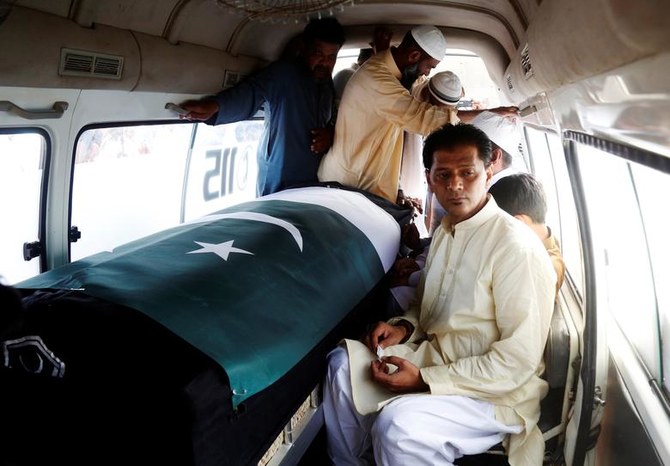

ISLAMABAD: In 2017, when two young women from Pakistan, Shaheera Jalil Albasit, 27, and her seventeen-year-old cousin, Sabika Sheikh, arrived in the US for two entirely different scholarship programs, they were nervous and excited -- and unprepared for the nightmare to come.
Growing up in the same house in Karachi, practically sisters, they could not have imagined how far the bonds of their sisterhood would be tested -- far enough to reach the corridors of the US Congress.
Albasit was a Fulbright scholar headed to Washington DC and Sheikh was on an exchange program at Santa Fe High School in Texas, 35 miles south of Houston where she was staying with a Muslim host family.
On May 18, 2018, a month before Sheikh was scheduled to return home to Pakistan, she was killed in that year’s second-deadliest high school shooting in the US, alongside eight other students and two teachers. The shooter was a seventeen-year-old student at the school.
“When I came across the news of the shooting in Texas, I obviously had no idea that it was her school,” Albasit told Arab News by telephone from Karachi.
“My mother in Pakistan, who I was on the phone with, told me that it was (Sabika’s) school. I immediately looked it up and it was right there: 10 people confirmed dead.”
“We were trying to reach her, but at the same time debating whether or not to call her,” she continued. “It was a very precarious moment, thinking she might be hiding and we did not want to give her away.”
Five minutes later, Albasit said she got a call from her brother who directed her to Sabika’s Facebook. There, a member of her cousin’s host family in Santa Fe had written Sabika did not survive the shooting.
113 people were killed or injured in school shootings in the US in 2018, the deadliest year for school shootings in the country, according to a BBC report.
“It was my worst fears materialising,” Albasit said.
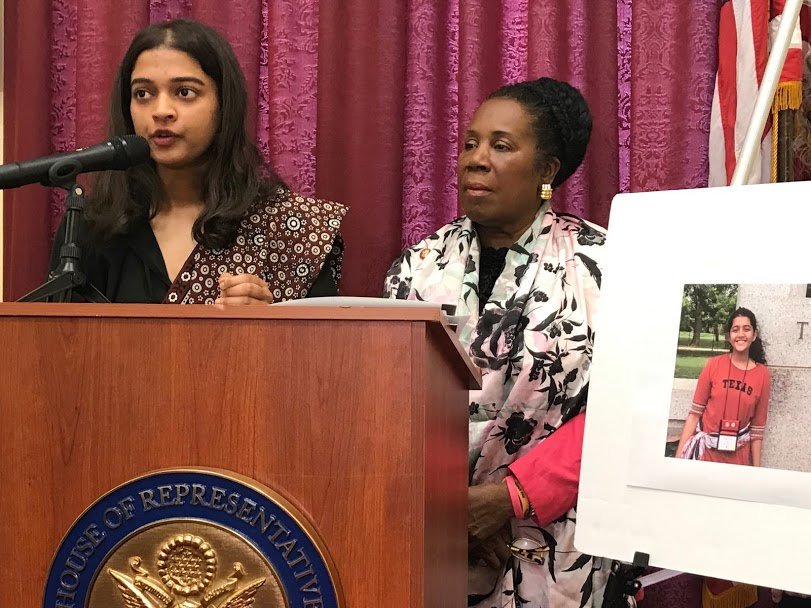
In this July 26, 2019 picture, Shaheera Jalil Albasit introduces the “Sabika Sheikh Firearm Licensing & Registration Act” alongside US Congresswoman Sheila Jackson Lee and a photo depicting her cousin Sabika Sheikh. (Photo Courtesy: Shaheera Jalil Albasit’s Twitter)
“I remember (in) April, I was telling my mother, ‘Thank God she (Sabika) is about to be done.’ This was something in the back of my head... It was surreal.”
Around the world, people mourned for the young teen, and her father told Reuters in an interview that his daughter’s case “should become an example to change gun laws.”
Albasit, who returned to the US after Sabika’s funeral, was heartbroken by her cousin’s senseless murder, and decided she would leave no stone unturned to honor her memory and to fight for gun law reform.
“Sabika’s murder happened on May 18th,” Albasit said. “I traveled with her to be laid to rest in Pakistan on May 23rd and within a week of that, (the family) sat down and we knew we were pursuing a legal battle.”
A stranger to American politics, Albasit spent months scrutinizing gun laws, making phone-calls, attending hearings, and began work on a bill in Sabika’s name.
“We reached out to what we found out to be the largest organization for guns and safety, ‘Every Town For Gun Safety.’”
Albasit, who had limited time remaining in the US under the terms of her Fulbright scholarship, began organizing a team, reaching out to organizations, congress and the senate, to draft an in-depth bill, the first of its kind, that made drastic changes to existing gun law registration in the US. She teamed up with Kristina Woods of Texas who had lost her own sibling to gun violence.
“We were trying to figure out the best way forward,” Albasit said. “We didn’t have a strategy, we would randomly come up with a name of a congressperson working in gun reform, anyone who was in NRA who made sense to reach out to... look up their information online... call their offices up.”
Eventually, Albasit and Woods reached out and secured the support of Congresswoman Sheila Jackson Lee, representing Texas’ 18th Congressional District in the US House of Representatives.
And last week, a day before Albasit was to leave the US, the gun reform bill called ‘The Sabika Sheikh Firearm Licensing & Registration Act’ was finally introduced in the US Congress.
The bill is the largest and most intricately comprehensive of its kind with a number of upgrades to existing laws and bills, and with the aim of creating a process with more checks and balances for people to register, license and buy guns.
If passed into law, the bill will introduce a prescribed process for the licensing and registration of firearms. It will make the legal buying age for guns 21 years (presently it is 18), require thorough psychological screening and create a public database so everyone from employees to local police can know exactly who owns a gun in the vicinity.
In the background of this huge achievement are the bonds of a Karachi sisterhood, with Albasit, who has returned to Pakistan, hopeful that the bill in Sabika’s name will eventually hinder mass gun violence from ever happening in America’s schools again.