

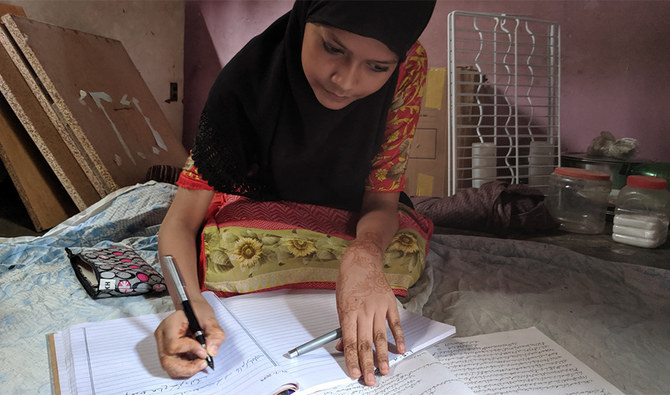


Karachi: Nestled in a tiny street next to the Lyari expressway in Pakistan’s sprawling megacity of Karachi, a tiny apartment with pink walls is home to an aspiring young doctor who won’t be allowed to go to school next year.
Thirteen-year-old Ume Hani, who dreams of a future in medicine, lives in Bengali Para, a poor neighborhood of ethnic Bengalis, where she spends most of her time doing her homework and extra reading on a blanket on the floor.
Next year, Hani who has remained top of her class hopes to graduate to the ninth grade.
But for the last four years, her family have been hiding a terrible secret from the star student: that she will be forced to drop out of school as soon as she’s done with grade eight final exams.
In 2012, the Board of Secondary Education in Karachi (BSEK), which is the authority responsible for the registration of private and government schools in the city, made it mandatory for students in the ninth grade to possess a Child Registration Certificate, commonly referred to as ‘Form-B,’ a National Database and Registration Authority document that registers minors under 18 years of age.
But the BSEK decision for students coincided with the federal government’s tightening rules and conditions for issuing national identity cards to adults. Consequently, hundreds of thousands of ID cards were blocked due to insufficient documentation and other reasons, and as a result, CRC’s could not be issued to the school-going children of these parents.
Some of the people hardest hit by the decision were immigrants, including Karachi’s two million Bengalis and Rohingyas who had come to the city in the 1960’s and 70’s and had even received Pakistani citizenship.
“I passed my eighth-grade examination with good marks in 2015, so I bought course books and started going to my Academy High School,” Hani’s brother, Muhammad Irfan, told Arab News as he fiddled with the ‘Pakistan’ bands on his wrist.
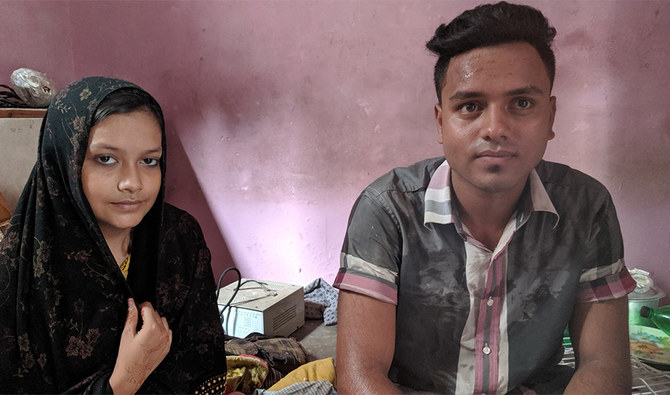
Ume Hani and her brother, Muhammad Irfan, who was forced to leave school in 2015 because he did not possess a Child Registration Certificate (CRC) or mandatory B-Form. July 24, 2019 (AN Photo)
Their father, Muhammad Nizam, had seen his national identity card blocked despite being born in Karachi.
“After ten days, my teacher asked me to bring my Form-B. When I told him I didn’t have one, he said coming to school was useless and eventually I had to quit,” Irfan said.
Nearby, Hani looked up from her homework to listen. It was the first time she had heard the story of why her brother had suddenly dropped out of school.
Irfan shrugged in his sister’s direction. “She was nine years old when this happened to me,” he said. “We didn’t share it with her then.”
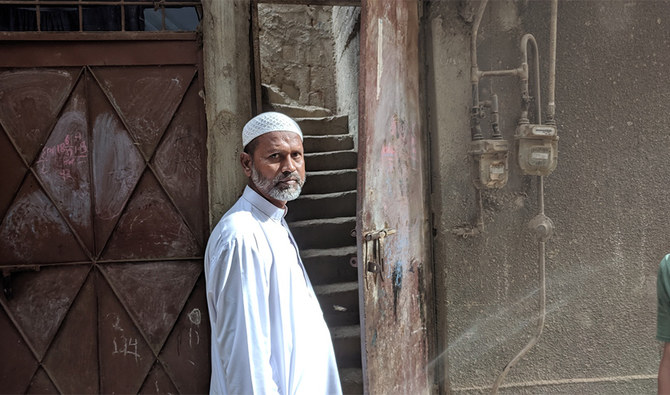
Muhammad Nizam, father of Ume Hani and Muhammad Irfan at the door of his home in Bengali Para, Karachi. Despite being born in Pakistan, Nizam’s national identity card was blocked by the government which has already cost his son his education. July 24, 2019 (AN Photo)
Although there is no official data, researchers estimate that apart from 1.6 million ethnic Bengalis, both Pakistani nationals and undocumented immigrants, there are around 400,000 Rohingyas and over 500,000 Afghan citizens living in Karachi. Rohingya activists say their population is closer to 800,000, though few admit they are actually from Myanmar.
For these three communities, the Bengalis, Rohingyas and Afghans, who have been living and working in Karachi for decades, stern rules for ID cards and mandatory Form-B’s have shattered the promise of a better future for their school-going children.
Shareefa, a migrant and widow from Afghanistan’s Kandahar, said she had sent her son to a good school with high fees despite being a domestic worker in people’s homes.
“But he wasn’t allowed to continue,” she said, despite her repeated visits to the board over several months asking management to review her son’s case and to allow him to keep coming to school.
“Today, he is washing dishes at a restaurant,” Shareefa said with a hint of sadness.
Noor Alam, a Rohingya rickshaw driver who lives in Karachi’s Arakan colony was hit by polio as a child but worked hard to give his children a decent education. Alam was born in Karachi, where his own parents had lived since 1965.
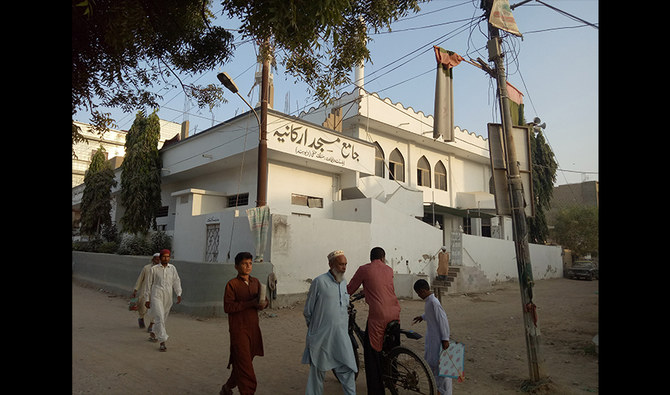
A mosque in Karachi’s Arkania Colony, a neighborhood where the majority are Rohingya immigrants from Myanmar. July 24, 2019. (AN Photo)
But when his ID card was blocked by the government, there was no way to register his son and daughter, and both were made to leave school when they passed the eighth grade.
These are not isolated cases, and according to a Rohingya activist, Syed Muhammad Yousuf, Alam’s story is the story of “every other person” from the hundreds of thousands of Rohingya families living in Pakistan’s coastal metropolis of 20 million people.
M. A. Jafri, the spokesperson of the BSEK, said the board of governors had taken the decision to make Form-B’s compulsory after complaints of frequent, illegal changes to birth certificates had emerged and created administrative issues.
When asked how communities without formal national status but settled in the country were to educate their children, Professor Dr. Saeeduddin, chairman of the BSEK told Arab News that Afghans and other immigrant communities whose members were involved in criminal activities would use their educational certificates for falsely justifying their Pakistani nationality.
Later, he added, “If the higher authorities come up with a way out, the board would be happy to implement it so the children of immigrants may get an education.”
So far, however, not much notice has been taken and the rule is depriving thousands of children of their basic right to education. For helpless parents with their identity cards blocked by the state, the only alternative to school are religious seminaries and madrasas.
Critics of the madrasa education system say, children who attend such schools, where the primary focus is on religious education, are often ill-equipped for the modern world and that some madrasas act as incubators for militant outfits.
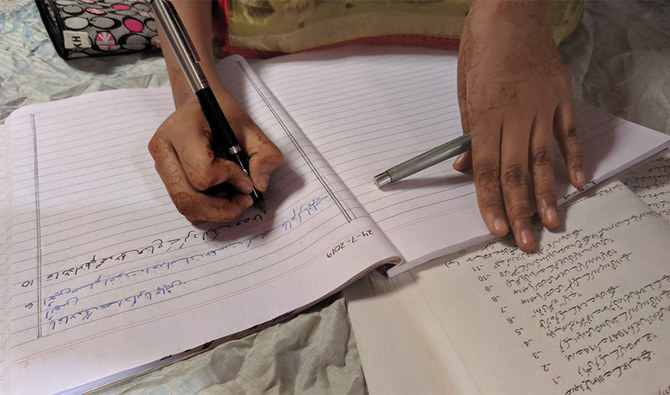
Ume Hani, a thirteen year old girl from Karachi’s Bengali community, is writing a historical essay on Pakistan as part of her eighth grade homework at her home in Bengali Para, Karachi. July 24, 2019 (AN Photo)
“The families of refugees and immigrants are compelled to send their children to seminaries because they have no other choice,” Karachi based researcher and journalist, Zia ur-Rehman told Arab News.
“Every school they try to get their children enrolled in asks for the parents’ computerized national (identity) cards and the child’s Form-B, which they don’t have,” he said.
Still sprawled out before her homework on the floor of her small home, Hani said she wasn’t worried. She knew Prime Minister Imran Khan had “talked for us.”
“So, I request him that I want to serve my country. My education should not be stopped when I pass my eighth-grade exam in February next year, please,” she said simply.
Then she picked up her pen and went back to her notebook, back to writing an essay on the great leaders of Pakistan’s freedom movement.


