ISLAMABAD: Diplomat, artist, and astronaut, Pakistan’s Namira Salim is all set to become the first Pakistani to travel to space.
“I feel honored. Being the ‘First Pakistani Astronaut’ is the most precious title a Pakistani can have,” Salim, 44, told Arab News on Thursday.
In 2005, she was one of the founding members of Sir Richard Branson’s Virgin Galactic commercial space liner and was announced as one of the shortlisted space tourists from over 44,000 candidates. Subsequently, Pakistan’s Ministry of Information and Broadcasting called her the country’s “first astronaut” in 2006.
It is with the Virgin Galactic that Salim is likely to fly to space next year.
Salim launched Space Trust, a non-profit, in 2015 to promote peace through space travel. She believes that “space tourism” can be a game-changer in terms of spreading peace among nations and helping more people achieve their dream of flying among the stars.
“Space Tourism will create an opportunity for the masses to go to space,” she said. “This is quite the opposite of government space programs which, at least at the outset, were known for sending a privileged few, typically military pilots, to space. It was always a male candidate for them!”
Salim started preparing for her upcoming flight in 2007 when she completed training for her suborbital spaceflight at the National Aerospace Training and Research (NASTAR) Center in the United States.
“Suborbital flights are easier on the body because our’s is not going to be a ground-up launch,” she said. “For such flights, even a 90-year-old, who can climb a few flights of stairs comfortably, is considered fit. I trained in the world’s most advanced suborbital spaceflight training center. The training process assessed my ability to tolerate and adapt to increasing gravitational forces and motion sickness. It prepared me for all the profiles I will experience during my potential space flight. The experience was a paradox: At first, it felt like I was being crushed down by a baby elephant; but soon after that, I was floating in the space – as light as a feather!”
Born and raised in Karachi, Salim completed her studies in international business and international affairs from Hofstra University and Columbia University, respectively. She returned to Pakistan to become the founding president of the nation’s first International Association of Students in Economics and Business Management, a cultural exchange program that works with the United Nations.
Salim now splits her time between Dubai and Monaco. She has lived in latter, a tiny city-state along France’s Mediterranean coastline, since 1997 and served Pakistan as an honorary ambassador since 2011 when Prince Albert II, the Sovereign Prince of Monaco, authorized her to practice her function as the first honorary consul of Pakistan to the Principality of Monaco.
Salim has a few other headline-making firsts under her belt, such as being the first Pakistani to visit the North and South poles.
“I wanted to raise the national flag, the flags of my adopted countries, Monaco and the UAE, and my peace flag at all three poles of the world. I wanted to go as far as possible on Earth before breaking orbits,” said Salim.
“Being the first Pakistani at the North and South Poles, as well as the first Asian to skydive [tandem] over Mount Everest in 2008, appears quite mind-blowing to most people, especially in the West where people have an image of Pakistani women as a somewhat timid individual. I never knew that I would one day touch the same pole star which my beloved father first sparked my imagination with.”
Salim had known from a young age that space was the frontier she wanted to cross.
“I was born with the inner knowing that I was going to space one day, as if someone was calling out to me. I’ve always said that space makes my DNA. So it was a childhood dream and it was my beloved father who first introduced me to stars,” said Salim. “One evening, he pointed toward the pole star and navigated me through the northern sky. I instantly took to stars and it is the stars that I made best friends with. Since then, there’s been no looking back.”


![]()

Pakistan's Namira Salim hopes to fly to space next year
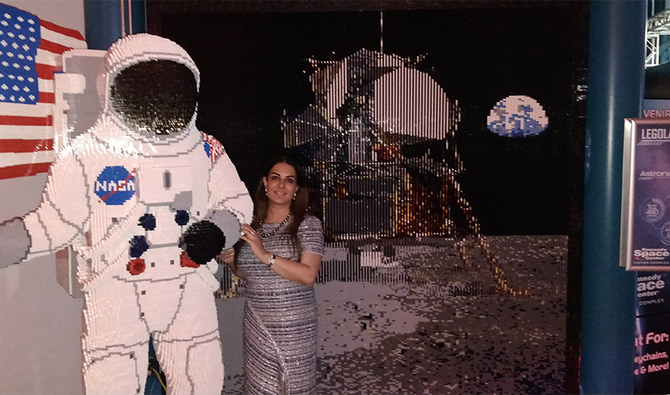
Pakistan's Namira Salim hopes to fly to space next year
- Arab News talks to “Pakistan’s first astronaut” about her lifelong love of space
- Salim is among a handful of astronauts selected for billionaire Sir Richard Branson’s Virgin Galactic flight to space
Latest updates


© 2026 SAUDI RESEARCH & PUBLISHING COMPANY, All Rights Reserved And subject to Terms of Use Agreement.