



DHAKA: Buddhist monk Ashin Wirathu, who was born on July 10, 1968, in Mandalay, Myanmar, has been labeled an extremist and ultranationalist by international media.
The outspoken preacher is known as the “Buddhist bin Laden,” in reference to the late Al-Qaeda leader Osama bin Laden.
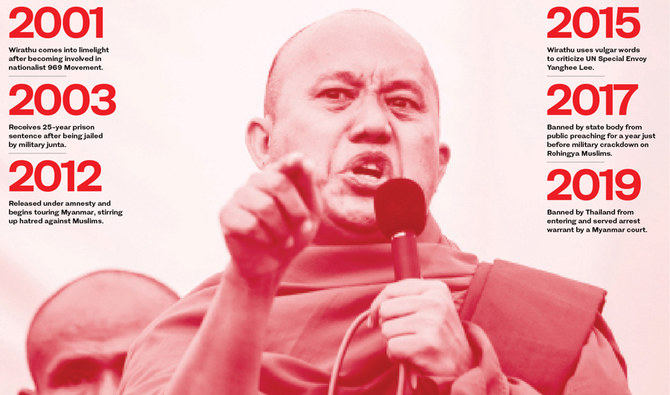
Wirathu stepped into the limelight in 2001 when he became involved with the nationalist 969 Movement, which is described by the international media as Islamophobic.
That is when he started spreading hatred in Myanmar against the Muslim minority of the predominantly Buddhist country, urging Buddhists to boycott all Muslim shops.
Wirathu was jailed in 2003 by the military junta for 25 years for distributing anti-Muslim leaflets and preaching about evicting Muslims from Myanmar’s Rakhine state.
But he was released in 2012 under an amnesty and began touring Myanmar, spreading hatred against Muslims through his sermons.
In September that year, Wirathu led a rally of monks in Mandalay to promote then-President Thein Sein’s controversial plan to send Rohingya Muslims to another country.
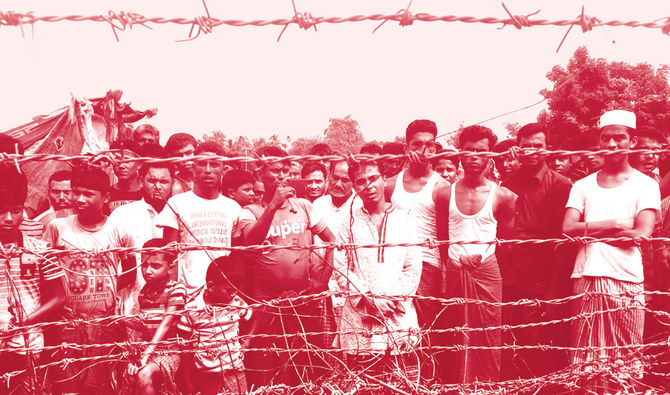
A month after the rally, brutal violence escalated in Rakhine, driving thousands of Rohingyas from their homes. In July 2013, Time magazine described Wirathu in its cover story as “the face of Buddhist terror.”
In 2017, he supported the persecution of Rohingyas in Rakhine, which was orchestrated by the country’s military.
BIO
Nationality Burmese
Place of residence Masoyein Monastery, Mandalay
Occupation Buddhist monk
Legal status Wanted for speeches against Myanmar’s government and its leader Aung San Suu Kyi
Media Facebook and YouTube
In May 2019, Myanmar authorities issued an arrest warrant against Wirathu for speeches against the government and its leader Aung San Suu Kyi, accusing her of hampering the ethnic cleansing of Rohingyas. He is on the run, and authorities are preparing to put him on trial in absentia.
Munshi Faiz Ahmed, chairman of the Bangladesh Institute of International and Strategic Studies, told Arab News: “Myanmar’s military was in need of a mass medium to reach the country’s Buddhists. Monks have more influence on Buddhists in Myanmar than politicians, so the powerful military recruited Wirathu to serve its purpose as the extremist monk has some fanatic followers.”
Ahmed, who was Bangladesh’s ambassador to China, described it as a “nexus of two evil forces.”
He said: “On one side, the ambitious Wirathu wanted to increase the number of his followers, and on the other side the military wanted to consolidate its power. So the army generals started backing the extremist monk in his spreading of hate against the Rohingya Muslims.”
Ahmed added: “Extremists such as Wirathu always use religion to create unrest in society. He became more powerful as democratic practices are almost absent in the governance of Myanmar.”
Prof. Delwar Hossain, an expert in South Asian politics and a teacher of international relations at Dhaka University, sees Wirathu’s rise as a “historic problem.”
Hossain said Myanmar’s first constitution, which was formed in 1948, was mostly democratic and liberal, and recognized the rights of 135 ethnic groups, including the Rohingyas.
“The problem started when the military junta took power in 1961 and discarded the constitution,” he added.
“Myanmar has been ruled by the army since 1961, and the spirit of Buddhist nationalism has been patronized in the country for many decades. Wirathu is the latest outcome of this Buddhist nationalism.”
Hossain said the spread of hate crimes against Muslims in Myanmar represents a “mutual understanding” between the government and extremist groups.
Myanmar is transitioning from military to political government. It had general elections in 2012 and 2016, and the next one is scheduled to take place in 2020.
“In this transition, the country’s influential monks want to establish more influence in the political arena,” Hossain said.
He identified “the absence of civil society” in Myanmar as one of the main reasons for the rise of extremist monks such as Wirathu.
“For many years, the country has been mostly run by an autocratic system that has created an acceptance of ultranationalist beliefs among the people,” said Hossain.
Prof. Amanullah Ferdous, an leading social scientist and political observer, said Wirathu is “nothing but a puppet” of Myanmar’s authorities.
“He is instructed, managed and guided by the influential forces of the country,” Ferdous said.
“Wirathu is blessed by the Myanmar Army and Aung San Suu Kyi’s ruling party, the National League for Democracy. He has connections with China also.”
Ferdous said Wirathu has gained significant influence in Mandalay, Rakhine and adjacent areas through his sectarian comments.
Myanmar’s authorities have used Wirathu’s ultranationalist hate crimes to “orchestrate the ethnic cleansing against Rohingyas,” Ferdous said.


