

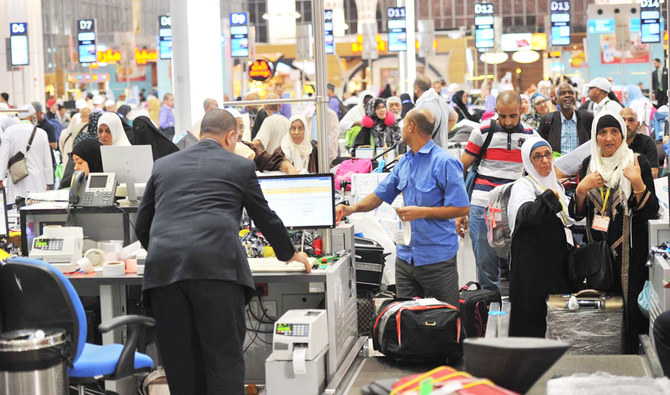
Modern airport technology reducing pilgrim congestion at Saudi airports

PMIA also benefited from the series of modern technology development projects. (SPA)
Updated 30 July 2019
Follow

Modern airport technology reducing pilgrim congestion at Saudi airports

  • Those services will include revolutionary “self-service airports” where passengers will be able to finalize their procedures, issue their boarding passes and weigh and register luggage themselves

JEDDAH: The Saudi General Authority of Civil Aviation (GACA) has started implementing technical solutions at Jeddah’s King Abdul Aziz International Airport (KAIA) and Madinah’s Prince Mohammed bin Abdul Aziz International Airport (PMIA) to reduce pilgrim congestion during this year’s Hajj.
The GACA has merged terminal hall paths into single directions to ensure the smooth flow of pilgrims, allowing both airports to welcome up 48,000 passengers during a single phase.
Operational systems, particularly the scheduling of flights dedicated to pilgrims, have also been coordinated with the Ministry of Hajj and Umrah and KAIA, to avoid overcrowding.
Passport controls have also been streamlined, as have baggage reclaim halls, whilst public transport and parking capacities have also been increased.
PMIA also benefited from the series of modern technology development projects.
The airport saw the addition of 24 self-service check-in platforms, six travel verification platforms, 10 self-boarding gates, an area dedicated for people with special needs, a new car park, a loading and unloading bay in front of the main hall, and a waiting area next to the departure hall.

HIGHLIGHTS

• Operational systems, particularly the scheduling of flights dedicated to pilgrims, have been coordinated with the Ministry of Hajj and Umrah and KAIA, to avoid overcrowding.

• Passport controls have also been streamlined, as have baggage reclaim halls, whilst public transport and parking capacities have also been increased.

• PMIA also benefited from the series of modern technology development projects.

The GACA will adopt additional electronic services in future development projects to facilitate pilgrim’s safe and efficient travels in the Kingdom during Hajj seasons to come.
Those services will include revolutionary “self-service airports” where passengers will be able to finalize their procedures, issue their boarding passes and weigh and register luggage themselves.
The GACA had adopted plans to develop the Kingdom’s airport network to cope with the steady increase in air traffic, improve the quality of services, achieve the greatest geographical coverage possible and promote the airports’ contribution to the Kingdom’s economic growth.


Makkah’s urban shift enhances the city’s quality of life

Updated 08 February 2026
Follow

Makkah’s urban shift enhances the city’s quality of life

  • By harmonizing its religious heritage with modern urban development, Makkah is proving that a city can honor its past while vigorously embracing the future

MAKKAH: Islam’s holiest city is currently witnessing a qualitative urban shift, one that seamlessly blends its profound spiritual sanctity with a modern, vibrant lifestyle. By integrating cultural, educational, and entertainment initiatives, Makkah is redefining the visitor experience and significantly enhancing the quality of life for its residents, directly supporting the goals of Saudi Vision 2030.

The city’s transformation was recently highlighted by the success of the Makkah winter season. The event attracted approximately 400,000 visitors — over 60% of whom were locals — demonstrating a strong domestic demand for high-quality public spaces.

The season revitalized community interaction, driving a 35% increase in visits to recreational sites and creating more than 1,200 temporary jobs for the local workforce.

Central to this urban renaissance is the Hira Cultural District. Since opening its doors in January 2023 near the historic Mount Hira, the district has become a definitive landmark that bridges Islamic history with contemporary identity.

Makkah’s Hira Cultural District has become a definitive landmark that bridges Islamic history with contemporary identity. (SPA photo)

Far from being a static monument, the district has cultivated a thriving creative economy. Its craftsmanship program, which features over 100 artisans, has generated up to SAR 3 million in sales and attracted 130,000 visitors to live workshops. These interactive spaces allow visitors to engage directly with the region’s heritage, moving beyond passive observation to active participation.

A living legacy 

The shift extends to Makkah’s broader ecosystem of museums and cultural sites, which are now positioned as key pillars of cultural tourism. Facilities like the Revelation Exhibition use cutting-edge technology and multilingual content to narrate the story of the Holy Quran’s revelation, offering an immersive experience that complements the spiritual journey of pilgrims.

These efforts align with the “Makkah: A Living Legacy” campaign, which seeks to document the city’s historical narrative and preserve its collective memory. Recent months have seen a surge in educational workshops for university students and tour guides, ensuring that the human element of Makkah’s history is conveyed with accuracy and depth.

City’s transformation recently highlighted by the success of the Makkah winter season. (SPA photo)
 

Economic and social impact 

The results of this integrated approach are tangible. Specialized museums and restored historic sites now attract up to 1.6 million annual visitors. Crucially, this cultural enrichment is encouraging pilgrims to linger longer, increasing the average duration of stay by 18%.

By harmonizing its religious heritage with modern urban development, Makkah is proving that a city can honor its past while vigorously embracing the future, offering a holistic experience that nourishes both the soul and the community.