ISLAMABAD: Pakistani filmmaker Saim Sadiq’s said on Saturday it was by “luck or something” that his film ‘Darling’ has landed a world premiere at the 86th Venice Film Festival this year, making it the first Pakistani film in history to get a “big three” screening.
The big three refers to the largest and most prestigious film festivals in the world in Berlin, Cannes and Venice, which is the oldest of the three.
But Sadiq, 28, whose masterpiece addresses taboo questions of gender in the Muslim majority country of 208 million people, said he had no idea his film would be accepted.
“I sent it in during the open submission call with zero expectations that it would be chosen,” Sadiq told Arab News on Saturday by telephone. “Through luck or something, we got in.”
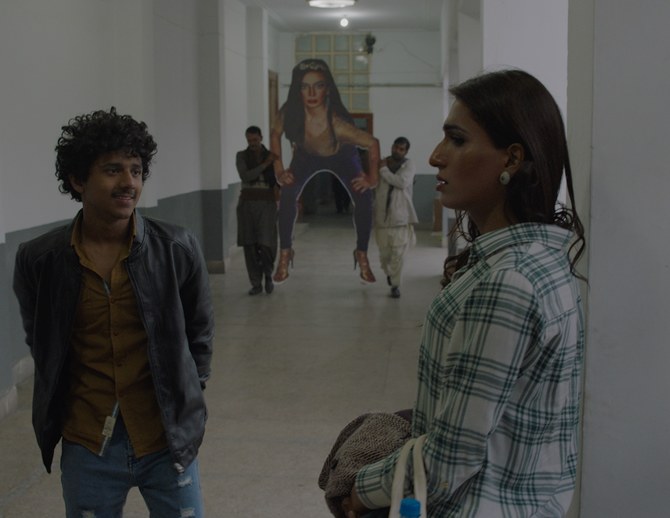
Darling, set in a dance theater in Pakistan’s romantic, eastern city of Lahore, follows the story of a young boy named Shani, played by Abdullah Malik, and a transgender girl named Alina, played by Alina Khan, a trans female actor. This is Khan’s first ever on-screen role.
“The film follows the journey of these two people, exploring their relationship, questions of identity, and dance,” Sadiq said.
With a total run time of 16 minutes, Darling will show in the film festival’s new Orizzonti section, a competition of short films submitted from around the world. It is the micro version of Sadiq’s upcoming feature-length film “Gulabi,” which is currently in the funding stages of production.
After studying anthropology at the Lahore University of Management Sciences in Lahore, Sadiq said he decided to follow his passion for film, and went on to graduate in film studies from New York’s prestigious Columbia University.
His decision to pursue film-making came as a shock for his “very normal, very conservative” Pakistani family, he said, which follows a long line of traditional army careers.
“I remember when I told my parents about wanting to be a filmmaker, it was shocking for them,” Sadiq said. “Nobody does film especially from the family background I come from... so there was a big departure, a big leap of faith.”
“Nice Talking to You,” a 2018 short film by Sadiq, was an official selection at South by Southwest this year and Palm Springs International Shortfest 2019. Last year, he won Vimeo’s Best Director award at the Columbia University Film Festival.
“I was born and brought up (in Pakistan), and I am completely infatuated with our country,” Sadiq said. “I don’t want to portray Pakistan in a bad way or a good way... just trying to show a true image of Pakistan which is a mix of everything.”
In the future, Sadiq said he hopes to tell more Pakistani stories in a still fledgling industry.
“I think the industry is so new it can be an almost childlike space where we are deciding what to make of it,” he said. “Films do not have to be particularly mainstream or very commercial. Small indie or art-house films have a market and an audience.”
“The premiere and the honor of showing our film at the Venice Film Festival gives me hope that people who are trying to do something different can see it pay off,” he said.
This year’s Venice Film Festival will run from August 28 to September 7.


![]()
![]()

‘Through luck or something,’ Pakistani film lands Venice Film Festival premiere

‘Through luck or something,’ Pakistani film lands Venice Film Festival premiere
- Darling is the first Pakistani film ever to get a screening at one of the world’s ‘big three’ film festivals
- This year’s Venice Film Festival will run from August 28 to September 7
Latest updates


Recommended


© 2026 SAUDI RESEARCH & PUBLISHING COMPANY, All Rights Reserved And subject to Terms of Use Agreement.